
Introduction
In a healthcare facility, a failed caster on a hospital bed, medication cart, or stretcher isn't a minor inconvenience—it's a safety risk. For procurement buyers managing dozens of equipment categories across facilities with hundreds of beds and thousands of wheeled assets, caster selection directly impacts patient safety, staff wellbeing, and operational budgets.
Wrong procurement decisions create cascading costs:
- Floor damage: Incompatible wheel materials prematurely destroy expensive LVT flooring
- Equipment failure: Under-spec'd load ratings cause caster breakdown, triggering downtime and patient safety incidents
- Infection risk: Exposed bearing designs create control gaps that conflict with CDC environmental guidelines
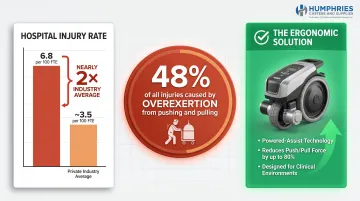
- Staff injury: U.S. hospitals face roughly $2 billion annually in workers' compensation costs, with 48% tied to overexertion from pushing and pulling equipment — a problem ergonomic caster design directly addresses
This guide covers the top caster brands proven in healthcare settings, what separates medical-grade from standard industrial casters, and a practical criteria framework for procurement decisions — one that balances safety, performance, and total cost of ownership.
Key Takeaways
- Medical-grade casters need sealed bearings, non-marking TPR or polyurethane wheels, reliable brakes, and chemical-resistant construction for repeated disinfection
- Top brands include Medcaster (Colson Group), TENTE, Hamilton Caster, Blickle, and Humphries Casters—each serving distinct procurement needs
- Evaluate casters by load capacity (with safety factor), floor compatibility, brake type, and cleanability—not price alone
- Price-only purchasing leads to premature failure in high-traffic settings, driving up replacement costs and operational downtime
- Humphries Casters provides product trials, warranties beyond manufacturer coverage, and nationwide sourcing—serving top-ranked hospitals and long-term care organizations since 1988
Overview of Medical Casters in Healthcare Facilities
What Makes a Caster "Medical-Grade"
Medical-grade casters differ from standard industrial models in ways that directly affect patient safety, infection control, and equipment longevity. Several standards and manufacturer specifications define the criteria:
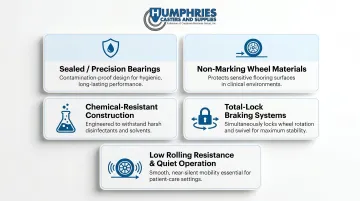
Core distinguishing features:
- Sealed or precision bearings to prevent contamination from fluids, dust, and debris
- Non-marking wheel materials (thermoplastic rubber or polyurethane) that protect expensive flooring
- Chemical-resistant construction to withstand hospital-grade disinfectants and repeated cleaning cycles
- Total-lock or central-locking braking systems for patient safety during procedures and transport
- Low rolling resistance and quiet operation for clinical environments where noise impacts patient recovery
These requirements are codified across ISO 22882:2004 for hospital and institutional casters, ANSI ICWM-2018/2026 for U.S. institutional and medical equipment casters, and EN 12531 for European medical equipment standards.
The CDC Guidelines for Environmental Infection Control in Health-Care Facilities explicitly identify wheels and casters as potential transporters of dust, debris, and fungal spores such as Aspergillus. That makes sealed bearings and cleanable surfaces infection-control design requirements — not optional features.
The Healthcare Procurement Challenge
Healthcare facilities manage casters across an extensive infrastructure. The U.S. operates 6,100 hospitals with 907,216 staffed beds and over 15,000 Medicare/Medicaid-certified nursing homes with 1,618,348 certified beds. Each of those beds implies multiple wheeled assets in active daily use:
- Hospital beds with central locking systems
- IV poles and infusion pumps
- Medication and crash carts
- Surgical instrument trays and case carts
- Stretchers and patient transport equipment
- Mobile workstations and computer carts
- Dietary, linen, and housekeeping carts
This adds up to millions of caster units requiring periodic replacement — each with different load, mobility, and hygiene requirements. A medication cart in a sterile compounding pharmacy demands different specifications than a bariatric bed supporting 600+ lbs or a mobile C-arm imaging unit.
Procurement complexity compounds across departments. Biomedical engineering, facilities maintenance, central supply, dietary services, and housekeeping each specify casters for different equipment categories — often with no shared standard or purchasing process.
Top Caster Brands for Healthcare Facilities
These brands were selected based on healthcare market presence, product depth for clinical applications, documented use in U.S. hospitals and long-term care facilities, and procurement flexibility for institutional buyers.
Medcaster — A Colson Group Brand
Medcaster is a dedicated medical caster brand under Colson Group USA—the world's largest caster manufacturer—purpose-built for hospital beds, IV stands, case carts, and medication carts. The brand's tagline, "If it moves in a hospital, we move it," reflects its healthcare-exclusive focus.
Medcaster holds the widest specification footprint in U.S. healthcare through application-matched product lines for each equipment category, broad distributor availability, and manufacturing scale that supports consistent spec compliance across large health systems.
Products are manufactured in Saint Joseph, Michigan and tested to meet or exceed ICWM standards using FEA (Finite Element Analysis) and rapid prototyping.
| Attribute | Details |
|---|---|
| Medical Focus | Hospital beds, IV stands, case carts, and medication carts; dedicated healthcare product lines for each application |
| Key Features | Total-lock and central-locking brake systems; non-marking TPR and polyurethane wheel options; sealed bearings for hygiene; ISO 22882:2004 compliant Primacy Twin series |
| Procurement Advantage | Widest distribution network in U.S. healthcare; consistent availability for high-volume institutional orders; USA-made products with rapid prototyping capability |
TENTE Casters
TENTE is a globally recognized caster manufacturer known for precision-engineered, ergonomic medical casters—with product lines specifically designed to reduce push/pull force on clinical staff and meet strict European and U.S. healthcare standards.
For healthcare procurement, TENTE stands out for ergonomic swivel geometry that reduces staff musculoskeletal strain, high-performance braking systems including central locking and directional locks, and cleanroom-compatible configurations for sterile environments.
That ergonomic focus matters. U.S. hospitals recorded 6.8 work-related injuries per 100 FTE—nearly twice the private-industry average—with 48% caused by overexertion from pushing and pulling. TENTE's E-Drive powered-assist series and optimized steering mechanisms directly address that injury category.
| Attribute | Details |
|---|---|
| Medical Focus | Surgical suites, sterile instrument carts, patient transport equipment, and mobile workstations requiring ergonomic mobility |
| Key Features | Ergonomic swivel design for reduced push force; central locking and direction-lock options; chemical-resistant materials for repeated disinfection; E-Drive powered-assist for heavy equipment |
| Procurement Advantage | Strong compliance documentation for ISO and healthcare standards; ISO 9001 certified; suitable for OEM medical device manufacturers |
Hamilton Caster
Hamilton Caster is a U.S. manufacturer with deep expertise in heavy-duty, custom caster solutions—well-suited for diagnostic imaging equipment, bariatric beds, and other high-load clinical applications where standard catalog options fall short.
Where Hamilton earns its place in specialized healthcare procurement: custom engineering for non-standard equipment, load ratings up to 40,000 lbs per caster, and a track record spanning industrial and clinical environments. Bariatric hospital beds supporting patient weights up to 600 lbs and CT scanner tables handling 440–661 lbs depending on model often exceed the 220–260 lb per-caster ratings of standard medical casters.
| Attribute | Details |
|---|---|
| Medical Focus | Heavy diagnostic equipment, bariatric patient-handling devices, and custom OEM applications requiring high load capacity |
| Key Features | Load ratings up to 40,000 lbs per caster; custom engineering for non-standard equipment dimensions; proven performance in both industrial and clinical settings |
| Procurement Advantage | Custom fabrication capability for specialized or oversized clinical equipment; suitable for facilities that have exhausted standard catalog options |