Introduction
Rubber casters keep industrial and medical environments moving—from warehouse carts and factory floor equipment to hospital beds and medication trolleys. Choose the wrong caster and you're looking at floor damage, premature equipment failure, or compliance violations that cost far more than the wheels themselves. Dozens of manufacturers claim "industrial-grade" or "medical-grade" quality, but certifications, rubber compounds, and load ratings vary widely between them.
Industrial buyers sourcing casters for heavy material handling carts have fundamentally different requirements than hospital supply managers specifying medication cart wheels. Load capacity, rubber compound composition, floor compatibility, and industry certifications all determine whether a caster holds up under your specific conditions.
This guide covers 10 leading US rubber caster manufacturers evaluated for industrial and medical applications, along with a practical framework to match your requirements to the right supplier.
Key Takeaways
- Rubber casters excel at floor protection, vibration dampening, noise reduction, and grip
- Top US manufacturers serve distinct niches: heavy industrial loads beyond 3,500 lbs, medical-grade compliance, or specialty applications
- Evaluate based on load capacity, rubber compound type, floor compatibility, and certifications
- Many manufacturers don't sell direct; distributors offer product trials, blanket orders, and warranty support beyond the manufacturer's
- Request samples before bulk orders to validate performance in your specific application
Why Rubber Casters? Key Properties That Matter for Industrial and Medical Buyers
Rubber casters deliver four core material advantages that make them the preferred wheel choice in hospitals, food processing facilities, electronics manufacturing, and warehousing:
- Floor protection through non-marking compounds that prevent scuffs on tile, hardwood, and linoleum
- Vibration and shock absorption that protects sensitive equipment during transport
- Noise dampening for quieter operation in noise-sensitive environments
- Superior grip on wet or smooth surfaces where harder wheels slip
These properties explain why medical facilities choose rubber for hospital beds and IV poles, while food processors specify rubber wheels for NSF-certified environments.
Rubber Caster Subtypes and Load Capabilities
Buyers encounter three primary rubber variants, each suited to different applications:
| Rubber Type | Durometer Range | Typical Load Capacity | Best Applications |
|---|---|---|---|
| Soft Rubber | 70-80 Shore A | 175-250 lbs per caster | Floor protection, quiet operation, furniture |
| Hard Rubber | 75-85 Shore D | 275-325 lbs per caster | Higher capacity, industrial carts |
| Specialty Compounds | Varies | Up to 6,000 lbs (press-on) | Chemical-resistant, high-temp, anti-static, heavy industrial |
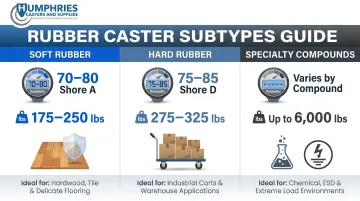
The right subtype depends on your load requirements and operating environment. Specialty compounds like neoprene and conductive rubber exist precisely because standard formulations can't handle every facility condition — which is also where material comparisons become critical.
Rubber vs. Thermoplastic Rubber and Polyurethane
Buyers often confuse true rubber with thermoplastic rubber (TPR) or polyurethane (PU). Genuine rubber — natural or synthetic vulcanized material — delivers superior elasticity, shock absorption, and traction that neither TPR nor PU can fully match. TPR holds an edge in non-marking performance and recyclability, but gives up grip in the trade. Polyurethane handles heavier loads and resists cuts and chemicals well, though it won't dampen vibration the way rubber does.
Choose rubber when shock absorption, quiet operation, and grip are non-negotiable. Consider alternatives when chemical resistance or load capacity exceeds rubber's practical limits.
Top 10 Rubber Caster Manufacturers in the US
Selection criteria include US market presence, rubber-specific product depth, industry certifications, manufacturing track record, and reputation among industrial and medical procurement professionals. These manufacturers vary widely by load range, market specialization, and supply model — matching the right one to your application matters as much as the product spec itself.
Hamilton Caster & Manufacturing Co.
With over 115 years of engineering history behind it, Hamilton Caster (Hamilton, Ohio) is one of America's oldest heavy-duty caster manufacturers. The company serves aerospace, automotive, and heavy manufacturing with custom-engineered solutions for extreme-load applications.
Hamilton's Press-On Rubber (POR) wheel series delivers the highest rubber wheel capacities in the industry: 3,500 to 6,000 lbs per caster, achieved through specialized press-on construction. Buyers with multi-ton material handling requirements or unique floor conditions can request application-specific rubber wheel configurations through Hamilton's engineering consultation service.
| Attribute | Details |
|---|---|
| Industry Focus | Heavy industrial, manufacturing, aerospace, automotive |
| Key Rubber Caster Types | Press-On Rubber (POR) wheels, solid pneumatic, custom rubber compounds for high-load carts |
| Standout Feature | Highest-capacity rubber wheels in the industry (3,500–6,000 lbs); engineering consultation available |
Colson Group USA (Colson Casters)
Colson Group (Oakbrook Terrace, Illinois) is the world's largest caster manufacturer by portfolio breadth, established in 1885. The company manages eight US sub-brands (including Colson, Albion, Shepherd, Faultless, and Pemco), offering over 200,000 standard caster models.
Colson's Performa wheel technology combines hard tread durability with soft tread floor protection, rated up to 1,700 lbs capacity. Performa wheels deliver cushioned rides and impact resistance while staying easy to roll. The company's distribution network across the US keeps lead times short for industrial buyers.
| Attribute | Details |
|---|---|
| Industry Focus | Industrial, institutional, foodservice, medical (via sub-brands) |
| Key Rubber Caster Types | Gray and black rubber wheels, Performa rubber, light-duty rubber stem casters, institutional rubber |
| Standout Feature | Largest standard catalog in the industry (200,000+ models); multiple specialized sub-brands |
RWM Casters
RWM Casters (Gastonia, North Carolina) invented the kingpinless swivel caster design and has manufactured heavy-duty industrial casters since 1935. Their products serve automotive plants, aerospace facilities, and defense contractors where precision and durability are non-negotiable.
RWM's patented kingpinless design achieves swivel tolerances of .017 inch versus the industry standard .030 inch, cutting swivel failure in demanding applications. Load capacities run from 350 to 40,000 lbs across their product lines. Their VersaTrac 27 series carries NSF approval for food service environments, covering capacities from 150 to 300 lbs.
| Attribute | Details |
|---|---|
| Industry Focus | Heavy industrial, automotive, aerospace, defense |
| Key Rubber Caster Types | Rubber-on-steel wheels, kingpinless rubber swivel casters, high-capacity rubber tread |
| Standout Feature | Original kingpinless design (patented); tighter swivel tolerances than industry standard |
Caster Concepts
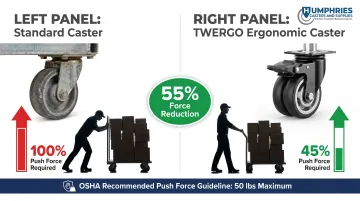
Caster Concepts (Albion, Michigan) has built its reputation since 1987 on ergonomic industrial caster solutions that reduce workplace injuries. Their rubber casters address both load capacity and push/pull force reduction, which matters most for facilities managing OSHA ergonomic compliance.
The TWERGO caster line delivers a documented 55% reduction in push force compared to traditional casters, protecting workers from repetitive strain injuries. Caster Concepts handles loads up to 100,000+ lbs and maintains domestic content exceeding 98%.
| Attribute | Details |
|---|---|
| Industry Focus | Industrial manufacturing, automotive assembly, ergonomic/OSHA-compliant facilities |
| Key Rubber Caster Types | Ergonomic rubber casters, drive casters with rubber tread, custom rubber compounds |
| Standout Feature | Published 55% push-force reduction data; strong OSHA compliance focus |
Shepherd Caster Corporation
Shepherd Casters (St. Joseph, Michigan) leads the institutional and healthcare caster market as part of the Colson Group family. Their rubber wheels are found on hospital beds, IV poles, medication carts, and institutional furniture across the country.
Shepherd's Optimus and Avant medical caster series use Performa Rubber and QuikStart wheels (the same non-marking compounds across Colson Group lines), adapted here for quiet operation and floor protection in clinical settings. Both series add integrated thread guards and labyrinth seals to support infection-control requirements. Capacities range from 75 to 1,000 lbs across medical-grade lines.
| Attribute | Details |
|---|---|
| Industry Focus | Medical, institutional, commercial furniture, educational |
| Key Rubber Caster Types | Soft rubber stem casters, non-marking rubber wheels, twin-wheel rubber for medical carts |
| Standout Feature | Decades of institutional expertise; thread guards and labyrinth seals for infection-control environments |
Faultless Casters
Faultless Casters (Evansville, Indiana) has been making casters since 1889, now operating within the Colson Group. The company produces rubber-wheeled casters for furniture, medical equipment, greenhouse applications, and light industrial uses.
Faultless serves diverse application weight classes from 80 to 1,250 lbs per caster. Their product range spans light-duty furniture casters to mid-range industrial applications, backed by an industry-leading 3-year warranty. The company's 135+ year design history delivers cost-efficient performance across commercial environments.
| Attribute | Details |
|---|---|
| Industry Focus | Light industrial, commercial, medical equipment, furniture, foodservice |
| Key Rubber Caster Types | Light-duty rubber casters, medical equipment rubber wheels, janitorial rubber casters |
| Standout Feature | 135+ years of design history; 3-year warranty across a wide application range |
Durable Superior Casters
Founded in 1991 by Mark and Lily Chang in Arlington, Texas, Durable Superior Casters operates regional assembly plants in Tacoma WA, Los Angeles CA, Cincinnati OH, and Arlington, totaling approximately 1 million square feet of warehouse space.
Durable Superior offers 5 million product combinations with 4+ million CAD drawings available. Their Ergo Blue Rubber Wheel, a copolymer rubber with strong elastic properties, delivers non-marking performance. Regional assembly plants support rapid order fulfillment, and stainless steel frame options with rubber wheels serve food processing and wet environments.
| Attribute | Details |
|---|---|
| Industry Focus | Industrial, commercial, food processing, maintenance and repair (MRO) |
| Key Rubber Caster Types | Cushion rubber casters, rubber tread on steel wheel, maintenance-free rubber, stainless with rubber |
| Standout Feature | Regional assembly plants for rapid fulfillment; one of North America's largest model catalogs |
Pemco Caster
Pemco Caster (Sheboygan, Wisconsin) has specialized in shopping cart wheels and institutional casters since 1952, serving retail, grocery, and light commercial applications as part of the Colson Group family.
Pemco's QuietKat shopping cart caster line features durable rubber wheels designed for quiet, cushioned rides on smooth retail floors. Their A-Line series offers 1-1/4" wide casters in Thermo-Rubber compounds. Capacity ranges from 80 to 1,250 lbs, and products meet ICWM standards plus California Proposition 65 compliance.
| Attribute | Details |
|---|---|
| Industry Focus | Retail, grocery, light institutional, commercial |
| Key Rubber Caster Types | Rubber shopping cart wheels, light institutional rubber casters, multi-purpose rubber stem |
| Standout Feature | Retail and grocery sector specialization; quiet-roll designs for smooth surfaces |
Darnell-Rose
Founded in 1921 and headquartered in Colton, California, Darnell-Rose merged with Rose Caster Company in 1998. The company operates a 25,000 sq ft California facility and a 40,000 sq ft Detroit, Michigan plant, both ISO 9001 certified.
Darnell-Rose handles its own rubber compounding in-house, offering formulations from extra-soft "E-Z Roll" to rock-solid hardness, plus conductive rubber for ESD applications. Their neoprene wheels, available in black or non-marking gray, outlast ordinary rubber in industrial automation and distribution environments.
| Attribute | Details |
|---|---|
| Industry Focus | Industrial automation, distribution, logistics, manufacturing |
| Key Rubber Caster Types | Rubber-tread industrial casters, medium-to-heavy duty rubber wheels, custom compounds |
| Standout Feature | 100+ year legacy; ISO 9001 certified; in-house custom compound capability |
ER Wagner Manufacturing
ER Wagner (Menomonee Falls, Wisconsin) started in baby carriage hardware in 1900 and entered the caster market in 1953. The employee-owned company maintains a partnership with Ford Motor Company dating to 1924, the longest such relationship in the industry.
ER Wagner manufactures precision casters across three load ranges: light-duty (up to 500 lbs), medium-duty (up to 1,200 lbs), and heavy-duty (up to 10,000 lbs). Their OEM capabilities include project-ready casters tuned quickly to customer specifications, making them a reliable choice for furniture manufacturers and institutional OEM suppliers that need tight dimensional consistency.
| Attribute | Details |
|---|---|
| Industry Focus | Furniture, institutional, light-to-medium industrial, OEM manufacturing |
| Key Rubber Caster Types | Precision rubber stem casters, furniture rubber casters, institutional rubber, OEM-spec wheels |
| Standout Feature | Combined caster and metal fabrication capability; precision manufacturing for OEM applications |
How We Chose These Manufacturers
Our evaluation prioritized four critical factors professional buyers should consider:
Selection Framework
US Market Presence and Accessibility
All manufacturers maintain domestic operations, ensuring consistent product availability and reasonable lead times. Buyers commonly make the mistake of selecting manufacturers based solely on catalog size without verifying rubber compound quality or application-specific engineering support.
Rubber-Specific Product Depth
We excluded manufacturers offering only one or two rubber SKUs. The selected companies maintain dedicated rubber wheel product lines with multiple durometer options, wheel diameters, and specialized compounds.
Documented Application Experience
Each manufacturer demonstrates proven performance in either industrial or medical environments—preferably both. This includes published load capacity ratings, floor compatibility certifications, and customer references from relevant industries.
Industry Standards and Certifications
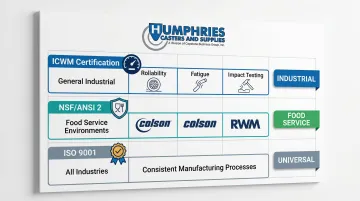
The Institute of Caster and Wheel Manufacturers (ICWM), which grew from the 1933 Caster & Floor Manufacturers Truck Association, administers standardized testing protocols including:
- Rollability testing (efficiency at weight capacity on smooth steel floors)
- Wheel brake and swivel lock efficiency
- Fatigue testing (repeated impacts at designated capacity)
- Impact testing for casters under 5,000 lbs
NSF/ANSI 2 certification governs food service casters, with NSF-listed brands including Colson (1 Series, Regent Series) and RWM (VersaTrac 27). Darnell-Rose holds ISO 9001 quality management certification, indicating consistent manufacturing processes.
Buyer-Specific Priorities
Industrial buyers should prioritize:
- Load capacity ratings validated through ICWM testing
- Swivel durability specifications (especially kingpinless designs)
- Ergonomic compliance documentation — OSHA recommends limiting push force to less than 50 lbs for hand carts
The requirements shift considerably for healthcare environments. Medical buyers should prioritize:
- Non-marking rubber compounds verified through testing, not just color
- Cleanability features like thread guards and sealed bearings for infection control
- Compliance with healthcare equipment mobility standards
The Distributor Advantage
For buyers sourcing at scale or needing hard-to-find configurations, working with specialized distributors provides advantages manufacturers rarely offer direct:
- Access to multiple manufacturers' catalogs for cross-comparison
- Product trial samples before bulk commitment
- Blanket order programs with flexible delivery schedules
- Extended warranty support beyond manufacturer terms
- Application engineering consultation
Humphries Casters (Cincinnati, OH) has served industrial and medical markets since 1988, providing these exact services to OEM customers and MRO buyers. Their relationships with manufacturers including Hamilton, Colson Group, RWM, Faultless, and Caster Concepts translate to competitive pricing, faster sourcing, and access to specialty compounds that aren't available through standard channels. Contact them at 800.733.4758 or Service@HumphriesCasters.com for application consultation.
Conclusion
The right rubber caster manufacturer depends on application match—not brand recognition. An industrial buyer sourcing casters for a 2,000-lb assembly cart faces fundamentally different requirements than a hospital supply manager procuring medication cart wheels. No single manufacturer excels equally across all rubber caster applications.
Before committing to production quantities:
- Request samples or product trials to validate performance in your specific environment
- Verify rubber compound specifications against your floor type and load requirements
- Confirm any industry-specific certifications required for your application
- Compare lead times and minimum order quantities if custom configurations are needed
Humphries Casters has supplied industrial, medical, and OEM customers with casters and facility equipment since 1988. For buyers who need help matching specifications to manufacturer options, sourcing specialty rubber casters, or managing ongoing supply, their team offers product trials, blanket order programs, and warranty coverage that extends past standard manufacturer terms. Contact them at 800.733.4758 or Service@HumphriesCasters.com to discuss your application requirements.
Frequently Asked Questions
What makes rubber casters different from polyurethane casters?
Rubber casters deliver superior shock absorption, grip on wet surfaces, and floor protection through softer compounds—but typically support lower loads (250-500 lbs standard, up to 6,000 lbs for specialty press-on construction). Polyurethane resists cuts and chemicals better while handling higher capacities, making the choice application-dependent.
Are rubber casters appropriate for hospital and medical equipment use?
Yes. Medical-grade rubber casters with non-marking compounds are widely used on hospital beds, IV poles, and medication carts. Verify the compound is cleanroom-compatible and includes thread guards or sealed bearings for infection control.
What load capacities do rubber casters typically support?
Capacity varies widely by wheel diameter, rubber hardness (durometer), and frame construction. Soft rubber casters (70-80 Shore A) typically support 175-250 lbs per caster. Hard rubber (75-85 Shore D) handles 275-325 lbs. Specialty press-on rubber reaches 3,500-6,000 lbs through Hamilton's POR series construction.
How do I know if a rubber caster is non-marking for sensitive floors?
Non-marking rubber casters exclude carbon black from the compound, resulting in gray or light-colored wheels. Color alone isn't definitive: verify the specific compound formulation with the manufacturer or distributor. Some products, like Durable Superior's Ergo Blue Rubber, achieve non-marking performance in non-standard colors.
What certifications should industrial rubber casters carry?
Key certifications depend on your application: ICWM protocols cover general industrial performance (rollability, fatigue, impact); NSF/ANSI 2 applies to food service environments; ISO 9001 confirms manufacturing quality management. Ergonomic applications reference OSHA's push force guideline of under 50 lbs.
Can I order custom rubber caster configurations from US manufacturers?
Yes. Most manufacturers listed offer custom rubber wheel compounds, frame dimensions, or specialty configurations. Lead times and minimum order quantities vary significantly. Working through a distributor like Humphries Casters gives you access to custom options across multiple manufacturers, often with shorter lead times and no high MOQs for prototype or trial orders.