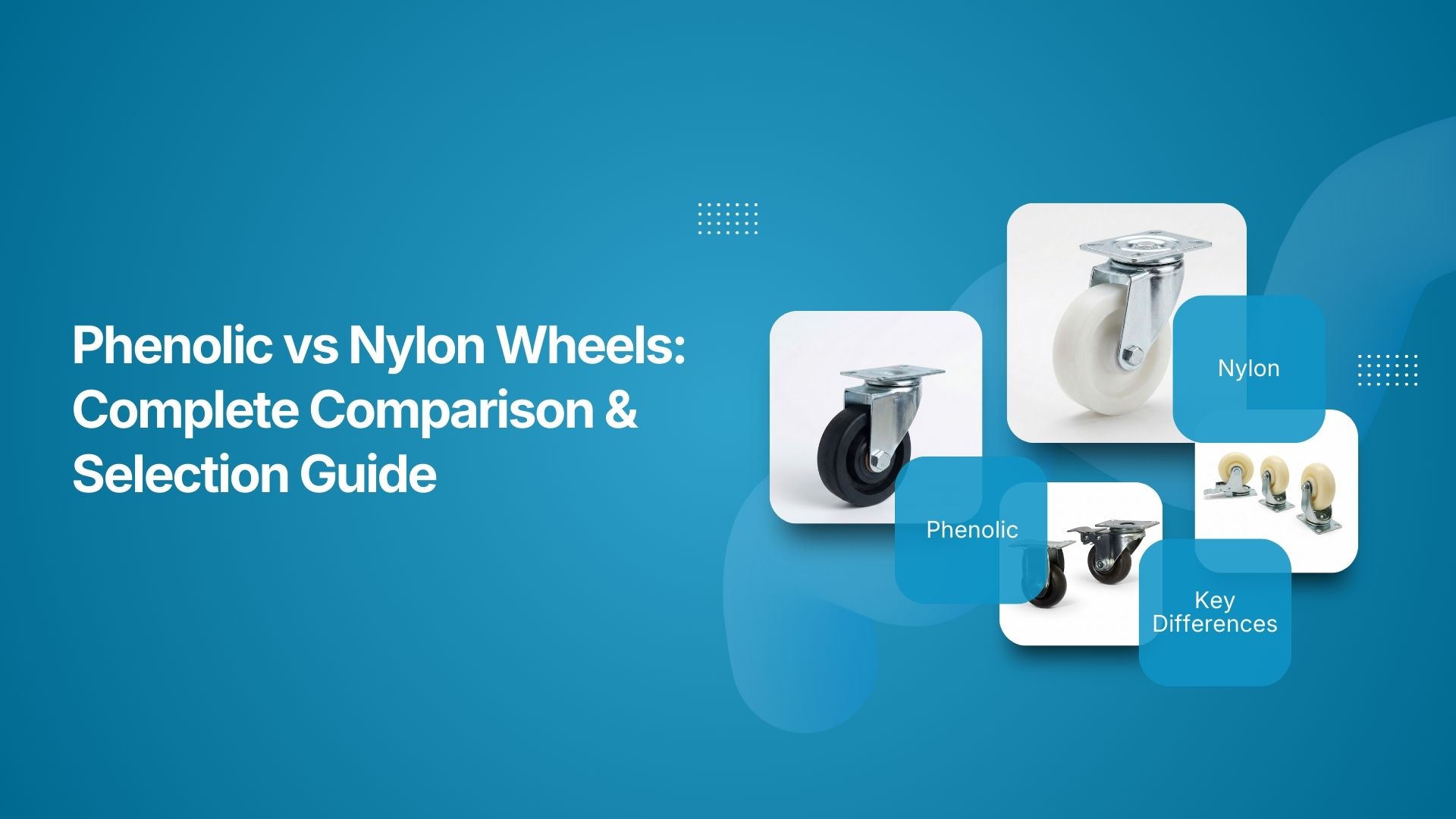
When you’re rolling heavy carts, machinery, or material racks, the wheels under them do more than just turn. Choosing between phenolic vs nylon wheels isn’t a trivial detail. It can affect load capacity, durability, floor protection, and long-term wear and tear on both your equipment and facility surfaces.
But which material truly performs better for your operation?
In this guide, you’ll get a clear breakdown of strengths and drawbacks, so you can choose confidently based on load, floor type, and use case, not guesswork.
Key Takeaways:
Different strengths: Phenolic vs nylon wheels excel in different conditions: phenolic handles extreme loads and heat; nylon performs better in wet, clean, and mixed-floor environments.
Choose based on failure risk: Pick phenolic when equipment failure would halt operations; choose nylon when smooth rolling, ergonomics, and floor protection matter most.
Environment dictates success: Phenolic is ideal for concrete industrial spaces; nylon is better for sanitation-heavy or customer-facing facilities.
Cost beyond purchase: Evaluate downtime, push-force, and floor repair costs—not just wheel price.
A Quick Look at Both Wheel Types
Before comparing performance factors and real-world applications, it helps to understand what each wheel material is built to do. This section gives you a straightforward snapshot of phenolic vs nylon wheels: how they’re constructed, how they behave under load, and the kinds of environments they’re engineered for.
Let’s start with Phenolic Wheels.
What Are Phenolic Wheels?
Phenolic wheels are made from layers of resin-impregnated canvas or fibers that are molded under high pressure to create a dense, rigid, and extremely durable wheel structure.
They’re designed to keep moving under serious weight without flat-spotting or deforming, even when left stationary for long periods.
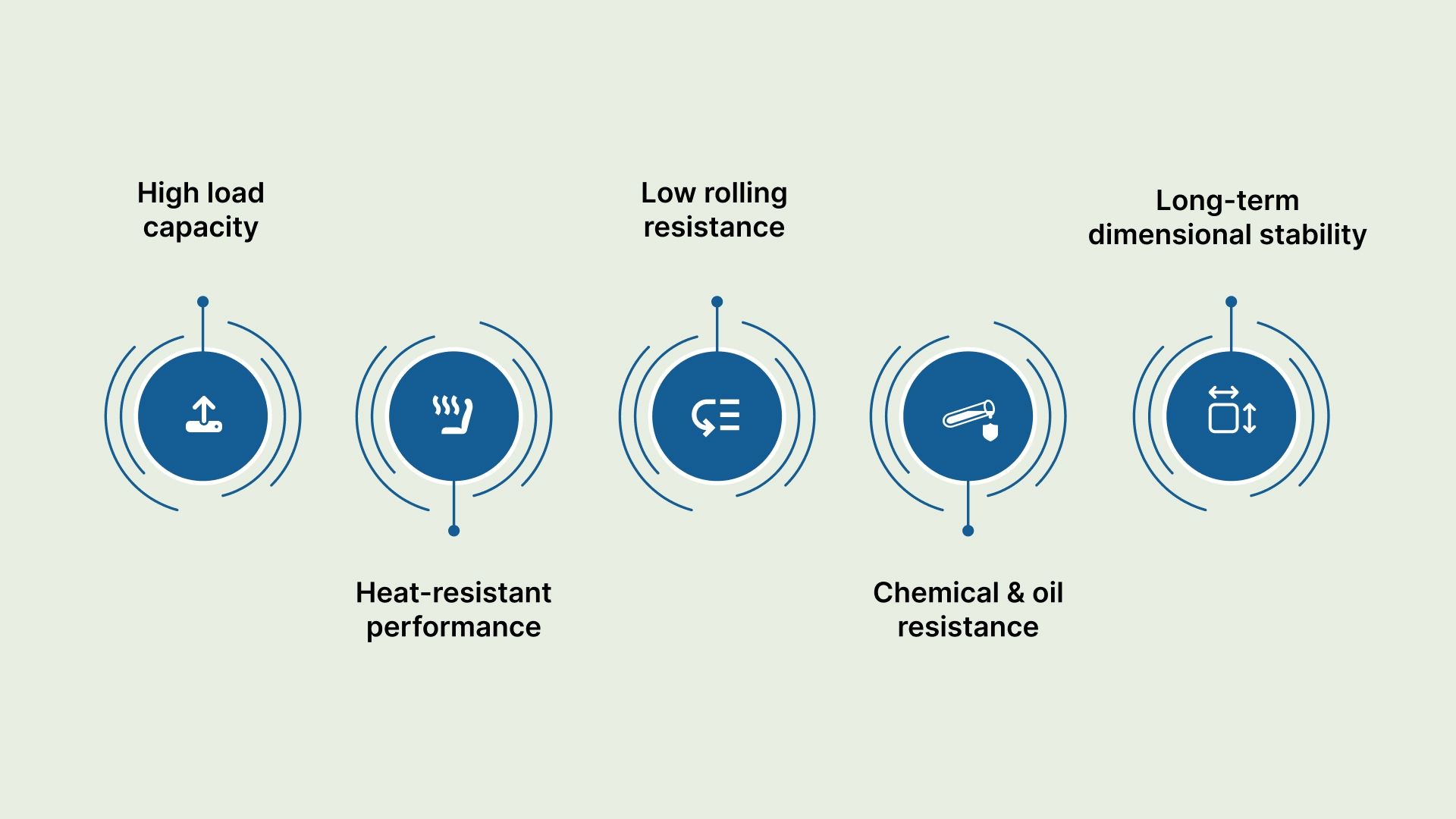
Key Traits
High load capacity — supports very heavy loads with minimal compression or wheel deformation.
Heat-resistant performance — withstands high temperatures generated by rolling friction or heat-exposed environments.
Low rolling resistance — moves heavy loads efficiently on smooth, hard surfaces like concrete.
Chemical and oil resistance — performs reliably in manufacturing and machining environments with exposure to grease and solvents.
Long-term dimensional stability — resists flat-spotting under static weight.
What Are Nylon Wheels?
Nylon wheels are manufactured from a tough, injection-molded thermoplastic designed for excellent load-bearing strength, consistent rolling performance, and resistance to abrasion, water, and chemical exposure.
These wheels are often selected for environments where sanitation, moisture, or chemical cleaning are involved, or where consistent mobility matters more than maximum load rating alone.
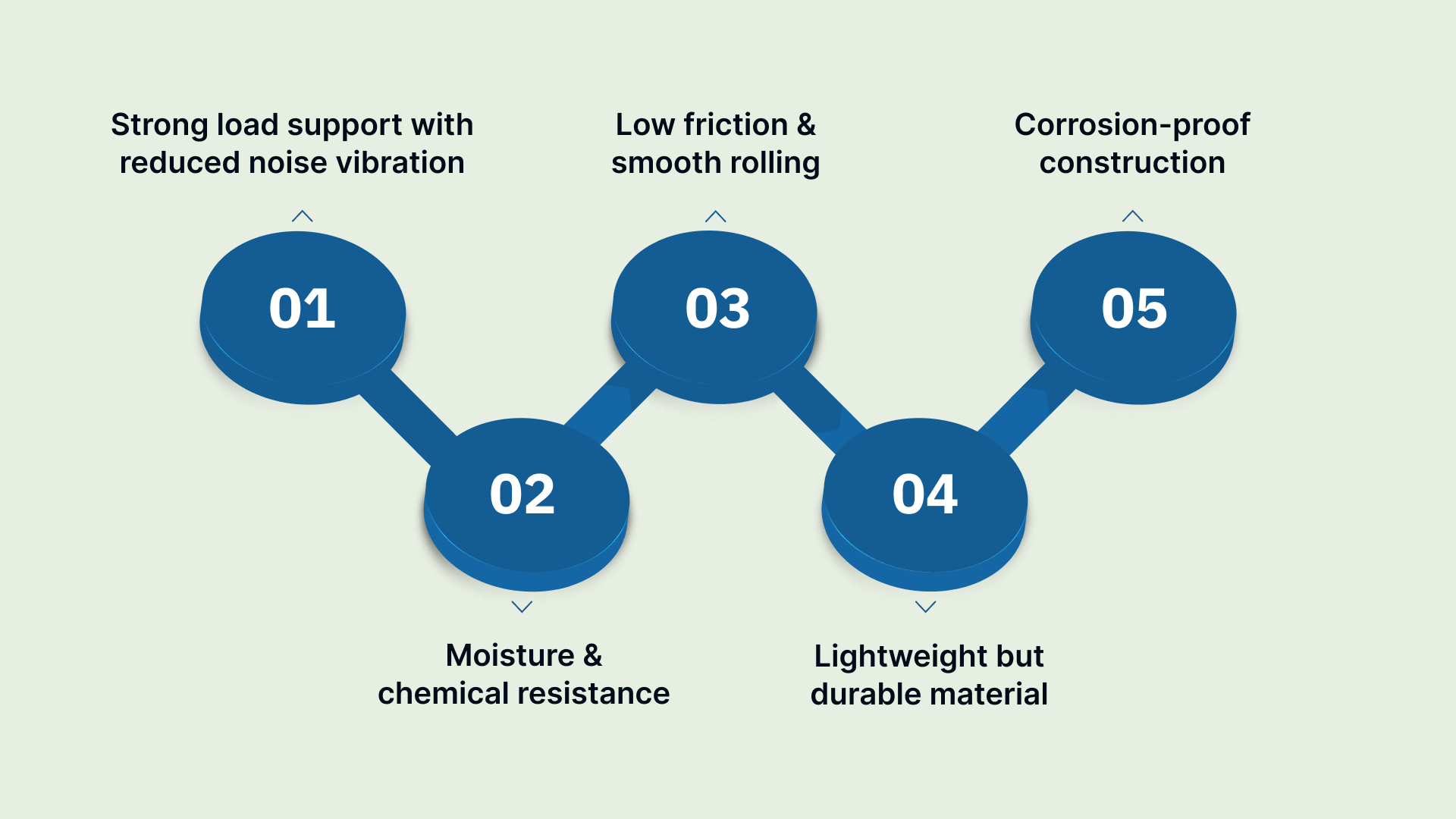
Key Traits
Strong load support with reduced noise and vibration compared to extremely hard industrial wheels.
Moisture and chemical resistance ideal for washdown, food service, and cleanroom environments.
Low friction and smooth rolling that reduces push force on medium to heavy loads.
Lightweight but durable material that handles high usage without cracking or chipping.
Corrosion-proof construction suitable for wet or humid spaces where metal wheels fail.
Although both are built for industrial use and heavy loads, they perform very differently when it comes to floor protection, temperature tolerance, noise, and long-term durability.
Phenolic vs Nylon Wheels: Key Differences
When you’re choosing between phenolic vs nylon wheels, the real question is how each material performs under pressure in your actual working conditions. Understanding these performance differences helps you match the right wheel to your equipment, facility surfaces, and operational demands, without costly trial-and-error.
The table below breaks down the key distinctions:
Performance Factor | Phenolic Wheels | Nylon Wheels |
Load Handling | Best for extremely heavy loads with minimal flex or deformation. | Strong load capacity but optimized for smoother rolling over raw weight extremes. |
Floor Interaction | Can damage softer floors; performs best on concrete or steel plate. | Safer for mixed flooring and coated surfaces with reduced abrasion risk. |
Temperature Tolerance | Performs reliably at high temperatures (heat-intensive environments, ovens, weld shops). | Stable across broad temperature ranges but less suited for high-heat applications. |
Noise & Vibration | Harder ride creates more vibration and noise during transport. | Quieter rolling and reduced operator fatigue on long movement routes. |
Moisture Exposure | Vulnerable to water absorption if not sealed—can swell or crack. | Fully moisture-resistant — ideal for washdown, cleaning, food-grade environments. |
Chemical Interaction | Strong resistance to oils, grease, and solvents. | Excellent chemical resistance, especially in sanitizing environments. |
Longevity in Harsh Use | Long life under static weight or constant pressure without flat-spotting. | Long life under dynamic movement where rolling friction is constant. |
Best Application Fit | Heavy industrial carts, machining, foundries, heat-exposed production lines. | Food processing, medical, laboratories, warehouses with polished or coated floors. |
The smartest way to choose between phenolic vs nylon wheels is to evaluate the real cost of failure in your operation. Whether that means downtime from wheel breakage, long-term floor damage, or reduced mobility affecting throughput.
How to Choose the Right Wheel Material?
Choosing between phenolic vs nylon wheels isn’t just about comparing specifications; it's about identifying what failure looks like in your operation. For some facilities, the biggest risk is a wheel collapsing under extreme load. For others, it's floor damage slowing production, noise disrupting workflow, or wheels seizing because of moisture or chemical exposure.
We know that balancing these factors and anticipating potential risks can be daunting, especially when each facility’s needs and priorities differ so much.
The guide below breaks down how to decide based on what matters most in your environment.
What Matters Most | Choose Phenolic Wheels If… | Choose Nylon Wheels If… |
Downtime Risk | A wheel failure would stop production or automation. | Smooth, uninterrupted movement is more critical than extreme load capacity. |
Floor Investment | Floors are industrial-grade and replaceable. | Floor protection and appearance carry financial or brand impact. |
Environmental Stress | Heat exposure is significant (weld shops, foundries, ovens). | Moisture, sanitation, or chemical washdowns are routine. |
Human Effort & Ergonomics | Movement is powered or automated, not manual. | Operator fatigue, push force, and noise reduction matter. |
Cost Strategy | You optimize for durability under static, heavy loads. | You optimize for long-term lifecycle cost and reduced floor repair. |
With the decision factors mapped out, the final step is choosing a supplier who understands how these materials behave in real environments. not just on paper.
Where Humphries Casters Comes In
Every facility has different priorities: load requirements, flooring conditions, sanitation needs, noise limits, or ergonomics goals. We understand that navigating these diverse and sometimes competing priorities can be challenging, and finding a tailored solution feels critical to maintaining smooth operations.
Humphries Casters helps you evaluate these factors and select the wheel material that performs best in your real environment, not just in theory.
What You Can Expect From Humphries Casters
Material-specific recommendations based on load type, terrain, speed cycles, sanitation requirements, and usage frequency.
Extensive wheel selection, including polyurethane, urethane, and specialty compounds engineered for harsh or regulated environments.
OEM-equivalent and custom-manufactured options to ensure compatibility and eliminate modification delays.
Bulk and scheduled purchasing programs for multi-location facilities, warehouses, and high-cycle operations.
Proven expertise across industries including hospitals, food-processing, distribution centers, assembly lines, and transport logistics.
Reliable sourcing partnerships with access to hundreds of manufacturing facilities for rapid fulfillment and application testing.
Whether you're upgrading equipment, solving recurring wheel issues, or standardizing materials across your operation, Humphries Casters helps you choose confidently and optimize long-term performance.
Conclusion
Instead of relying on guesswork or spec-sheet assumptions, align wheel material with how your facility actually functions. You’ll see the difference in safety, efficiency, and long-term operating cost.
If you want help determining the best fit for your application, Humphries Casters is ready to support you with practical guidance and proven solutions.
Need help choosing between phenolic vs nylon wheels? Reach out to us for tailored recommendations based on your environment and workload.
FAQs
1. Are phenolic vs nylon wheels interchangeable on most carts and equipment?
Not always. Mounting style, bearing type, and load rating can vary significantly between models. When comparing phenolic vs nylon wheels, always confirm compatibility with your existing caster rig and hardware.
2. Which material lasts longer over time—phenolic or nylon?
It depends on the environment. Phenolic lasts longer under extreme static weight and dry industrial conditions, while nylon outperforms in wet, chemical-cleaned, or high-movement environments. Choosing between phenolic vs nylon wheels should be based on the conditions they face, not lifespan claims alone.
3. Can phenolic vs nylon wheels damage floors?
Phenolic wheels can mark or chip softer or coated floors, and are best suited for concrete or steel. Nylon is safer on polished or sealed surfaces, but can still cause wear if overloaded or dirty. Floor type is critical when deciding between phenolic vs nylon wheels.
4. Are nylon wheels strong enough for heavy industrial use?
Yes—modern nylon wheels can handle significant loads, but phenolic wheels are better when weight demands are extremely high or stationary load time is long. Consider maximum static load when choosing between phenolic vs nylon wheels.
5. Do temperature changes affect phenolic vs nylon wheels differently?
Yes. Phenolic handles high heat much better, while nylon performs better under moisture, cold, or frequent temperature cycling. Evaluate your environment before choosing between phenolic vs nylon wheels.