Introduction
Hospitals, long-term care communities, and clinics replace or upgrade casters and wheels across hundreds of beds, carts, and equipment pieces every year—yet GPO volume pricing remains one of the most underused levers for controlling that cost.
What a facility pays for medical casters varies dramatically based on caster type, material, load capacity, compliance requirements, and purchase volume. Misunderstanding this pricing landscape leads to overspending or under-specifying, often both at once.
This article breaks down typical GPO pricing tiers for medical casters, the key factors that drive cost up or down, what separates entry-level from premium options, and how to budget accurately through a GPO contract.
Key Takeaways
- GPO volume pricing for medical casters ranges from basic institutional wheels to antimicrobial, locking, or ESD-rated casters; the right tier depends on application and compliance needs.
- Key cost drivers: caster type (swivel vs. rigid, brake included), load capacity, infection-control material requirements, and GPO contract volume tier.
- Facilities with dozens to hundreds of units in scope see the strongest per-unit savings; blanket orders under GPO contracts amplify those discounts further.
- Focusing only on per-unit price without accounting for replacement cycles, infection control compliance, and total lifecycle cost is the most common and costly mistake in GPO caster procurement.
How Much Does GPO Volume Pricing for Medical Casters Cost?
Medical casters do not have a fixed price, and costs vary significantly based on specifications, compliance requirements, order volume, and GPO contract terms. Buying outside a GPO contract or in small quantities almost always means paying substantially more per unit.
When cost is misunderstood, the consequences are predictable and expensive. Underbudgeting leads to mid-cycle replacements that disrupt clinical operations. Choosing the wrong specification creates safety and compliance risks. Not leveraging volume tiers leaves money on the table across a large equipment fleet. Reactive repairs cost 4.8 times more than planned maintenance—$1,850 versus $390 per work order—making procurement decisions particularly critical.
Typical GPO Price Tiers for Medical Casters
Medical caster pricing under GPO contracts falls into three bands. Actual negotiated pricing is contract-specific, but these tiers give procurement teams a reliable framework for budgeting and matching product to application.
| Feature | Entry-Level | Mid-Range | High-End / Specialized |
|---|---|---|---|
| Wheel Type | Standard polyurethane or rubber | Dual-wheel or precision swivel | Antimicrobial or 316L stainless steel |
| Load Rating | 175–220 lbs per caster | 300–500 lbs per caster | 500–1,000+ lbs per caster |
| Brake Options | None or simple stem brake | Total-lock or directional brake | Ergonomic total-lock with push-resistance reduction |
| Noise Level | Standard (60–70 dB) | Quieter rolling profile | Ultra-quiet precision bearings (<40 dB) |
| Infection Control | Basic corrosion-resistant finishes | Chrome or sterilization-appropriate finishes | Full antimicrobial or ESD-rated construction |
| Bearings | Standard | Sealed precision ball bearings | Sealed precision bearings with full cert documentation |
| Compliance | Minimal | Meets most hospital procurement specs | Full regulatory certification for sterile and imaging environments |
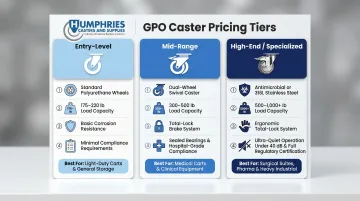
Entry-Level casters suit non-patient-contact applications where cost efficiency is the priority: housekeeping carts, general storage, and utility equipment with minimal clinical compliance requirements.
Mid-Range casters cover the majority of acute-care equipment — patient beds, IV poles, overbed tables, nursing carts, and medication carts — where reliable performance and baseline infection-control compliance are both required.
High-End / Specialized casters are specified for the most demanding environments:
- ICU and surgical suite equipment
- Imaging and radiology transport
- Bariatric care applications (load ratings up to 1,000+ lbs per caster)
- Cleanroom and sterile processing environments
- OEM equipment integrations requiring custom specifications and full documentation
Key Factors That Affect Medical Caster Pricing in GPO Contracts
The price any healthcare GPO member pays for casters is shaped by a combination of product specifications, operational context, and contract structure. Understanding each factor helps procurement teams make better decisions and negotiate more effectively.
Caster Type and Configuration
The caster configuration—swivel vs. rigid, total-lock brake vs. directional lock vs. no brake, single vs. twin wheel—directly impacts unit cost. Over-specifying a configuration wastes budget, while under-specifying leads to premature failure.
Key configuration considerations:
- Twin-wheel casters cost more than single-wheel but distribute weight better and roll more smoothly
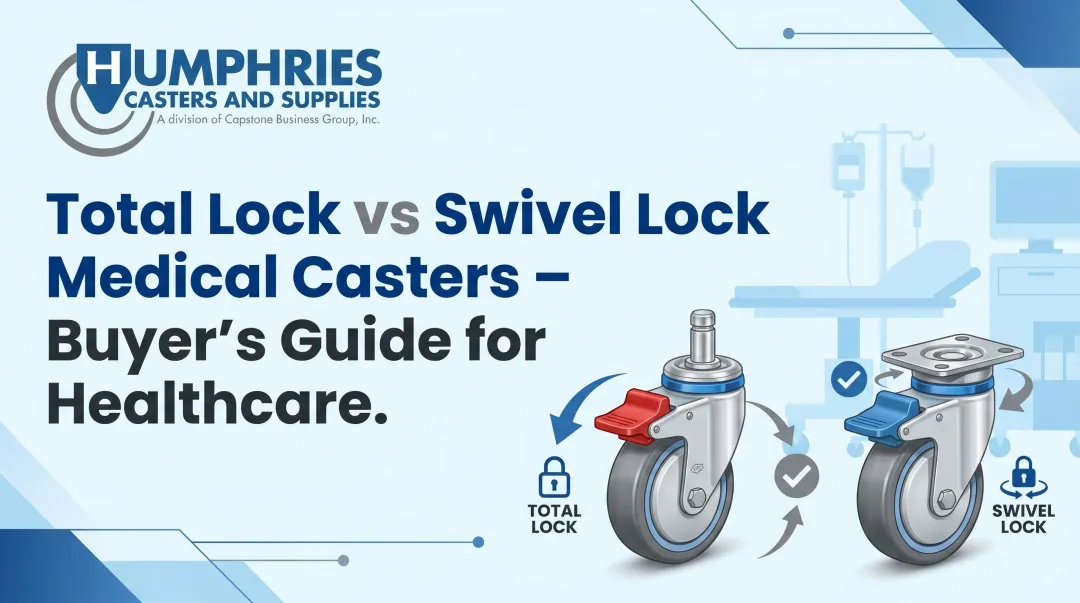
- Central locking mechanisms command a premium but allow multiple casters to lock simultaneously for enhanced safety
- Total-lock brakes (locking both wheel and swivel) cost more than simple wheel locks but provide complete immobilization
- Brake-and-steer combinations add complexity and cost but offer precise control for procedural stretchers
Load Capacity and Application Environment
Load rating is a primary cost driver because higher-capacity casters require stronger materials and more robust engineering. Standard hospital beds support 350-450 pounds, while bariatric models handle 600-1,000+ pounds. Per-caster load capacity typically ranges from 100-150 kg for standard hospital beds to 200+ kg for bariatric applications.
Incorrect load-matching creates two problems:
- Safety failures when casters are under-rated for the application
- Unnecessary replacement costs when equipment stress exceeds design limits
Industry standards recommend a "Rule of 3" safety factor—divide total equipment load by 3 (not 4) to account for uneven weight distribution during patient movement.
Material, Finish, and Infection Control Requirements
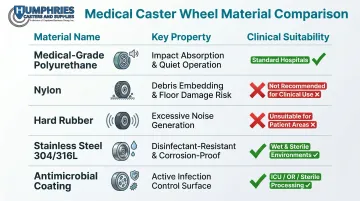
Wheel and housing material (polyurethane, rubber, nylon, stainless steel, antimicrobial-coated) affects both unit cost and suitability for clinical environments. On any given day, about 1 in 31 hospital patients has at least one healthcare-associated infection, and portable medical equipment is a recognized vector for microbial contamination.
Infection control requirements in sensitive environments demand specific finishes and materials that cost more upfront but deliver better patient safety outcomes and longer service life.
Material choices and their implications:
- Medical-grade polyurethane absorbs impact, rolls quietly, and resists floor marking — the standard choice for most hospital settings
- Nylon is unsuitable for clinical use; floor debris embeds in the tread and hardens over time
- Hard rubber generates excessive noise, particularly problematic in patient care areas
- Stainless steel (304 or 316L) withstands repeated disinfectant exposure and resists corrosion in wet environments
- Sealed bearing assemblies block fluid and biological material from entering the mechanism
- Antimicrobial coatings carry a price premium justified by infection-control outcomes in ICUs, ORs, and sterile processing
Order Volume and GPO Tier Structure
GPO volume pricing works by unlocking lower per-unit pricing at larger quantity tiers. A facility ordering 50 units pays more per caster than one ordering 500 units. Blanket orders—committing to a set volume over a contract period—and stocking programs further reduce cost by securing supply and locking in pricing.
GPOs save the healthcare system $34.1 billion annually, and individual institutions pay 10-18% less through GPO contracts. Facilities with large equipment fleets or multi-site systems capture the most value through these tiered structures because they can aggregate demand and meet higher volume thresholds.
Customization and Lead Time
Off-the-shelf GPO catalog casters carry the best pricing. Custom colors, logos, specialized dimensions, or non-standard mounting configurations add cost and lead time.
When customization is worth the premium:
- OEM replacement needs requiring exact dimensional match
- Brand-specific bed frames with proprietary mounting
- Unique clinical applications not served by standard catalog items
In many cases, though, standard equivalents perform just as well. When catalog items are the better call:
- General-purpose clinical carts with no dimensional constraints
- Non-critical equipment replacement where any compliant caster will do
- Applications with flexible mounting options
Standard vs. Medical-Grade Casters: What the Price Difference Gets You
Substituting standard industrial casters to reduce unit cost is tempting for procurement teams, but in healthcare environments this trade-off creates more expense than it saves. Emergency repairs cost 4.8 times more than planned maintenance, and every dollar of deferred maintenance costs $4-$5 to remediate within five years.
Four areas show where the price gap earns its keep.
Performance and Noise
Standard casters run at 60-70 dB — enough to disrupt patient rooms — while medical-grade units are engineered for under 40 dB. The difference in rolling resistance matters too: staff report equipment is up to 50% easier to push and pull with high-quality casters, directly reducing musculoskeletal strain. A typical back injury runs $62,000-$81,000 per incident, which reframes a per-unit price difference quickly.
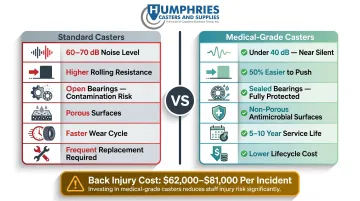
- Standard: higher rolling resistance, louder operation, less precise swivel
- Medical-grade: low-noise, low-effort rolling, smooth swivel for better equipment control
Infection Control Compliance
Standard:
- Open ball bearings and porous materials harbor bacteria
- Difficult to clean effectively
- Materials degrade under repeated disinfectant exposure
Medical-grade:
- Sealed bearings prevent fluid and biological material entry
- Smooth, non-porous surfaces designed for washability
- Antimicrobial materials or stainless steel construction
- Withstands repeated disinfectant exposure without degrading
Workstations on wheels had approximately twice the microbial bioburden of vitals machines, and equipment used for patient mobility requires infection-control features that standard industrial casters don't provide.
Durability and Replacement Cycle
Standard:
- Faster wear under clinical use patterns
- More frequent replacement
- Higher total spend over equipment lifecycle
Medical-grade:
- Longer service life under heavy daily use
- High-quality casters last 5-10 years based on usage and maintenance
- Total lifecycle cost often lower despite the higher upfront price
Long-Term Value
GPO contracts are designed to make appropriate specification affordable at scale. When replacement frequency, labor, downtime, and compliance risk are factored in, the per-unit price premium for medical-grade casters routinely pays for itself before the first replacement cycle on a standard unit.
How to Estimate the Right GPO Caster Budget for Your Healthcare Facility
Accurate budgeting requires matching specification to application first, then applying GPO volume pricing to the right product — not just the cheapest option in the contract catalog. The three factors below determine whether your GPO contract delivers real savings or just a lower unit price on the wrong item.
Conduct a Full Equipment Audit
- Identify all caster-bearing assets by type, quantity, current condition, and replacement timeline
- Group items by specification tier (basic institutional, standard medical-grade, specialized)
- Understand true volume at each price point
- Determine what GPO tier thresholds are achievable across your facility portfolio
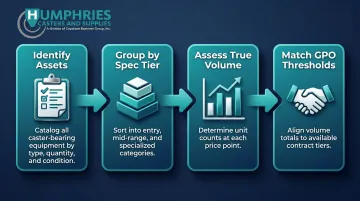
That inventory picture feeds directly into your cost model — because unit price alone rarely reflects what casters actually cost over time.
Factor in Lifecycle Cost, Not Just Unit Price
- Estimate annual replacement rate by equipment category
- Calculate total cost of downtime or safety incidents from failed casters
- Include labor involved in unplanned replacement versus scheduled program replacements
- Account for infection-control compliance requirements
Leverage blanket order and bulk discount programs:
Suppliers like Humphries Casters offer blanket order structures that allow healthcare systems to commit to annual volume across their facility portfolio and access lower per-unit pricing without requiring all units to ship at once. These programs reduce administrative load for both budgeting and inventory teams by offering:
- Regular interval shipments or on-demand delivery
- Bulk purchase discounts delivered directly or stored for future use
- Reduced procurement administrative burden
- Consistent supply availability
What Most Healthcare Buyers Miss When Budgeting for GPO Casters
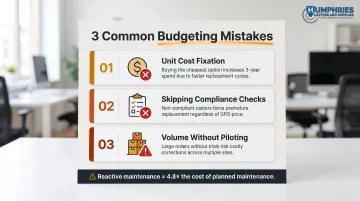
Three budgeting mistakes routinely cost healthcare facilities more than they save on GPO pricing:
- Pricing on unit cost alone: Facilities that buy the cheapest available option often spend more over a three-year window due to accelerated replacement cycles and higher labor costs. Reactive maintenance captures only 72% of designed useful life versus 96% for planned maintenance — a gap that compounds across large equipment inventories.
- Skipping compliance checks until after purchase: A caster that doesn't meet infection-control standards, load ratings, or flooring compatibility for a specific environment forces premature replacement — regardless of how attractive the GPO price appeared.
- Committing to volume before piloting: GPO contracts should be tested before large-scale rollout. Requesting samples or running a trial in one unit first identifies fit issues early and prevents costly large-order corrections across multiple sites or departments.
Conclusion
GPO volume pricing for medical casters varies significantly based on specification, application, and contract structure—and the right pricing strategy starts with accurate specification, not the lowest price tier. Healthcare facilities with large equipment fleets and multi-site systems have the most to gain from GPO caster programs, and working with a supplier experienced in healthcare procurement turns that volume into measurable, documented cost reductions.
Humphries Casters has supplied casters to the #1, 2, and 3 long-term care organizations in America and leading hospitals nationwide since 1988, with direct experience in GPO-aligned volume purchasing. For healthcare procurement teams, that experience translates into programs built around your actual fleet needs:
- Blanket order programs that lock in pricing across multi-site systems
- Product trials and samples for evaluation before committing to volume
- Specification guidance to reduce total cost of ownership and avoid compliance gaps
Frequently Asked Questions
How do group purchasing organizations (GPOs) get paid?
GPOs are primarily funded by administrative fees paid by suppliers—typically a percentage of sales volume generated through the GPO contract—rather than by member organizations. Federal regulations cap this administrative fee at 3% of sales volume, and actual weighted GPO fees typically range from 1.22% to 2.25%. Members generally join and purchase at no direct membership cost.
What is the difference between a pharmacy benefit manager (PBM) and a group purchasing organization (GPO)?
A GPO aggregates the purchasing volume of multiple member organizations to negotiate better pricing across a broad range of products and services—including medical supplies and equipment like casters. A PBM specifically manages prescription drug benefits, negotiating with drug manufacturers and pharmacies on behalf of health insurers or employers.
Who are the big three group purchasing organizations (GPOs)?
The three largest healthcare GPOs by member spend are Vizient, Premier Inc., and HealthTrust Performance Group. Premier Inc. alone aggregates over 4,000 hospitals and 175,000 healthcare providers. Their collective contracts cover medical supplies, equipment, and facility products including mobility and caster-related items.
Who supplies medical supplies to hospitals?
Hospitals source medical supplies through a combination of GPO-contracted distributors (like Medline, Cardinal Health, and McKesson), direct manufacturer relationships, and specialty suppliers. For specific categories like casters and mobility equipment, facilities often work with specialty industrial and medical caster suppliers who offer GPO-compatible volume pricing and healthcare-specific product lines.
What are the three types of group purchasing organizations (GPOs)?
The three main types are vertical GPOs (industry-specific, such as healthcare), horizontal GPOs (cross-industry, covering common indirect spend categories like office supplies or facility equipment), and regional or cooperative GPOs (geographically focused or member-governed models). Healthcare facilities may participate in more than one type, depending on their purchasing structure.
What types of casters are most commonly purchased through healthcare GPO contracts?
The most common categories include total-lock and directional-brake casters for patient beds and clinical carts, antimicrobial or stainless-steel casters for infection-sensitive environments, and heavy-duty casters for transport and imaging equipment. Central locking systems and sealed bearing assemblies are popular mid-to-high tier selections, with pricing varying by specification and supplier contract.