Introduction
A medical cart's mobility is only as reliable as the casters beneath it. Wrong casters mean disrupted workflows, floor damage, infection risks, and staff strain in busy emergency departments and patient wards. Every time a crash cart navigates a crowded emergency room, a medication cart moves through patient wards, or an imaging cart crosses thresholds and elevator gaps, the casters beneath bear the weight of critical operations.
The procurement stakes extend far beyond price per unit. Caster selection directly affects patient safety, staff ergonomics, infection control compliance, and total lifecycle cost.
The numbers make the case plainly. OSHA identifies pushing and pulling carts as a direct risk factor for back, shoulder, and upper/lower extremity injuries among healthcare workers. The CDC documents that equipment wheels can transport pathogens including C. difficile, MRSA, VRE, and C. auris across hospital wards. Commodity casters on tile floors generate 60–70 dB of noise, nearly double the WHO's recommended hospital noise guideline of 35 dB.
This guide covers the technical specifications, environmental considerations, and compliance requirements that separate medical-grade casters from standard industrial options — so procurement teams can make decisions that protect patients, staff, and long-term budgets.
Key Takeaways
- Medical cart casters differ from standard industrial casters in infection control, noise performance, precision maneuverability, and compliance requirements
- Load capacity calculation: divide total weight (cart + contents + operator force) by 3 casters—not 4—then multiply by 1.25 for safety margin
- Polyurethane wheels offer the best all-around performance for noise, floor protection, chemical resistance, and cleanability
- MRI suites, washdown zones, and ESD-sensitive areas each require purpose-built caster types
- Request product samples for pilot testing before committing to fleet-wide orders
What Are Medical Cart Casters?
Medical cart casters are specialized mobility components engineered for the demands of healthcare cart applications. Unlike general industrial or office casters, they must meet stringent requirements for material safety, hygiene design, noise output, and durability under daily disinfection protocols.
The distinguishing features include precision bearings (ABEC-5 or higher), sealed assemblies that prevent biological fluid entry, and materials that withstand hospital-grade disinfectants — including quaternary ammonium compounds, hydrogen peroxide solutions, and bleach — without corroding or degrading over time.
Types of Medical Cart Casters
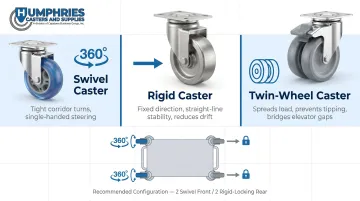
Three core categories address different mobility needs:
- Swivel casters rotate 360°, enabling tight corridor turns and single-handed steering during emergencies
- Rigid casters run in a fixed direction, reducing drift and improving straight-line tracking
- Twin-wheel casters spread load across two mounted wheels — lowering tipping risk and keeping casters clear of elevator gaps and cord tracks
Most medical carts use a combination: two swivel casters at the front for maneuverability and two rigid or locking casters at the rear for stability.
Why Healthcare Facilities Need Specialized Cart Casters
Standard industrial casters fail in medical environments in ways that directly affect patient safety and workflow:
- Rubber treads crack and metal components corrode under repeated chemical disinfection cycles
- Rolling noise is a real problem: research shows standard casters on tile produce 60–70 dB, while medical-grade polyurethane and TPR treads drop that below 40 dB
- Unsealed bearings trap hair, sutures, and debris — the leading cause of caster failure in hospitals
- Standard swivel action lacks the precision needed for quick, single-handed steering during time-sensitive procedures
What to Consider When Choosing Casters for Medical Carts
Selecting the right caster requires matching technical specifications to operational realities. The factors below vary by cart type (crash cart vs. medication cart vs. imaging cart), facility floor type, and department environment.
Load Capacity
Load capacity is the most critical specification. Procurement teams must calculate total weight—cart frame + maximum contents + attached equipment—and divide by the number of casters, then apply a safety factor.
Use the N-1 method: Divide total load by 3 casters (not 4) because one caster may be airborne during dynamic use when crossing thresholds or navigating uneven floors. CasterHQ documents this as industry-standard practice, then apply a 1.25x safety factor (or 1.35x for shock-load environments).
Worked example: \
- Cart weight: 400 lb \
- Maximum payload: 600 lb \
- Total: 1,000 lb ÷ 3 = 333 lb per caster × 1.25 safety factor = 417 lb minimum dynamic rating per caster
Undersizing load capacity is the leading cause of premature caster failure in healthcare settings and creates a safety liability. Always verify you're using dynamic capacity ratings (for rolling loads), not static capacity (weight at rest).
Wheel Material
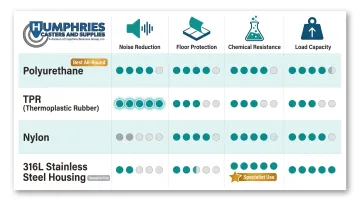
Wheel material determines four attributes most cited in healthcare procurement specs: noise output, floor protection, chemical resistance, and cleanability.
Material comparison:
- Polyurethane (PU): Best all-around balance of load capacity, noise reduction, floor protection, and chemical resistance; suitable for equipment carts, medication carts, and general hospital use
- Thermoplastic Rubber (TPR): Quietest operation (under 40 dB), ideal for IV stands and patient ward carts where noise is the top concern
- Nylon: Excellent chemical resistance and high load capacity; suitable for washdown zones but generates more noise and can scratch floors
- Stainless steel housings (316L grade): Superior resistance to peracetic acid, sodium hypochlorite, and chloride-rich disinfectants; required for sterile processing departments
Avoid hard materials: Standard nylon or phenolic wheels cause noise and surface damage on vinyl, epoxy, or linoleum hospital floors.
Wheel Diameter and Size
Larger wheel diameters roll more easily over floor transitions, elevator thresholds, and cable tracks common in hospitals. The OHSAH guide identifies wheels under 3 inches as a risk factor for increased physical effort.
General guidelines:
- 4-5 inch wheels: Standard for most medical carts, providing balance between clearance and maneuverability
- 3 inch or smaller: Suitable only for lightweight, flat-surface applications like IV pole bases
- 5-8 inch wheels: Recommended for long-distance transport or heavy-load carts
Wheel diameter also affects cart clearance height, which matters when carts must slide under counters or workstations.
Locking Mechanisms
Three main locking types serve different operational needs:
| Lock Type | Function | Best Use Case |
|---|---|---|
| Total lock | Stops both wheel rotation and swivel | Stationary procedures; IEC 60601-1 compliance |
| Directional lock | Disables swivel while allowing rolling | Long-corridor transport (crash carts) |
| Central wheel lock | All casters lock via single pedal | Reduces operator effort; supports quick locking at bedside |
IEC 60601-1 compliance: Under IEC 60601-1 3rd Edition (Clause 9.4), medical carts must not slide more than 50mm on a 5-degree (transport) or 10-degree (non-transport) incline. Four locking casters are now considered the default standard to meet this requirement.
Brake accessibility matters: If the brake pedal is obscured by the cart frame, staff will avoid using it, creating safety gaps.
Noise Reduction and Ergonomics
The WHO recommends hospital sound levels not exceed 35 dB average daytime with a 40 dB maximum overnight. Hard-plastic casters rolling on tile floors significantly exceed these limits, while TPR and PU treads with precision bearings help keep rolling noise within acceptable range.
Ergonomics are equally important. Boyer et al. (2013) measured peak two-hand forces of 147N when pushing medicine carts during turning phases on carpet. Medical staff push heavily loaded carts for hours per shift. Casters with low rolling resistance reduce cumulative physical strain and lower MSD injury risk.
Infection Control and Cleanability
Beyond ergonomics, casters are also infection control surfaces. Research published in the American Journal of Infection Control identifies portable equipment wheels as potential vectors for transmitting C. difficile, MRSA, VRE, and C. auris across hospital wards.
Medical-grade design features:
- Sealed bearing assemblies prevent biological fluid, dust, and debris from entering the mechanism
- Thread guards prevent hair, sutures, and packing material from winding into the axle—the leading cause of caster failure in hospitals
- Smooth, crevice-free housing surfaces don't trap bacteria and resist cleaning with quaternary ammonium, hydrogen peroxide, and bleach solutions
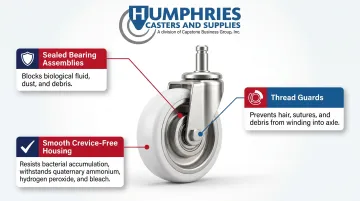
Casters must withstand daily disinfection without corroding or degrading.
Special Environments and Compliance Requirements
Certain healthcare zones impose non-negotiable caster requirements that standard procurement catalogs may not flag automatically.
MRI Suites
MRI rooms generate powerful magnetic fields that can turn ferrous metal components into dangerous projectiles. All casters used in MRI environments must have all-plastic/non-magnetic construction with polymer bearings and composite axles.
ASTM F2503 classifications:
- MR Safe: Non-ferromagnetic, all-plastic construction — poses no risk in any MRI environment
- MR Conditional: Safe only under specific tested conditions (defined field strength and gradient limits must be confirmed)
- MR Unsafe: Contains ferromagnetic components — must never enter MRI suites
Verify compliance directly with the manufacturer — never assume it. Require third-party validation across multiple MRI field strengths before approving equipment for suite use.
ESD-Sensitive and Cleanroom Areas
Carts carrying sensitive electronic medical equipment in labs or imaging suites may require conductive or anti-static (ESD) casters to dissipate electrostatic charges.
ESD resistance classifications (per IEC 61340 and ANSI/ESD S20.20):
- Conductive: Less than 1.0 × 10⁶ ohms — optimal for high-risk ESD environments
- Dissipative: 1.0 × 10⁶ to less than 1.0 × 10⁹ ohms — suitable for general ESD protection
- Insulative: 1.0 × 10⁹ ohms or greater — not suitable for ESD environments

Uncontrolled static discharge jeopardizes patient safety, damages diagnostic equipment, and creates ignition hazards in oxygen-rich environments.
Washdown Zones and Sterile Processing
Environments with frequent water exposure or chemical sterilization impose their own material requirements. At minimum, specify stainless steel bracket construction and sealed wheel assemblies — but the grade of stainless steel matters significantly.
316L vs. 304 stainless steel: 316L contains 2-3% molybdenum, providing superior resistance to peracetic acid, sodium hypochlorite, and chloride-rich disinfectants. 304 lacks molybdenum and is vulnerable to pitting and stress corrosion cracking in harsh chemical environments.
Key requirements for washdown and sterile processing zones:
- 316L stainless steel brackets — mandatory for SPD and any area using peracetic acid or chloride-based disinfectants
- Sealed wheel assemblies — prevent moisture intrusion that degrades bearings and promotes bacterial growth
- Non-porous tread materials — polyurethane or nylon; avoid open-cell foam or unsealed rubber
Specify 316L explicitly on purchase orders. "Stainless steel" alone does not guarantee 316L-grade compliance.
Procurement Best Practices Before You Buy
Procurement teams often default to price comparison before gathering the right specifications. The steps below prevent costly fleet-wide mismatches.
Document Cart Specs Before Contacting Suppliers
Gather this minimum information:
- Total cart weight with maximum payload
- Floor surface type in each department where the cart will be used
- Mounting style (top plate vs. threaded stem)
- Height clearance constraints
- Special environment flags (MRI, ESD, washdown)
Run a Pilot Test Before Fleet Orders
Install selected casters on one or two carts and evaluate:
- Start-up force and rolling resistance
- Noise on the actual floor surface
- Brake hold on inclines
- Response to routine disinfection protocols
Catching mismatches on one cart costs far less than retrofitting an entire fleet. Humphries Casters offers product samples and trials before bulk commitment, so procurement teams can validate performance under real-world conditions before committing to volume.
Calculate Total Cost of Ownership (TCO)
A caster priced at half the cost but replaced twice as often doesn't save money — it shifts the cost to labor, downtime, and floor repairs.
TCO factors:
- Labor cost of replacements
- Floor repair costs (vinyl repairs cost $2–9 per square foot)
- Downtime during cart servicing
- Ergonomic injury claims from excessive push forces
- Equipment damage from vibration
Verify Supplier Reliability
For healthcare facilities with large cart fleets, a supplier's ability to fulfill reorders quickly, honor warranties, and supply exact replacement parts matters as much as the initial specification.
Humphries Casters has supplied casters to hospitals ranked #1 in their specialties and the top three long-term care organizations in America since 1988. Their programs are built around how healthcare facilities actually purchase:
- Blanket order programs for predictable ongoing supply
- Bulk pricing options for fleet-scale procurement
- Warranty coverage that extends beyond manufacturer terms
- Exact replacement parts to maintain fleet consistency
How Humphries Casters Can Help
Humphries Casters has supplied the #1, #2, and #3 long-term care organizations in America, along with multiple hospitals ranked first in their specialties or regions. That track record means their team understands what procurement teams actually need — not just product specs, but reliable supply programs built around healthcare operations.
Procurement-specific advantages:
- Product samples and trials — evaluate caster performance in your facility before committing to a fleet-wide order
- Blanket order programs with scheduled or on-demand releases, reserved inventory, and locked pricing across contract terms
- Bulk pricing with delivery to your location or warehousing at Humphries' Cincinnati facility until you need it
- Extended warranty coverage beyond the manufacturer's terms, including exchanges and refunds
Humphries sources hard-to-find caster types—including MRI-safe non-magnetic casters, ESD/conductive casters, and 316L stainless steel washdown casters—and provides onsite in-service support for larger implementations. They serve both OEM medical cart manufacturers and hospital MRO buyers, with flexible purchasing structures for each.
Stock includes twin-wheel swivel casters, total-lock systems, and common hospital cart diameters (4–5 inch) in polyurethane, thermoplastic rubber, nylon, and stainless steel. Contact the team at 800-733-4758 or service@HumphriesCasters.com for specification support.
Conclusion
The right caster for a medical cart isn't the most popular or least expensive option—it's the one that matches the cart's load profile, the facility's floor environment, the department's hygiene protocols, and the procurement team's long-term reliability needs.
That match isn't permanent, either. As carts age, loads increase, or facilities are renovated, the original specification may no longer hold. Build periodic reviews into your procurement calendar before gaps in safety or compliance appear.
Key triggers for re-evaluation include:
- Noticeable increase in cart weight or load frequency
- Floor surface changes from renovation or new construction
- New infection control requirements in the department
- Caster wear patterns appearing sooner than expected
Humphries Casters has worked with hospitals and long-term care facilities since 1988 and offers product trials so procurement teams can evaluate casters under real facility conditions before committing to a specification.
Frequently Asked Questions
How do I know what size casters I need?
Calculate total loaded weight divided by 3 (not 4) for the safety factor, then multiply by 1.25. Select wheel diameter based on floor transitions—generally 4-5 inch wheels for standard hospital cart applications that must cross thresholds and cable tracks.
How to choose the right cart wheels?
Match wheel material to floor type and cleaning environment: polyurethane for general cart use, TPR for quiet patient areas, nylon for washdown zones. Match wheel diameter to the cart's load and the obstacles it must navigate.
What size castor cups do I need?
Size caster cups to match the wheel diameter exactly — a 5-inch wheel needs a 5-inch cup. For medical carts in imaging or lab areas, non-marking rubber caster cups are the standard choice to prevent floor damage.
What is the best wheel material for medical carts?
Polyurethane (PU) offers the best all-around performance for most medical cart applications: strong floor protection, chemical resistance, solid load capacity, and low noise. TPR is preferred where absolute minimum noise is the priority.
Do medical cart casters need to meet any compliance standards?
Medical casters may need to comply with IEC 60601-1 (locking requirements for medical device carts), REACH/RoHS material safety standards, and facility-specific infection control protocols. Verify that suppliers can provide documentation.
How often should medical cart casters be inspected or replaced?
Inspect quarterly for wear, wobble, noise increase, and brake function — and replace at the first sign of any issue. High-traffic carts like crash carts or medication carts warrant more frequent review than low-use storage carts.