Introduction
Selecting the wrong caster manufacturer leads to equipment downtime, floor damage, and preventable injuries. With 937,620 musculoskeletal disorder cases reported in private industry during 2023-2024, caster selection carries real operational and safety consequences—not just a procurement checkbox.
The US caster wheel market reached $1.94 billion in 2024, expanding across manufacturing, logistics, healthcare, and distribution. Yet most of that market is commodity product.
The US market includes dozens of caster suppliers, but only a handful specialize in true heavy-duty applications rated for loads exceeding 2,000 lbs per caster. These manufacturers engineer solutions for environments where standard catalog products fail: automotive assembly lines, steel processing facilities, aerospace tooling transport, and hospital equipment mobility.
This guide profiles the top 10 heavy-duty caster manufacturers in the US, with the procurement criteria you need to tell them apart before one fails under load.
Key Takeaways
- Heavy-duty casters handle loads above 2,000 lbs per caster and serve manufacturing, healthcare, and logistics operations
- Top US manufacturers include Hamilton Caster, Colson Group, RWM Casters, Caster Concepts, and Durable Superior Casters
- Key selection criteria: load rating accuracy, wheel material, floor protection, swivel geometry, and supplier support
- Request product trials before large orders—distributors like Humphries Casters facilitate testing with the top manufacturers
- Choosing the wrong manufacturer leads to voided warranties, floor damage, and costly unplanned downtime
Overview of Heavy-Duty Casters in US Industrial Operations
Heavy-duty casters are engineered mobility components rated to carry substantial loads—typically 2,000 lbs and above per caster. They're used on assembly line equipment, industrial carts, hospital beds, aerospace tooling platforms, and manufacturing dollies where failure isn't an option.
The United States caster wheel market was valued at $1,942.42 million in 2024 and is projected to reach $2,683.38 million by 2033, growing at 3.63% annually. This growth reflects increasing automation, material handling expansion, and replacement cycles across US industrial facilities.
Load capacity thresholds vary significantly across product lines. Key benchmarks to know:
- 2,000 lbs per caster — the industry-standard minimum for heavy-duty classification
- Up to 30,000 lbs — achievable with kingpinless designs (Colson Group)
- Up to 44,000 lbs — available for extreme-duty applications (RWM Casters)

The manufacturer you source from directly affects equipment longevity, worker safety, and total cost of ownership. The 10 manufacturers below represent the strongest options available to US procurement teams.
Top 10 Heavy-Duty Caster Manufacturers in the US
This list prioritizes companies with US manufacturing or distribution presence, documented heavy-duty load capacity range, customization capability, and cross-industry client bases.
Hamilton Caster
Founded in 1907 and based in Hamilton, Ohio, Hamilton Caster stands as one of the oldest and most respected heavy-duty industrial caster manufacturers in the US. The company specializes in custom-engineered casters, wheels, industrial carts, and platform trailers for demanding applications across manufacturing, automotive, and aerospace.
Hamilton's engineering depth sets it apart. The company custom-built the Colossus series at 100,000 pounds per caster—200 tons total on four casters—for a federal contractor in 2015, a scale no standard catalog product can match.
| Specification | Details |
|---|---|
| Load Capacity Range | 300 - 40,000 lbs per caster (standard catalog); up to 100,000 lbs custom |
| Key Industries Served | Manufacturing, automotive, aerospace, shipbuilding, material handling |
| Notable Differentiator | Custom-engineered solutions backed by 117 years of heavy-duty design experience; proprietary Duralast polyurethane and Spinfinity maintenance-free technology |
Hamilton's product lines include Heavy Duty Forged (300-2,800 lbs), Extra Heavy Duty (4,000-10,000 lbs), Maxi-Duty (up to 20,000 lbs), and dual wheel configurations (up to 40,000 lbs). Their AGV continuous-duty casters range from 3,200 to 15,400 lbs and serve automated manufacturing environments where unplanned downtime carries steep costs.
Colson Group (Albion Brand)
Established in 1885 and headquartered in Oakbrook Terrace, Illinois, Colson Group operates as the largest global manufacturer of casters and wheels. The company's Albion brand focuses specifically on heavy-duty industrial applications and has become a staple in industrial MRO procurement.
Colson's catalog breadth is unmatched—over 200,000 standard caster models across multiple brands. This depth gives procurement teams access to specialized configurations without custom engineering timelines. The Albion heavy-duty lineup includes kingpinless designs rated up to 20,000 lbs and dual wheel kingpinless models rated to 30,000 lbs per caster.
| Specification | Details |
|---|---|
| Load Capacity Range | Up to 2,000 lbs (standard), up to 30,000 lbs (dual wheel kingpinless) |
| Key Industries Served | Industrial manufacturing, healthcare, food service, material handling |
| Notable Differentiator | Largest global catalog with 200,000+ models; proprietary Performa wheel innovation combines hard tread durability with soft tread floor protection |
Colson's Performa wheel technology addresses a common tradeoff: hard wheels roll easily but damage floors, while soft wheels protect floors but resist rolling. Performa wheels deliver both benefits with capacities up to 1,700 lbs.
RWM Casters
RWM Casters invented the kingpinless caster design — and that single innovation changed the industry. Founded in 1935 and based in Gastonia, North Carolina, the company earned international recognition as the originator of the "American-style caster," and remains the market leader for industrial kingpinless designs.
The kingpinless architecture uses patented offset raceway construction to transfer forces to areas of maximum strength. This design eliminates the kingpin bolt that typically fails under continuous heavy loads and side impacts.
| Specification | Details |
|---|---|
| Load Capacity Range | Up to 44,000 lbs per caster |
| Key Industries Served | Automotive, aerospace, RV manufacturing, towline/towing systems, precision tooling |
| Notable Differentiator | Original inventor of the kingpinless design; eliminates the most common failure point in industrial swivel casters |
RWM's heavy-duty category defines load capacity above 2,000 lbs per caster, with models reaching 44,000 lbs for extreme manufacturing and aerospace applications. Their designs are engineered for continuous-duty environments where downtime costs exceed equipment costs.
Caster Concepts
Where most caster manufacturers focus on load capacity alone, Caster Concepts — founded in 1987 in Albion, Michigan — built its reputation around both load capacity and worker safety. The company's TWERGO wheel technology reduces initial start force by up to 30%, directly addressing OSHA's recommendation to limit pushing force below 50 pounds.
This ergonomic focus addresses real cost. Private industry reported 937,620 musculoskeletal disorder cases in 2023-2024, many linked to repetitive pushing and pulling of heavy carts. Reducing push force through caster design prevents injuries and workers' compensation claims.
| Specification | Details |
|---|---|
| Load Capacity Range | 2,000 - 100,000+ lbs per caster |
| Key Industries Served | Automotive assembly, aerospace (Aerol division), manufacturing, warehousing |
| Notable Differentiator | Patented TWERGO ergonomic wheel reduces push/pull forces by up to 30%, lowering workplace injury risk; motorized drive casters rated to 10,000 lbs |
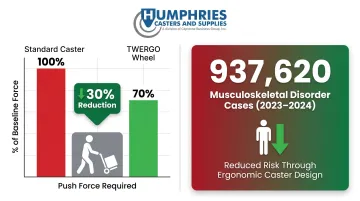
Caster Concepts serves automotive assembly environments where operators push carts hundreds of times per shift. For facilities tracking injury rates and workers' comp exposure, that 30% force reduction translates directly to measurable risk reduction.
Durable Superior Casters
Durable Superior's multi-facility footprint reduces shipping times and freight costs — a real advantage for procurement teams managing distributed facilities or urgent equipment repairs.
Faultless Caster
Faultless serves air cargo support applications where casters must handle extreme loads while protecting aircraft flooring — floor protection requirements in that environment are as strict as load ratings, which speaks to the engineering precision involved.
Darnell-Rose
Their 940P Series kingpinless casters handle up to 20,000 lbs per caster and serve logistics operations requiring rapid equipment repair turnaround.
| Specification | Details |
|---|---|
| Load Capacity Range | Up to 20,000 lbs per caster (940P Series kingpinless) |
| Key Industries Served | Logistics operations, hospitality, industrial distribution |
| Notable Differentiator | Same-day shipping capability; live caster expert consultation on every call; multi-brand distribution model |
For procurement teams managing time-critical repairs, Caster Technology's distributor model often beats direct manufacturer lead times — especially for off-hours or urgent orders.
How We Chose These Heavy-Duty Caster Manufacturers
These manufacturers were evaluated on US manufacturing or distribution presence, industry tenure, documented heavy-duty load capacity range, customization capability, and cross-industry client bases. Too many procurement teams select suppliers on unit price alone, overlooking load rating accuracy, floor compatibility, and lead time reliability — all of which drive real costs over time.
Critical procurement factors tied to business outcomes:
- Load rating accuracy — prevents premature failure and unplanned downtime
- Wheel material choice determines floor protection and rolling resistance
- Swivel geometry directly affects push/pull force and long-term operator fatigue
- Warranty coverage, product trials, and blanket order programs reduce total cost of ownership
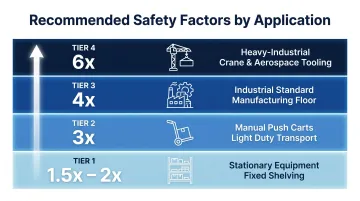
Industry guidance recommends a minimum 4x safety factor for industrial procurement — not the 1.5x–2x commonly cited in standard procurement guides. CasterHQ's engineer-reviewed guidance specifies 2x for stationary equipment, 3x for manual carts, 4x as the industrial standard, and up to 6x for heavy-industrial crane loading or aerospace tooling.
Applying these factors across a multi-facility program isn't straightforward. Distributors like Humphries Casters — serving major clients in consumer goods, grocery, and heavy trucking since 1988 — help procurement teams navigate manufacturer selection, evaluate products before large commitments, and match parts across manufacturers to simplify sourcing at scale.
For regulated environments, compliance standards matter:
- NSF/ANSI 2 governs minimum food protection and sanitation requirements for food handling equipment casters
- NSF/ANSI 59 applies specifically to mobile food carts
- Healthcare facilities should specify sealed bearings, non-marking wheels, and antimicrobial materials based on facility infection control policies
Conclusion
Selecting a heavy-duty caster manufacturer directly impacts equipment uptime, floor integrity, worker safety, and long-term operational costs. Brand recognition alone doesn't justify procurement decisions. Performance data and application fit do.
Before finalizing supplier relationships, make sure to:
- Request load test documentation and product samples before committing
- Confirm lead time commitments in writing for both standard and rush orders
- Ask about scalable programs — blanket orders and bulk pricing for ongoing needs
- Test products in your actual operating environment, since spec sheets rarely surface compatibility issues
For procurement teams needing guidance sourcing from top US caster manufacturers, Humphries Casters in Cincinnati, OH has been solving industrial caster challenges since 1988. Contact them at Service@HumphriesCasters.com or 800.733.4758 for product trials, competitive pricing, and expert application support.
Frequently Asked Questions
What is the weight limit for caster wheels?
Weight limits vary by caster type. Light-duty casters handle under 500 lbs per caster, medium-duty up to 2,000 lbs, and heavy-duty industrial casters range from 2,000 to 44,000+ lbs. Match your caster rating to your application — see the load capacity question below for how to calculate the right spec.
What is the best material for heavy-duty casters?
Forged steel and cast iron provide maximum load capacity for non-floor-sensitive settings. Polyurethane handles high loads while protecting floors and reducing noise. Nylon works well for high-load, dry environments. Material choice depends on floor type, load requirements, and environmental conditions like moisture or temperature extremes.
What caster wheels won't damage floors?
Polyurethane and rubber wheel materials protect floors due to their softer durometer ratings. Harder materials like cast iron or phenolic can crack or gouge flooring and should only be used on reinforced industrial floors or rail tracks. For sensitive flooring, specify non-marking polyurethane with appropriate hardness ratings.
What is the best caster for outdoor use?
Pneumatic (air-filled) or solid rubber wheels absorb shock on uneven terrain, making them ideal for outdoor applications. Stainless steel or zinc-plated caster frames resist moisture and corrosion in outdoor environments. Consider wheel diameter—larger wheels roll more easily over debris and rough surfaces.
How do I calculate the right caster load capacity for my application?
Start with total load weight (equipment plus maximum payload), then divide by three — this accounts for one caster potentially losing contact on uneven floors. Multiply by a safety factor: 3x for manually pushed carts, 4x for standard industrial use, and up to 6x for heavy-industrial or aerospace environments.
What is the difference between a swivel and rigid caster for heavy loads?
Rigid casters move in a fixed direction, providing stability and preventing unwanted drift under heavy loads. Swivel casters rotate 360 degrees for maneuverability. Most heavy-duty setups pair two swivel casters at one end with two rigid at the other, balancing steering control with directional stability.