Introduction
Most warehouses have enough space — they just don't use it well. The right shelving accessories can transform how your facility uses the square footage it already has, without a single expansion or renovation. Many warehouse managers install standard shelving and stop there, missing the performance gains that purpose-built accessories unlock. According to industry data, up to 50% of a picker's time is spent simply traveling between locations, and a poorly designed warehouse layout is a leading factor causing operational delays.
This guide covers how to select, configure, and use Husky shelving accessories in real warehouse conditions — with practical recommendations for improving space utilization, cutting pick times, and tightening daily operations.
Key Takeaways
- Husky shelving accessories—dividers, bin clips, label holders, post extenders, and wire liners—work together and configure to match specific warehouse workflows
- Before purchasing, assess your warehouse layout, inventory types, weight loads, and workflow patterns to determine which accessories deliver the most impact
- Installation follows a logical sequence: plan your layout first, then build up from base shelving to accessories, loading, and labeling
- The biggest gains come from vertical expansion with post extenders, compartmentalization with dividers, and visual management with label holders
- Audit and reconfigure accessories as SKU counts or picking patterns shift—static setups become inefficiencies over time
When Should You Use Husky Shelving Accessories in Your Warehouse?
Accessories are not an afterthought—they're most valuable when introduced during initial shelving setup, during a facility reorganization, or when current shelving is causing picking errors, wasted motion, or safety issues.
Accessories are the right solution when you have:
- High-SKU environments needing clear compartmentalization to prevent mis-picks
- Warehouses with underused vertical space and ceiling clearance to take advantage of
- Facilities with shifting inventory that requires reconfigurable shelving
- Operations where mislabeled or mixed product is a recurring problem
Even well-intentioned setups can fall short, though. Accessories are often underused or misapplied when:
- Facilities install shelving once and never revisit the configuration
- Teams mix incompatible accessories across shelving brands
- Operations scale up SKU count without adding dividers or labeling systems
That gap between capability and execution is exactly why timing matters. With 45% of companies planning to invest in racks and shelving over the next 12 months, optimizing what you already have with the right accessories delivers measurable gains — fewer mis-picks, less wasted motion — before you ever add a square foot of space.
What You Need Before Getting Started
Space and Load Assessment
Measure available floor-to-ceiling height, aisle widths, and calculate expected weight per shelf bay before selecting accessories like post extenders. Undersized components are a safety risk. Husky shelving models have specific capacities:
- Model N2W772472W4B (77" Wide): 2,500 lbs per shelf
- Model N2W902490W5B (90" Wide): 1,800 lbs per shelf
- Model N3R482478W5R (48" Wide): 1,000 lbs per shelf; 5,000 lbs total unit capacity
Compatible Base Shelving
Confirm the Husky shelving units on-site are compatible with the accessory line being purchased. Not all Husky accessories are universal across every shelving series. Manufacturer documentation states that add-on shelves like the HBR7824W-1 fit only specific 77" wide units and cannot be used to connect two separate units.
Basic Tools and Hardware
Most Husky shelving accessories require only basic hand tools, but heavier add-ons like post extensions may have specific fastener requirements — confirm these before installation. Keep two compliance points in mind:
- Tool requirements: Check manufacturer specs for torque or fastener specs on post extensions and structural brackets
- OSHA 1910.176(b): Materials stored in tiers must be stacked, blocked, and limited in height to remain stable and secure against collapse
An industrial distributor like Humphries Casters can help facilities identify the right accessory combinations and flag compatibility issues before ordering.
How to Set Up and Use Husky Shelving Accessories Step by Step
Accessory configuration works best when it follows a defined sequence. Start with layout, then purchase—not the other way around.
Assessment and Planning
Map your warehouse floor plan before ordering anything:
- Identify zones by inventory type: fast-moving vs. slow-moving SKUs, bulk vs. small parts, hazardous vs. standard goods
- Calculate vertical capacity by measuring ceiling clearance
- Note bays where post extenders can add shelf levels without expanding the footprint
Installation and Configuration
Install in this sequence to avoid rework:
- Base shelving frame — set it first and level it before anything else
- Structural accessories — post extenders and shelf liners, if needed
- Organizational accessories — dividers and bin clips
- Label holders — install last, once shelf positions are finalized
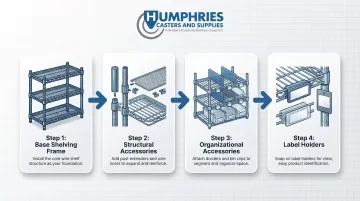
Critical installation rules:
- Install support hooks on wire decks — skipping this step risks collapse under heavy loads
- Distribute weight evenly across each level; keep heaviest loads on bottom shelves
- Mount the unit to a wall or floor using anti-tip hardware to prevent tip-overs
Common installation errors to avoid:
- Overtightening wire shelf clips (which can warp the shelf wire)
- Installing dividers without accounting for product dimensions
- Attaching label holders to shelves that will be repositioned frequently
Loading and Organizing Inventory
Once accessories are in place, load shelves this way:
- Heaviest items on lower shelves
- Dividers set to exact product width, not approximated
- Label holders filled before inventory is stocked—not after
Bin clips and wire shelf liners work together to create defined pick slots for small parts, reducing mis-picks and improving pick speed in high-volume order fulfillment environments. Operators using visual picking systems can gain 5 to 30 seconds per transaction, primarily through reduced search time.
Those time savings compound quickly across high-volume shifts—which makes regular monitoring just as important as the initial setup.
Monitoring and Reconfiguring
Watch for these warning signs during regular warehouse audits:
- Dividers migrating out of position
- Overloaded shelf bays (visually bowing wire)
- Label holders with outdated or missing labels
- Uneven wear on components (a sign of unbalanced loading)
Review and adjust your accessory layout whenever any of these conditions occur:
- SKU count in a zone increases by more than 20%
- A picking route changes
- A new product category is introduced
Configurations that go unreviewed tend to drift—small inefficiencies accumulate until they're costing real pick time and labor.
Where Husky Shelving Accessories Make the Biggest Difference in a Warehouse
Receiving and Staging Areas
Receiving and staging areas get the most value from mobile shelving configurations — provided the setup falls within manufacturer specifications. Units that roll out of the way during unloading reduce congestion and move product from dock to shelf faster.
Picking Aisles
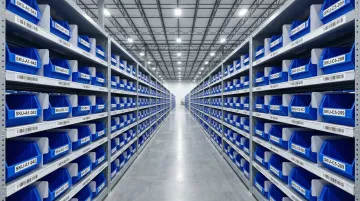
Picking aisles benefit most from dividers, bin clips, and label holders — accessories that directly cut pick times and reduce misfills. According to WERC's 2022 DC Measures report, best-in-class operations reach order-picking accuracy of ≥99.68%, compared to ~99.20% for median performers. That gap adds up fast in high-volume environments.
Overflow and Archive Storage
Overflow and archive storage benefit most from post extenders. Husky post couplers connect bottom and top posts to reach standard factory heights — typically 72 to 78 inches — so you add capacity by going up rather than out.
MRO and Parts Rooms
Parts rooms, MRO supply areas, and assembly-line staging see the sharpest improvements from Husky accessories. Inventory variety is high, and a missed or wrong pick can stall a production line. Highly organized MRO systems can boost productivity by 77% and push pick accuracy to 99.7%, according to Kardex — numbers that matter when downtime is expensive.
Best Practices for Getting Consistent Results from Husky Shelving Accessories
Four practices separate warehouses that get lasting value from their shelving accessories from those that don't:
- Standardize by zone, not by shelf. Mixing accessory configurations across the same zone increases training time and raises the risk of misplaced inventory. Uniform visual markers keep workers oriented and picking accurately.
- Put label holders on every bay — not just primary pick locations. Before buying inserts, confirm which label format (color-coded, alphanumeric, or barcode-compatible) your warehouse management system supports. Color-coding picking locations has been shown to accelerate order picking by up to 17.28%.
- Schedule quarterly accessory audits. Wire liners, dividers, and bin clips degrade under heavy use. Replace them before they fail — OSHA enforcement cases repeatedly cite deflected columns and damaged stanchions as precursors to collapse and struck-by incidents.
- Reconfigure as inventory changes. A shelving setup optimized for last year's SKU mix is rarely right for this year's. Build in a review cycle that matches your replenishment or season-change schedule.
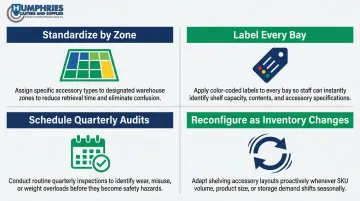
Discipline in maintenance and periodic reconfiguration is what separates a well-organized warehouse from one that was organized once.
Frequently Asked Questions
What types of Husky shelving accessories are most useful in a warehouse setting?
The most impactful accessory categories for warehouse use include post extenders for vertical storage expansion, dividers and bin clips for inventory compartmentalization, and label holders for visual management. These accessories work together to increase SKU density, reduce search times, and improve picking accuracy.
How much weight can Husky shelving accessories support in an industrial environment?
Weight capacities vary strictly by model and require evenly distributed loads. For example, the N2W772472W4B supports 2,500 lbs per shelf, while the N3R482478W5R supports 1,000 lbs per shelf with a maximum concentrated load of 125 lbs per square foot. Always consult manufacturer specifications and factor in total bay weight before loading.
Can Husky shelving accessories be used with other shelving brands?
Most Husky accessories are designed specifically for Husky shelving dimensions and post sizes. Cross-brand compatibility should always be verified before purchasing to avoid fit issues. Using incompatible accessories can compromise structural integrity and create safety hazards.
How often should I reconfigure Husky shelving accessories as my warehouse needs change?
Conduct a formal review at least quarterly and any time inventory mix, SKU count, or picking workflow changes significantly. Accessories should evolve with operations—not remain static—so your shelving keeps pace with how your facility actually works.
Are Husky shelving accessories suitable for heavy-duty industrial warehouse applications?
Husky offers industrial-grade shelving lines rated for heavier loads, and selecting the correct shelving series (not just accessories) is critical for heavy-duty applications. Always consult the product specifications or a knowledgeable supplier before purchasing to ensure the system meets your load requirements and safety standards.
What is the easiest way to expand existing Husky shelving without buying new units?
Post extenders are the most cost-effective expansion path, allowing facilities to add shelf levels vertically on existing frames. Before extending, confirm ceiling clearance and load limits. Any non-standard vertical expansion should also be reviewed by a storage rack design professional and securely anchored.