You need caster wheels that support your equipment, keep workers safe, and maintain workflow efficiency. But selecting casters based only on size or cost leads to preventable failures, wheels that deform under heavy loads, noisy rolling on sensitive floors, or mounting that simply doesn’t fit.
There is no single “best caster.” There is only the best caster for a specific application, based on weight, environment, movement, and mounting requirements. Choosing wrong leads to downtime, floor damage, ergonomic strain, and safety incidents.
This guide breaks down the essential engineering factors that define caster performance and reliability so that you can specify the right product with confidence.
Need to know
There is no universal “best caster”; the right choice depends on weight, movement, environment, and mounting requirements.
Load capacity must be calculated using the three-caster rule to ensure safety and prevent overload on uneven floors.
Installation success relies on precise mounting compatibility, stem or bolt pattern errors lead to immediate failures.
Industry-specific applications require tailored caster engineering, from healthcare to cold storage to heavy manufacturing.
Replacing all casters together prevents uneven wear, better load distribution, and safer handling.
Early signs like noise, push-force increase, and wheel deformation indicate it’s time for a system upgrade.
Working with a specialized caster supplier reduces guesswork, improves ergonomics, and extends equipment lifespan.
What Defines the Best Casters?
There is no universal standard for “best.” The ideal caster is the one engineered to match the exact workload, floor conditions, and movement requirements of your equipment. When these specifications align, casters deliver reliable mobility, reduce strain on operators, and protect facility surfaces.
Knowing what defines a high-performance caster is only the first step. The next step is understanding which technical factors most directly impact mobility, safety, and lifespan.
The Critical Factors That Determine the Best Casters
Each caster must be selected based on how the equipment is used, how much weight it carries, and what conditions it operates in every day. These eight engineering factors determine whether a caster will deliver reliable mobility or become a maintenance problem.
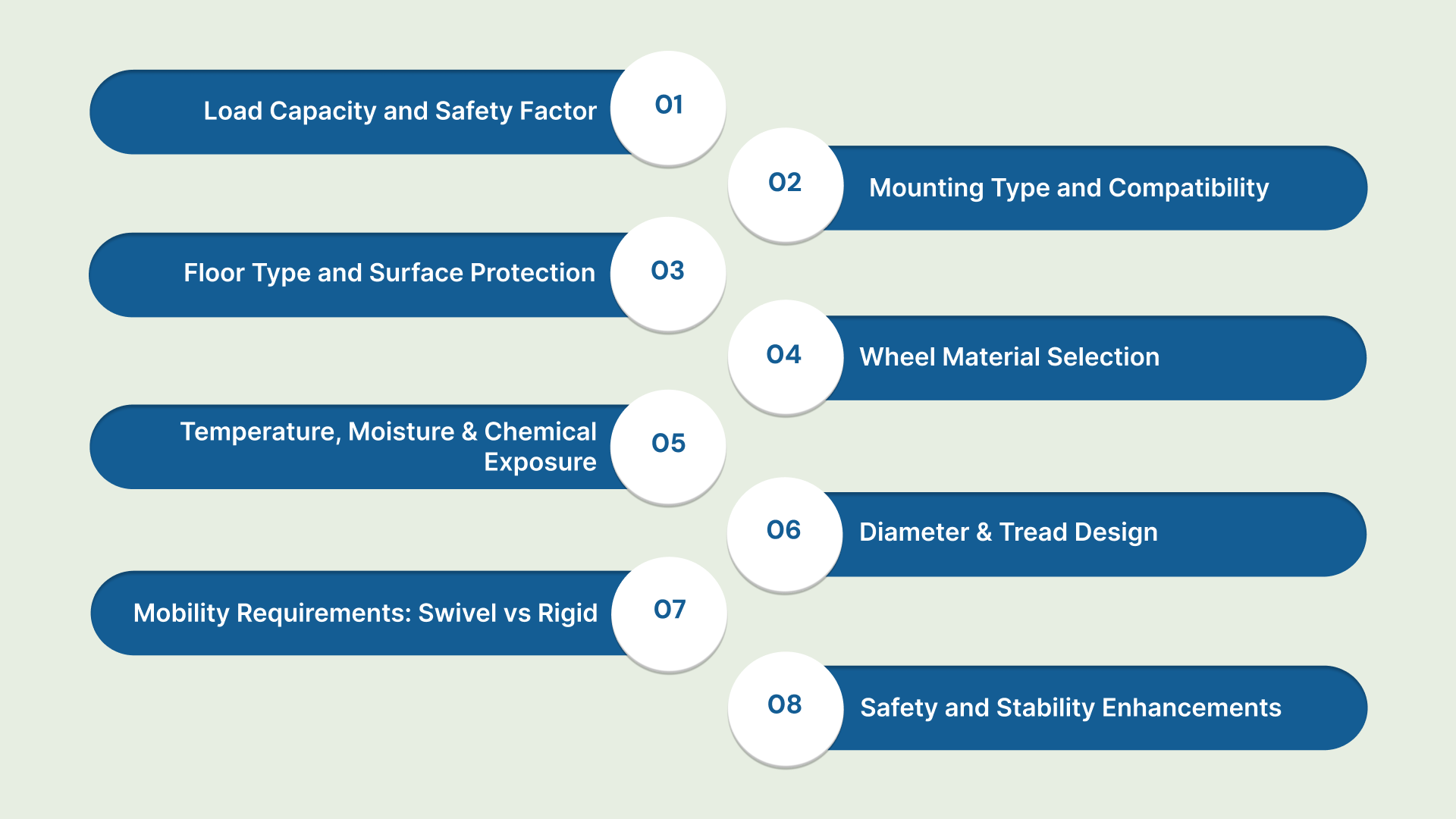
1. Load Capacity and Safety Factor
Casters must support both static weight (when the equipment is still) and dynamic weight (when the equipment is moving). Real-world operation means weight shifts, and equipment often rests on only three wheels at a time.
Rule: (Total equipment weight + max load) ÷ 3 = Minimum load per caster
Using a three-caster safety factor prevents bearing collapse, wheel deformation, and instability on uneven floors.
2. Mounting Type and Compatibility
Mounting mismatch is the most common cause of installation failure.
You must match:
Top plate bolt-hole spacing
Stem diameter, length, and thread pitch
Overall mounting height
If even one measurement is wrong, the caster cannot install properly, causing delays and rework.
3. Floor Type and Surface Protection
Floors dictate wheel composition:
Soft floors (vinyl, tile, epoxy): need non-marking protection
Rough concrete: needs high-durability tread
Sensitive surfaces: require shock absorption and low noise
Selecting the wrong wheel leads to costly floor repairs, vibration issues, and higher push/pull force.
4. Wheel Material Selection
Each material is engineered for different performance conditions:
Polyurethane: durable and versatile across mixed surfaces
Rubber: quiet and protective for healthcare or retail
Nylon: economical for light-duty on smooth floors
Phenolic: ideal for moisture and cold storage environments
Cast Iron: best for extreme heat and heavy-duty loads
Material must match the weight, floor, and environment for longevity.
5. Temperature, Moisture & Chemical Exposure
Environmental stress changes wheel behavior.
Examples:
Polyurethane cracks in freezing temperatures
Rubber swells in cleaning chemicals
Nylon warps in high humidity
Applications like bakeries, freezers, and chemical plants require specialty-rated casters.
6. Diameter & Tread Design
Size impacts performance:
Larger diameter → easier rolling over gaps & debris
Wider tread → better stability under load
Narrower tread → tighter turning and agility
Wrong geometry means operator fatigue and higher ergonomic risk.
7. Mobility Requirements: Swivel vs Rigid
Movement pattern determines placement:
Swivel casters enable 360° maneuverability
Rigid casters maintain controlled linear paths
Incorrect combinations cause handling issues, especially during directional changes.
8. Safety and Stability Enhancements
Critical when equipment must lock or stay grounded:
Total lock brakes (wheel + swivel)
Directional locks for long travel paths
Anti-static wheels for electronics environments
Noise-control wheels to maintain quiet zones
These features must align with the use case, not be added as an afterthought.
Choosing the Right Caster Material for Your Application
Wheel material directly affects how a caster performs, including durability, floor protection, rolling resistance, and environmental tolerance. When the wrong material is used, wheels wear out quickly, damage floors, and require more operator effort to move equipment.
Use the table below to identify which material is best suited for your operating conditions:
Best For | Recommended Material | Key Benefits | Considerations |
Heavy loads & long travel | Poly-on-Iron / Cast Iron | Highest strength and durability | Noisy; may mark floors |
Quiet, floor-safe operation | Soft Rubber | Low noise; protects polished surfaces | Wears faster under heavy use |
Mixed flooring (most warehouses) | Polyurethane | Non-marking; good grip; ergonomic | Hardens in freezing temperatures |
Wet or chemical environments | Phenolic / Stainless Hardware | Moisture and chemical resistance | Hard tread may mark soft floors |
Cold storage / freezers | Cold-rated Polyurethane / Phenolic | Maintains performance in low temps | Requires correct floor pairing |
High-heat environments | Cast Iron / High-temp Compounds | Heat-resistant; handles extreme use | Loud; rougher on floors |
Light-duty + budget-focused | Nylon | Low-cost and easy-rolling | Not suitable for heavy or uneven floors |
Selecting based on material alone is not enough. The material must be aligned with both operational and environmental conditions.
Not sure which caster is the best fit for your equipment? Get expert support from Humphries Casters to ensure you select the right specifications the first time.
Additional Strategies to Avoid Costly Caster Selection Mistakes
Even when the right specifications seem obvious, buyers often face preventable issues once equipment goes into service. These challenges usually stem from assumptions made early in the purchasing process. The right strategy won’t just help you choose casters, it will help you avoid operational headaches later.
Avoid these common mistakes to protect performance and budget:
Selecting based on price instead of lifecycle cost: Cheaper casters degrade faster, creating more downtime and higher long-term spend.
Assuming a “same size” caster will match perfectly: Minor height or mounting differences lead to unstable loads and misalignment.
Overlooking ergonomics and push force: Even correctly sized wheels can strain workers if rolling resistance is too high.
Replacing individual casters instead of full sets: Mixing worn and new wheels causes uneven wear and unpredictable movement.
Skipping real-route evaluation: Ramps, transitions, and debris quickly expose wheel limitations that specs don’t reveal.
No documentation for procurement consistency: Standardizing proven specifications prevents mismatched purchases across locations.
These mistakes are easy to avoid, and correcting them keeps your facility safer and more efficient.
When performance begins to drop, it’s important to identify the right time to replace your casters before failure disrupts operations.
Industry-Specific Best Caster Recommendations
Every industry places different demands on mobility. A caster that performs well in a hospital may fail quickly in a warehouse. Matching caster design to the operating environment ensures safer, smoother, and more efficient equipment movement.
Below is a quick reference guide to help align common industry needs with the most suitable caster type:
Industry / Application | Recommended caster Type | Why It Works |
Warehousing & Material Handling | Polyurethane swivel + optional brakes | Strong load support, low rolling resistance on mixed floors |
Manufacturing & Heavy Equipment | Poly-on-iron or Cast Iron | Handles maximum weight and continuous duty cycles |
Healthcare & Laboratory | Soft Rubber with Total-Lock | Quiet mobility and secure equipment positioning |
Food Production & Washdown Areas | Stainless hardware with moisture-resistant wheels | Withstands chemicals, cleaning agents, and sanitization |
Cold Storage & Freezers | Phenolic or Cold-rated Polyurethane | Maintains rigidity and performance at low temperatures |
Hospitality & Retail Fixtures | Non-marking Rubber or Polyurethane | Protects decorative floors and keeps noise low |
High Heat Environments (bakeries/ovens) | Cast Iron / High-temp compounds | Ideal for thermal exposure and heavy loads |
Electronics & Data Centers | Anti-static / Conductive wheels | Prevents static discharge that can damage equipment |
Struggling with caster failures, noise, or push-force issues? Browse our caster wheel catalog to find wheels engineered to solve your mobility challenges.
When to Upgrade Your Caster System
Casters rarely fail all at once; performance declines gradually, often creating unnoticed risks. Replacing casters at the right time protects productivity and worker safety. Look for these signs:
Higher push/pull force required: Rolling resistance increases as bearings wear or wheels deform, causing ergonomic strain.
Swivel wobble or imprecise tracking: Loose swivel bearings reduce steering control and can lead to sudden instability under load.
Wheel tread defects such as flat spots, cracks, or chunking. These indicate material fatigue and risk of sudden failure.
Uneven wheel rotation or cart leaning: Height variations overload specific casters, accelerating damage and compromising balance.
Noticeable vibration or noise when rolling: A sign of internal bearing deterioration or wheel surface hardening.
Floor scuffs, gouges, or deterioration: Incorrect or worn wheel material begins damaging the flooring, often more costly than replacement casters.
Recurring breakdowns or adjustment needs: Frequent troubleshooting means the current caster specification is not suitable for the application.
Early action prevents downtime, avoids floor repair costs, and ensures mobility remains safe and efficient. The quickest way to avoid costly mismatches is to collaborate with a supplier who understands your industry’s mobility challenges, like Humphries Casters.
How Humphries Casters Helps You Select the Best Casters
Every application has unique mobility challenges. Humphries Casters ensures equipment is supported by wheels that fit correctly, roll efficiently, and last longer.
Our performance advantages include:
Consultative Engineering: We assess weight, mobility patterns, and floor surfaces to specify the correct caster.
Custom Manufacturing: For non-standard plate patterns, stem sizes, or environmental conditions, we produce parts precisely matched to your equipment.
Ergonomics-Focused Solutions: Reduced push/pull force lowers operator fatigue and incident risk.
Reliable Sourcing Network: Access to trusted global suppliers ensures product consistency and compliance with industry standards.
We help you avoid costly misfits and repetitive maintenance problems. If you're replacing casters due to premature wear, uneven rolling, or floor damage, it's time for a smarter specification.
Final Words
Caster performance depends on making the right specification decisions, aligned with how the equipment truly operates day-to-day.
Whether you’re replacing a single set or standardizing mobility across an entire facility, expertise matters. Investing in the right casters today prevents downtime, protects your people and infrastructure, and delivers measurable ROI across your operation.
Need help determining the best casters for your application? Get in touch with Humphries Casters for accurate specifications and reliable caster solutions tailored to your operation. Contact our team; we are ready to support your mobility challenges with components that are built to perform and engineered to last.
FAQs
1. What are the best casters for heavy-duty industrial equipment?
Poly-on-iron and cast-iron casters offer maximum durability and load capacity, especially for manufacturing and material handling.
2. Which casters work best for hospitals or clean environments?
Soft rubber or medical-grade polyurethane casters with total lock systems provide quiet mobility and stable positioning.
3. How do I know if caster material is suitable for my floor?
Evaluate floor hardness, moisture exposure, and whether marking is acceptable. Polyurethane is a reliable multi-floor option.
4. Why is push/pull force important when choosing casters?
High rolling resistance causes strain and injury. Low-resistance wheels improve ergonomics and compliance with safety standards.
5. What should I consider for casters used in freezer or cold-storage environments?
Select phenolic wheels or cold-rated polyurethane, which maintain integrity at low temperatures without cracking.