Introduction
In food processing plants and medical facilities, the wrong caster choice can trigger recalls, regulatory sanctions, or patient safety incidents. Standard casters that rust, shed particles, or harbor bacteria in unsealed bearings create liabilities that far exceed their purchase price. When FDA inspectors audit your facility or health departments review your HACCP plan, non-compliant casters become Exhibit A in any enforcement action.
The regulatory environment is tightening. Since the FDA Food Safety Modernization Act (FSMA) shifted enforcement from reactive to preventive controls under 21 CFR Part 117, equipment surfaces, including casters, must be cleanable and must not become contamination sources.
The global caster wheel market reached $8.1 billion in 2024, with the medical/healthcare segment growing at approximately 9% annually, driven by stricter hygiene mandates and facility expansion.
This guide profiles the top 10 US-based manufacturers and distributors of food and medical-grade stainless steel casters. Each entry covers the compliance markers, material specifications, and purchasing considerations that separate genuinely compliant products from standard industrial casters simply labeled "stainless steel."
Key Takeaways
- Stainless steel casters (304 or 316 grade) are mandatory in environments requiring corrosion resistance, chemical washdowns, and hygiene compliance
- Food-grade and medical-grade certifications (NSF/ANSI listings, FDA-compliant materials) are not automatic—most stainless steel casters lack them
- Leading manufacturers pair corrosion-resistant construction with sealed bearings, non-porous wheels, and verified third-party certifications
- Key selection criteria: steel grade, wheel tread material, bearing seal design, and documented NSF or FDA compliance
- Humphries Casters has supplied hospitals, long-term care facilities, and food-sector clients nationwide since 1988, with product trials available
What Makes a Stainless Steel Caster Food-Grade or Medical-Grade?
Stainless Steel Grade: 304 vs. 316
Two grades dominate food and medical caster applications, and choosing the wrong one can mean a failed audit or a corroded component.
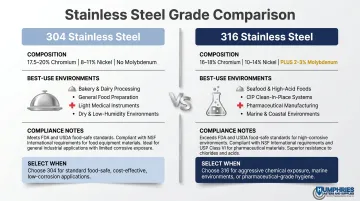
304 Stainless Steel contains 17.5–20% chromium and 8–11% nickel with no molybdenum. It handles general corrosion well—bakeries, dairy processing, standard food prep—and meets FDA and NSF/ANSI 51 requirements for moderate exposure conditions.
316 Stainless Steel adds 2–3% molybdenum, which sharply increases resistance to chloride-induced pitting and crevice corrosion. That addition makes 316 the required grade in:
- Seafood processing and high-salt environments
- Acidic food applications (citrus, tomato)
- Aggressive CIP systems using chloride-based sanitizers
- Marine and pharmaceutical settings
According to materials engineering standards, the molybdenum content is the critical differentiator when washdown conditions turn corrosive.
Selection Rule: Specify 316 SS for any facility using chloride-based sanitizers, processing high-salt or acidic foods, or operating in marine/pharmaceutical environments. Use 304 SS for general food service, bakery, and light medical applications.
Compliance Certifications That Matter
A caster labeled "stainless steel" without certification documentation may not meet food or medical-grade standards. Three compliance frameworks govern this space:
| Framework | What It Covers | What to Request |
|---|---|---|
| NSF/ANSI 2 & 51 | Food equipment design, materials, and finishes | Actual NSF listing number — not a self-declaration |
| FDA 21 CFR 174–178 | Indirect food additives, polymers (wheel treads), lubricants | Material declarations citing specific CFR sections |
| ISO 13485 (Clause 7.4) | Medical device purchasing controls at the OEM level | Supplier audits and documentation from caster vendors |
Wheel Tread Material Compliance
A stainless steel frame alone is insufficient—the wheel material must also be non-porous, chemical-resistant, and free of additives that can leach into food or medical environments.
Food-grade polyurethane must be verified against 21 CFR Part 177. It's non-porous, chemical-resistant, and easier to sanitize than rubber, which can absorb contaminants over time. Thermoplastic rubber (TPR) and polypropylene are FDA-compliant for dry or mildly wet zones.
Avoid: Standard industrial rubber, zinc-plated steel wheels, or any material without documented FDA compliance.
Sealed Bearings: Non-Negotiable for Washdown
Open bearings fail under high-pressure washdown conditions. Above 80 bar, grease is forced out of open bearings, creating an immediate contamination risk. Sealed stainless steel ball bearings with NSF H1-registered food-grade grease are the industry standard. Reject any specification that doesn't include sealed bearings for washdown applications.
Surface Finish Standards
For food-contact environments, surface roughness should be Ra 0.8 micrometers or less. Standard mechanical polishing produces Ra 1.6 micrometers, which may fail audit. Electropolishing achieves the required smoothness and eliminates microscopic crevices where bacteria colonize.
Top 10 Stainless Steel Caster Manufacturers in the US – Food and Medical Grade
The following manufacturers were selected based on stainless steel product specialization, documented food or medical industry use cases, certifications, and reputation in the US market.
Humphries Casters
Founded in 1988 and headquartered in Cincinnati, OH, Humphries Casters serves industrial, medical, and food-sector clients nationally, including the #1, #2, and #3 long-term care organizations in America and several top-ranked hospitals. The company's differentiator is sourcing hard-to-find stainless steel caster configurations and supporting both MRO buyers and OEM procurement teams.
Humphries also extends warranty coverage beyond the manufacturer's standard terms—useful when validating a new caster specification against washdown protocols or demanding load cycles.
| Attribute | Details |
|---|---|
| Stainless Steel Grade Available | 304 and 316 SS configurations with stainless steel bearings for corrosion resistance |
| Key Industry Applications | Medical carts, hospital beds, nursing home equipment, food service and commercial kitchen equipment, dietary carts |
| Purchasing Programs | Blanket orders, bulk discounts, product trials, samples for evaluation—nationwide service from Cincinnati, OH |
](https://file-host.link/website/humphriescasters-8dr3vb/assets/blog-images/c747be02-265d-4c65-ab19-2c6686cf2acd/1778144295224259_590fb1f1246d48d5915535f05b101bd9/360.webp)
Contact: 800.733.4758 | Service@HumphriesCasters.com
Colson Group (including Medcaster and Jarvis Casters)
Colson Group traces its roots to 1885 and operates as the largest caster manufacturer globally, with brands including MedCaster (medical focus), Jarvis (foodservice focus), Faultless, Shepherd, and Albion. The company's scale means broad distribution availability and deep product catalogs.
Jarvis Casters, founded in 1929, offers NSF-listed stainless steel caster series (S30, S34, S36, S40) with polished 304 stainless steel, Grade 440 stainless steel ball bearings, and antimicrobial additives certified by FDA, EPA, and NSF for foodservice and medical use.
MedCaster positions itself as the hospital mobility specialist ("If it moves in a hospital, we move it"). Key products include antimicrobial TPR wheels with EPA, FDA, EU, and NSF-registered compounds proven in hospital use for over 25 years, and sterilizer-rated wheels engineered for 280°F autoclave cycles.
| Attribute | Details |
|---|---|
| Notable Sub-Brands | Medcaster (medical), Jarvis (foodservice/hospitality), Shepherd (institutional) |
| Key Certifications | Jarvis: NSF-listed S30/S34/S36/S40 series; MedCaster: EPA/FDA/NSF-approved antimicrobial compounds |
| Best-Fit Application | Hospital beds, IV stands, medication carts, commercial kitchen equipment, food transport carts, autoclaves |
Hamilton Caster
Founded in 1907 in Hamilton, OH, Hamilton Caster is a family-owned manufacturer specializing in heavy-duty and custom-engineered solutions. The company offers six stainless steel caster series with capacities ranging from 325 lbs (STL series) to 3,200 lbs (SS Champion CHS series).
Hamilton's stainless steel lines are marketed for food processing plants, pharmaceutical factories, and sanitary/corrosive environments requiring washdown operations. Hot-forged swivel sections with CNC-machined raceways provide durability under demanding loads. Same-day and next-day PRONTO delivery is available for stocked items.
| Attribute | Details |
|---|---|
| Specialty | Heavy-duty and custom-engineered stainless steel casters (up to 3,200 lbs capacity) for industrial and institutional use |
| Key Certifications/Compliance | Marketed for food processing and pharmaceutical environments; specific NSF listings not publicly documented |
| Best-Fit Application | Food processing equipment, heavy institutional carts, medical transport equipment, pharmaceutical facilities |
Caster Concepts
Founded in 1987 and headquartered in Albion, MI, Caster Concepts is a US manufacturer specializing in ergonomic and heavy-duty casters. The company's divisions include Aerol (aluminum casters) and Reaction Industries (custom polyurethane formulation), enabling in-house wheel material customization.
Caster Concepts' stainless steel lines (Series 51 and 55, 900-1,500 lbs capacity) are engineered for washdown environments, food processing, and pharmaceutical cleanrooms. The company emphasizes ergonomic design that reduces push/pull force—a measurable benefit in facilities where operators move heavy loads repeatedly throughout a shift. ISO 9001:2015 certified.
| Attribute | Details |
|---|---|
| Specialty | Ergonomic and heavy-duty stainless steel configurations with custom polyurethane formulation capability |
| Key Certifications/Compliance | ISO 9001:2015; products designed to meet NSF and FDA requirements for food and pharmaceutical zones |
| Best-Fit Application | Food production lines, pharmaceutical facilities, institutional medical environments, cleanrooms |
RWM Casters
Founded in 1935 and headquartered in Gastonia, NC, RWM Casters is the original inventor of the kingpinless caster design, now known overseas as the "American-style caster." The kingpinless design eliminates a common failure and contamination point by removing the traditional kingpin, distributing stress more evenly across the swivel section.
RWM's S45 stainless steel casters are explicitly listed for food and beverage, medical, pharmaceutical/laboratory, and hospitality applications. Features include patented neoprene swivel seals for moisture and debris resistance—critical in washdown environments.
| Attribute | Details |
|---|---|
| Specialty | Kingpinless stainless steel casters for high-demand food, beverage, and pharmaceutical environments |
| Key Certifications/Compliance | Marketed for food, medical, and pharmaceutical use; specific NSF/FDA documentation not publicly listed |
| Best-Fit Application | Food and beverage processing, pharmaceutical manufacturing, medical laboratories, heavy-duty institutional use |
Service Caster Corporation
Headquartered in West Reading, PA, Service Caster operates as a large-scale distributor with an online superstore model. The company distributes 316 stainless steel casters described as meeting FDA requirements for food processing environments, with explicit labeling for commercial, institutional, hospitality, food service, and pharmaceutical usage where washdown is required.
Service Caster also distributes MedCaster products (Colson Group) for hospital and pharmaceutical settings, as well as DuraStar catalog products. For MRO buyers, the multi-brand catalog means common replacement sizes are typically available without long lead times.
| Attribute | Details |
|---|---|
| Specialty | Broad stainless steel caster catalog with 316 SS options and multi-brand distribution (MedCaster, DuraStar) |
| Key Certifications/Compliance | 316 SS products labeled as meeting FDA requirements; certification responsibility traces to original manufacturers |
| Best-Fit Application | Food prep areas, medical equipment carts, washdown environments, MRO replacement casters |
Faultless Caster
Founded in 1889 in Nebraska, Faultless Caster is one of the earliest US caster manufacturers and now operates as part of the Colson Group family of brands. Faultless stainless steel casters are available through distributors for medical and food service applications.
Documented products include stainless steel swivel casters (350 lbs capacity, grey crowned polyurethane wheel) and rigid casters (900 lbs capacity, white polypropylene wheel), both described as ideal for medical and food service environments. Procurement teams working within established Colson Group distribution agreements can access Faultless alongside MedCaster and Jarvis products through a single vendor relationship.
| Attribute | Details |
|---|---|
| Specialty | Stainless steel casters for medical, institutional, and light industrial use (part of Colson Group portfolio) |
| Key Certifications/Compliance | Marketed for medical and food service; specific certifications not publicly documented on brand site |
| Best-Fit Application | Medical equipment, nursing home carts, food service applications, institutional settings |
Durable Superior Casters
Founded in 1991 by Mark and Lily Chang, Durable Superior operates 6 assembly plant warehouses in North America (Texas, Ohio, Washington, California, Canada, Mexico) totaling over 600,000 square feet. The company operates the largest caster testing facility in North America.
Durable Superior's DuraStar brand offers NSF-certified stainless steel casters that are 100% washable and resistant to rust, abrasion, grease, and most cleaning solvents. The S30 and S34 Series (304 stainless steel, up to 1,250 lbs capacity) and the 28 Series (NSF Medical Grade Caster) are explicitly designated for food service and healthcare applications. Geographically distributed assembly supports faster lead times across the US compared to single-location manufacturers.
| Attribute | Details |
|---|---|
| Specialty | NSF-certified stainless steel casters with geographically distributed assembly for fast lead times |
| Key Certifications/Compliance | DuraStar NSF-certified S30/S34 Series (food service) and 28 Series (NSF Medical Grade Caster) |
| Best-Fit Application | Food service, pharmaceutical facilities, healthcare equipment, MRO replacement casters |
All States Casters
Founded in 1990 and headquartered in Austin, TX, All States Casters explicitly positions itself as a food processing specialist. The company states: "Through working closely with food processing facilities, we learned that stainless steel casters were the only option that could deliver the performance and reliability these environments demand."
All States uses a hybrid sourcing model combining domestically available stainless steel options with high-quality imported casters from European manufacturers. Brackets are highly polished AISI 304 stainless, with 316 stainless steel available for the harshest operating conditions. Wheel tread materials include Superlan Polyurethane, Everlast Polyurethane, and high-temperature bakery wheels in soft and hard treads.
| Attribute | Details |
|---|---|
| Specialty | Stainless steel casters purpose-built for food processing and food retail environments, including high-temperature bakery casters |
| Key Certifications/Compliance | References meeting rigorous sanitation protocols; specific NSF/FDA certification numbers not publicly listed |
| Best-Fit Application | Food processing lines, cold storage, grocery and food retail, bakery ovens, washdown environments |
Caster Connection
Headquartered in Columbus, OH, Caster Connection identifies as a manufacturer and "Caster Solutions Expert" providing consultation-driven product selection. The company offers multiple stainless steel product lines tailored to food processing, pharmaceutical, laboratory, and institutional applications.
Key products include POBS (polyurethane wheel, corrosion/hydrolysis resistant, up to 194°F, ~1,000 lbs capacity) for medical use, TPA (thermoplastic rubber elastomer, non-marking, low noise) for food processing, and stainless steel lines for pharmaceutical and laboratory environments. The company also publishes technical guidance on high-temperature stainless steel caster selection for food processing equipment—useful for procurement teams evaluating temperature and chemical resistance requirements.
| Attribute | Details |
|---|---|
| Specialty | Innovative stainless steel caster designs with consultation-driven selection and distribution access to national brands |
| Key Certifications/Compliance | Marketed for food and medical compliance; specific certifications not publicly documented on product pages |
| Best-Fit Application | Medical facilities, commercial kitchens, pharmaceutical labs, specialty industrial environments |
How We Chose the Best Stainless Steel Caster Manufacturers
Generic caster rankings often miss the critical distinction between standard stainless steel and truly food/medical-grade casters. The biggest procurement mistake buyers make is assuming all stainless steel casters are interchangeable. They're not.
A caster labeled "stainless steel" without certification documentation may have incomplete weld penetration that traps organic residue, surface roughness (Ra 1.6 micrometers) that exceeds food-grade requirements (Ra 0.8 micrometers or less), or industrial grease instead of NSF H1-rated lubricant.
Industry compliance guides confirm that using 304 SS in high-chloride environments where 316 is required leads to pitting corrosion. Pairing a compliant SS bracket with a non-compliant wheel material voids overall system compliance.
Selection Criteria Tied to Business Outcomes
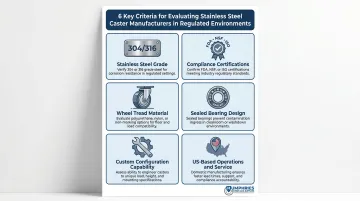
These compliance gaps shaped how we evaluated each manufacturer. Six factors directly determine whether a caster supplier can support regulated environments — or just sells metal on wheels:
1. Stainless Steel Grade (304 vs. 316): Does the manufacturer clearly differentiate grades and guide buyers to the correct specification for their chemical exposure profile?
2. Compliance Certifications: Are NSF/ANSI 2, NSF/ANSI 51, or FDA material compliance (21 CFR Parts 177/178) documented with listing numbers, or does the manufacturer rely on generic "meets standards" claims?
3. Wheel Tread Material Compatibility: Wheel materials must be FDA-compliant, non-porous, and chemically resistant — and documentation should be readily available.
4. Sealed vs. Open Bearing Design: Do stainless steel casters for washdown environments include sealed bearings with NSF H1-registered grease?
5. Custom Configuration Capability: The manufacturer should support hard-to-find configurations, non-standard load requirements, and specialty mounting options.
6. US-Based Operations and Service Reliability: Are lead times predictable? Are product trials or samples available? Is post-purchase technical support accessible?
Geographic and Service Factors
Three manufacturers in this list (Colson/MedCaster, Jarvis, Faultless) are part of the same parent company, Colson Group. Buyers seeking genuine supply chain diversification should factor in this concentration risk before committing to multiple suppliers from the same group.
Several manufacturers offer product trials or samples — worth prioritizing when validating caster performance under actual washdown protocols, floor conditions, and load cycles before committing to volume orders. For facility managers in regulated environments where contamination risk carries real cost, trial programs reduce the chance of a costly specification error.
Conclusion
In food processing and medical environments, caster selection is a compliance and safety decision with direct consequences for hygiene, regulatory standing, and operational continuity. The right stainless steel caster manufacturer must align with your facility's hygiene standards, load requirements, cleaning protocols, and regulatory framework—whether that's FDA FSMA requirements, NSF certification for foodservice equipment, or ISO 13485 purchasing controls for medical device manufacturing.
Before finalizing a supplier, run through these verification steps:
- Request the actual NSF listing number — not a self-declaration
- Review material data sheets confirming FDA compliance for wheel treads and lubricants
- Evaluate operational fit: washdown frequency, floor surface type, chemical exposure profile, and load cycles
A stainless steel caster that fails prematurely under your facility's conditions is not compliant, regardless of what the spec sheet claims.
Humphries Casters has served hospitals, long-term care facilities, and food-sector clients since 1988. They stock hard-to-find stainless steel configurations, offer product trials to validate performance before purchase, and provide practical guidance on NSF and FDA compliance requirements. Nationwide service, competitive pricing, and programs tailored for both MRO and OEM customers are available.
Contact Humphries Casters: 800.733.4758 | Service@HumphriesCasters.com
Frequently Asked Questions
What type of casters are best?
For food and medical environments, stainless steel casters (304 or 316 grade) with food-grade wheel materials (polyurethane or non-porous rubber) and sealed bearings are the right choice. They offer corrosion resistance, easy cleanability, and compliance with hygiene standards. The optimal spec depends on your specific application and washdown frequency.
Are rubber or polyurethane casters better?
Polyurethane is generally preferred in food and medical settings because it is non-porous, chemical-resistant, and easier to sanitize. Rubber can absorb contaminants over time, making it a poor fit for hygiene-critical environments. Floor surface and load capacity should also factor into the final selection.
What is the difference between 304 and 316 stainless steel casters?
304 SS offers general corrosion resistance suitable for most food and light medical environments. 316 SS adds 2-3% molybdenum for superior resistance to chlorides and harsh sanitizing chemicals. Specify 316 for pharmaceutical, seafood processing, or aggressive washdown applications.
Do stainless steel casters need to be NSF certified for food environments?
NSF certification is required or strongly recommended for casters on equipment that contacts or is near food. Verify NSF/ANSI compliance requirements for your specific operation type and local health code, as an NSF listing number provides audit-defensible documentation during inspections.
Can stainless steel casters be used in wet or washdown environments?
Yes, stainless steel casters are built for wet and washdown environments, but sealed or precision bearings are essential to prevent water infiltration and bearing corrosion. Open bearing designs will fail prematurely under regular washdown and create contamination risk.
How do I know if a caster is truly food-grade or medical-grade?
Request NSF listing numbers, FDA-compliant material declarations (referencing 21 CFR Parts 177/178), and manufacturer compliance statements before purchasing. A "stainless steel" label alone does not confirm food or medical-grade compliance — also verify that lubricants carry NSF H1 registration.