In workshops and industrial floors, equipment on wheels moves fuelled by convenience, and if unchecked, by risk. Whenever a loaded cart, tool cabinet, or mobile workbench shifts unexpectedly, it isn’t just inconvenient. It invites accidents, misalignment, damage, or downtime.
Castors Online notes that using proper locking casters “provides enhanced stability and safety,” avoiding accidental movement under load. That’s why locking casters aren’t just optional hardware; they’re a smart safety investment.
In this guide, you’ll learn how to choose the best locking casters, match them to real load and floor demands, and avoid expensive trial-and-error mistakes.
At a Glance:
Locking casters balance mobility and stability — essential for safe positioning of heavy equipment in workshops and industrial environments.
Choose based on real load, vibration, and floor conditions, not catalog specs or wheel size alone.
Total-lock casters offer the highest stability, while wheel-lock and swivel-lock serve different movement control needs.
Heavy-duty PU and pneumatic locking casters solve challenges with weight, uneven floors, and vibration.
When locks aren’t enough, add stability measures like floor locks, leveling feet, or diagonal lock placement.
What Are Locking Casters?
Locking casters are caster wheels equipped with a built-in locking mechanism that stops movement when engaged, keeping equipment securely in place. Unlike standard casters that roll and swivel freely, locking casters provide controlled mobility, allowing heavy equipment to move when needed, then stay fixed and stable during use.
They’re designed for environments where precision positioning, safety, and load stability are essential, such as workshops, manufacturing floors, warehouses, tool stations, and mobile machinery setups.
To understand why they’re different, here’s how locking casters compare to regular casters:
Feature | Regular Casters | Locking Casters |
Movement Control | Always free-rolling and swiveling | Can lock wheel, swivel, or both for full stability |
Use Case | General movement and repositioning | Precise placement where the equipment must stay fixed |
Safety Under Load | Can shift due to vibration or accidental push | Holds equipment securely, prevents drift and tipping risk |
Operational Impact | Mobility only | Mobility + stability for safer, accurate work |
Common Applications | Light furniture, basic carts, office use | Workshops, industrial carts, workbenches, machinery |
Choosing locking casters for industrial or workshop use isn’t just about picking a wheel with a brake. The right choice depends on real operating conditions.
Key Selection Criteria for Industrial Locking Casters
Instead of focusing only on wheel size or brake style, the real decision comes down to how well the caster performs in your environment: under load, during vibration, and through repeated lock–unlock cycles. Choosing the wrong caster isn’t just inconvenient; it can compromise safety, stability, and equipment uptime.
Before selecting the best locking casters for your setup, evaluate how they’ll perform under actual working conditions, not just catalog specs.
Selection Factor | What to Look For | Why It Matters in Industrial Use |
Load Capacity (per caster, not total) | Rated capacity that exceeds the real working load | Prevents brake failure, wheel compression, and equipment instability under heavy or shifting loads |
Locking Mechanism Type | Wheel lock, swivel lock, or total lock based on task demands | Controls movement and rotation during precision work or vibration-heavy operations |
Wheel Material & Tread | PU, rubber, or steel-core PU, depending on floor & load | Ensures traction, floor protection, and smooth rolling without skidding or grinding |
Bearing Quality | Sealed precision bearings | Supports smooth movement under weight and reliable locking without drag or wobble |
Wheel Diameter | Larger diameter for heavy loads or uneven floors | Improves roll efficiency, reduces operator effort, and enhances stability |
Mounting Type & Hardware Strength | Heavy-duty plate mounts or reinforced stems | Prevents loosening, frame damage, or caster leg bending under industrial stress |
Brake Strength & Durability | Mechanism proven to withstand repeated lock/unlock cycles | Maintains safety and positional accuracy over long-term use |
Environmental Suitability | Heat, chemical, debris, or oil-resistant materials where needed | Avoids brake slip, tread breakdown, or lock failure in harsh environments |
Once you know what to evaluate, the next step is choosing the caster type that aligns with your equipment and workload.
Common Types of Locking Casters for Workshop/Industrial Use
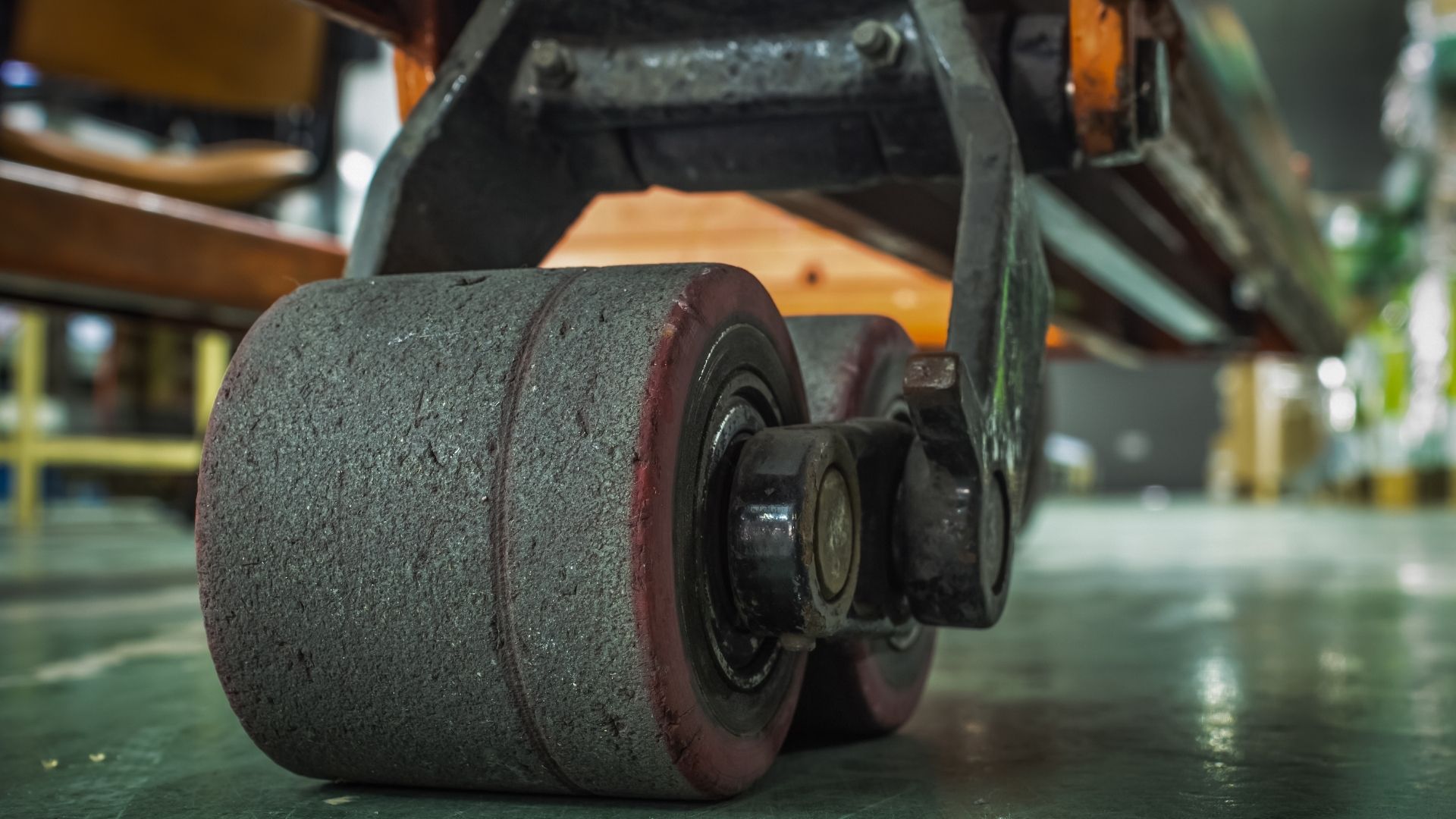
Not all locking casters deliver the same performance; different designs solve different stability problems, especially when dealing with vibration, uneven floors, or heavy static loads. The right type depends on how the equipment is used, how often it moves, and how much precision the task demands.
Here are the most practical options used across workshops, manufacturing floors, and industrial environments:
1. Total-Lock Casters (Wheel + Swivel Lock)
Total-lock casters secure both the wheel and the swivel rotation at the same time. When engaged, the caster becomes fully rigid, preventing any rolling or pivoting. This makes them one of the best locking casters for applications where absolute stability is required.
Best suited for
Workbenches for cutting, grinding, welding, or assembly
Precision equipment and calibration setups
Heavy industrial carts and tool cabinets that must stay fixed during use
Operational advantages
Maximum stability — equipment stays completely still, even under vibration, torque, or directional force
Accurate positioning — enables repeatable alignment and measurement without drift
Safer working environment — reduces the risk of movement injuries or equipment shift during load handling
Considerations
Slightly more expensive than basic wheel-lock casters, but pays off in safety & uptime
Requires proper load matching; under-rated casters can compromise lock strength
Ideal when priority is:
Precision, stability, vibration-resistance, and safe equipment anchoring during work tasks.
2. Wheel-Lock Casters (Brake on Wheel Only)
Wheel-lock casters stop the wheel from rolling but still allow the caster to swivel. They provide controlled stopping without fully locking rotation, offering a balance between mobility and basic stability.
Best suited for
Tool carts, rolling storage, portable shelving
Equipment that needs frequent repositioning and quick directional changes
Situations where full rigid locking isn’t necessary
Operational advantages
Fast lock/unlock action — ideal for high-movement workflows
Improves safety and control by preventing unintended rolling on flat or slightly uneven floors
Cost-effective stability without sacrificing maneuverability
Considerations
Not suitable for high-precision or vibration-heavy tasks, equipment can still swivel under load
Requires good floor traction to prevent sliding
Ideal when priority is:
Mobility first, stability second, easy rolling with simple stop control.
3. Swivel-Lock Casters
Swivel-lock casters allow the swivel mechanism to lock in a fixed direction while the wheel can still roll. This creates straight-line control for moving heavy loads without fishtailing or drifting, especially useful on long paths or uneven flooring.
Best suited for
Long workshop aisles, warehouse lanes, and production lines
Equipment that must move in controlled straight paths before locking in place
Heavy carts or machinery where directional control is difficult
Operational advantages
Improved steering accuracy when handling heavy or awkward loads
Prevents sideways drift on slopes, textured flooring, or vibration-prone areas
Reduces operator strain by controlling movement instead of fighting uncontrolled swivel
Considerations
Not a full locking solution, usually combined with wheel locks or total-lock casters on the same equipment
May require pairing (2 swivel-lock + 2 total-lock) for optimal control
Ideal when priority is:
Directional control, easier handling of heavy loads, and safer straight-line movement before stationary locking.
4. Heavy-Duty Pneumatic Locking Casters
Pneumatic locking casters use air-filled or foam-filled tires designed to absorb shock and roll smoothly over rough, uneven, or debris-covered surfaces. When locked, they stabilize equipment even in environments where rigid wheels would vibrate or bounce.
Best suited for
Workshops with mixed indoor/outdoor transitions
Industrial floors with expansion joints, gravel, cracks, or irregular surfaces
Heavy carts, generator stands, mobile machinery, and maintenance rigs
Operational advantages
Superior shock absorption during movement and while locked under vibration
Protects both equipment and load — less rattling, shaking, and impact stress
Improved traction on unfinished or textured floors
Safer in environments where standard casters may slide or chatter
Considerations
Not ideal for ultra-precise positioning tasks, slight tire flex under load
Requires pressure checks and ongoing maintenance
Ideal when priority is:
Smooth movement and stable locking on imperfect flooring, job sites, and rugged industrial paths.
5. Steel-Core Polyurethane Heavy-Duty Locking Casters
These casters use a steel or cast-iron core with a thick polyurethane tread, combining high load capacity with floor protection and secure locking performance. They’re engineered for heavy industrial equipment, machine bases, and static load scenarios where reliability is non-negotiable.
Best suited for
CNC machines, industrial tool cabinets, fabrication tables, production carts
Applications with long static load periods and vibration exposure
Environments where standard rubber or basic PU casters fail prematurely
Operational advantages
High load capacity with minimal deflection — holds heavy equipment securely without flattening or lock slippage
Durable long-life performance — resists wear, chemicals, oil, and heat
Stable locking under vibration — prevents micro-shift that affects precision work
Protects floors while supporting heavy loads
Considerations
Higher cost, but long lifespan and safety improvements often reduce total ownership cost
Must verify mounting hardware strength, not just wheel rating
Ideal when priority is:
Load security, vibration resistance, and long-term industrial durability.
Locking casters dramatically improve control and safety, but in some setups, wheel locks alone may not deliver the level of stability the task demands.
When Locking Casters Aren’t Enough: Additional Stability Measures
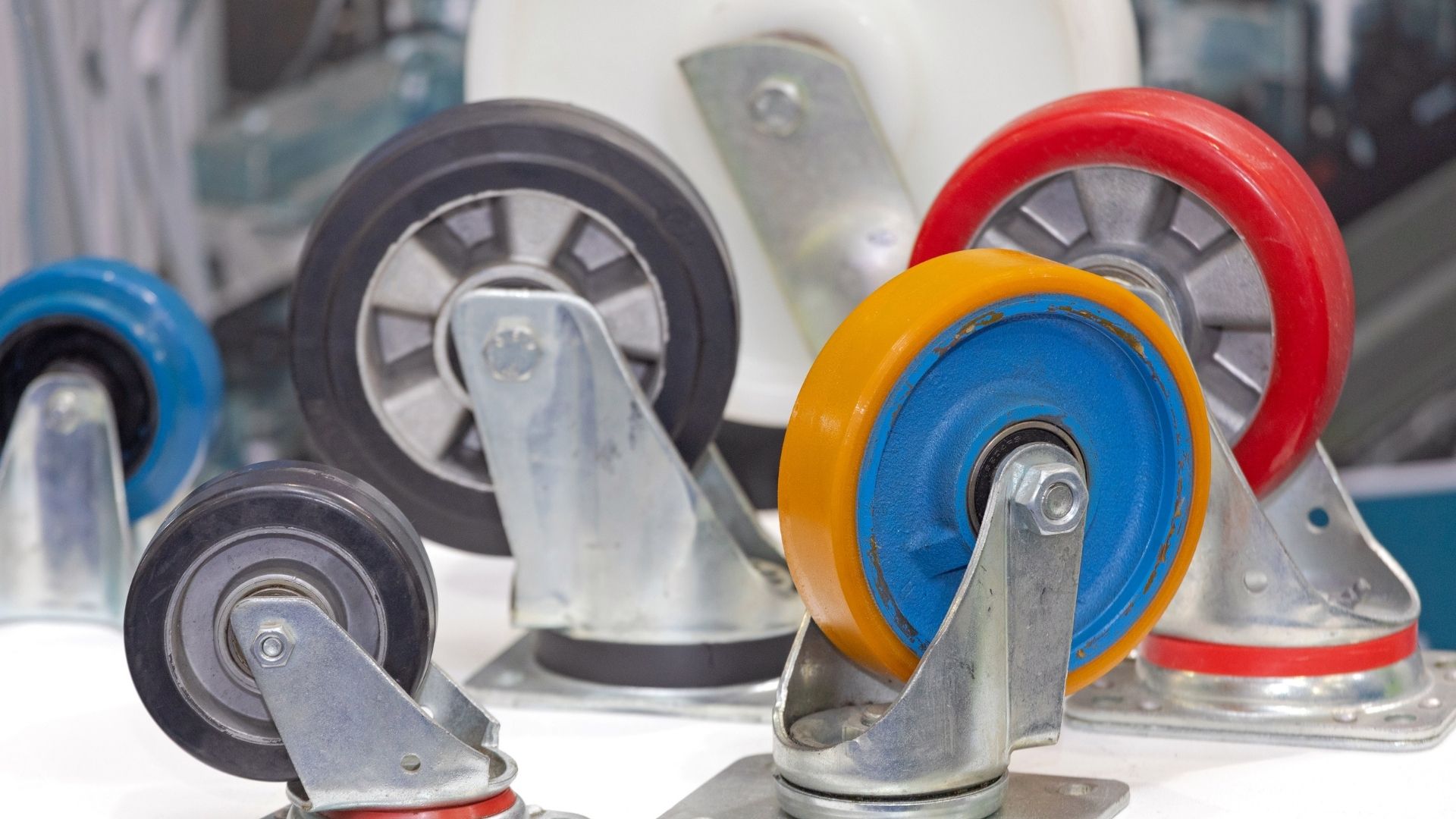
Even the best locking casters have limits. In these situations, the smartest approach is combining locking casters with additional stabilizing tools designed for static security rather than movement control. The goal isn’t just to stop rolling, it’s to eliminate every source of unwanted shift: vibration, floor flex, load imbalance, or directional force.
Here are practical add-ons that strengthen stability when locking casters alone won’t cut it:
Floor Locks — A mechanical foot pedal device that presses directly onto the floor to hold equipment firmly in place. Ideal when the load is too heavy for wheel locks alone to resist vibration or torque.
Leveling Feet / Adjustable Machine Pads — Used alongside casters to lift wheels slightly off the floor once positioned, completely removing movement and improving precision for machining, calibration, or measuring equipment.
Diagonal Locking Pattern (Caster Placement Strategy) — Using 2 total-lock casters diagonally instead of side-by-side distributes holding force more evenly and prevents twisting or pivot-shift under load.
Anti-Slip Floor Mats or Grip Pads — Increase surface friction and absorb shock on polished or coated floors where wheels may slide even when locked.
Hybrid Systems (Floor Lock + Total-Lock Casters) — Combine mobility and rigid anchoring for equipment repeatedly relocated but needing zero movement during use.
Wheel Chocks for Oversized Loads — Add physical blocking to stop directional drift on slopes or long workshop lanes where momentum can overpower built-in locks.
In most workshops and industrial settings, failures happen not because casters were low quality, but because they were misaligned with load demands, vibration levels, floor types, or safety expectations. That’s where expert guidance becomes the differentiator.
How Humphries Casters & Supplies Can Help

Humphries Casters supports buyers, operations managers, and workshop teams by helping translate real-world use cases into the right caster choice, not guesswork or catalog browsing. Instead of offering generic hardware, we provide application-specific recommendations built around safety, equipment longevity, and smooth workflow movement.
What You Can Expect From Humphries Casters
Material-specific recommendations based on load type, terrain, speed cycles, sanitation requirements, and usage frequency.
Extensive wheel selection, including polyurethane, urethane, and specialty compounds engineered for harsh or regulated environments.
OEM-equivalent and custom-manufactured options to ensure compatibility and eliminate modification delays.
Bulk and scheduled purchasing programs for multi-location facilities, warehouses, and high-cycle operations.
Proven expertise across industries including hospitals, food-processing, distribution centers, assembly lines, and transport logistics.
Reliable sourcing partnerships with access to hundreds of manufacturing facilities for rapid fulfillment and application testing.
Choosing locking casters shouldn’t be trial-and-error. If you need stability you can trust under real pressure, our team can help you select the setup that performs on the floor, not just on paper.
Wrapping Up
The best locking casters don’t just stop a wheel from rolling; they protect people, equipment, precision work, and uptime. If repositioning equipment feels unstable, if vibration causes drift, or if heavy loads overpower basic brakes, it’s a sign your casters aren’t aligned with real operating demands.
Upgrading to the right locking caster setup delivers immediate impact: safer workflows, more accurate work, and fewer equipment headaches.
Not sure which locking casters fit your environment and load profile? Reach out to us, and we’ll help you choose a solution built for real-world conditions, not guesswork.
FAQs
1. Do I need total-lock casters or are wheel-lock casters enough?
If your equipment must hold position during vibration, precision work, or heavy load, total-lock casters are the safer choice. Wheel-lock casters work well for carts and storage that move frequently and don’t need rigid stability.
2. Why do some locking casters still move even when they’re locked?
This usually happens when the caster is under-rated for the load, used on uneven flooring, or exposed to vibration. Sometimes the lock is strong, but the wheel material or placement causes drift.
3. How many locking casters should be used per piece of equipment?
At least two; typically diagonally placed. For heavy or precision equipment, all four may need locking or a hybrid setup with floor locks.
4. Are pneumatic locking casters good for indoor workshops?
Yes, if surfaces are uneven or shock absorption matters. They’re not ideal for tight precision work since tire flex can allow slight movement.
5. Can I mix different locking caster types on the same piece of equipment?
Absolutely, many industrial setups combine total-lock and swivel-lock or wheel-lock depending on handling direction and stability needs.