Introduction
In healthcare settings, caster selection affects patient safety, staff health, and equipment longevity in ways rarely seen in other industries. The choice between twin wheel and single wheel medical casters impacts staff injury rates, infection control compliance, patient comfort, and equipment service life.
The stakes are higher in medical facilities than anywhere else. Physical overexertion causes 35% of all work-related injuries in hospitals, with back injuries alone accounting for 20% of workplace incidents — and high-quality casters can reduce equipment push force by up to 50%. Beyond ergonomics, three additional requirements shape every caster decision:
- Infection control: surfaces must be smooth, sealed, and resistant to chemical disinfectants
- Noise control: patient ward environments must stay within WHO-recommended thresholds
- Load capacity: bariatric care requires specialized ratings that only certain caster configurations can meet
This guide breaks down the structural and performance differences between twin wheel and single wheel medical casters, provides facility-specific selection criteria based on load, floor type, and department requirements, and gives procurement teams a clear framework for matching caster specs to each equipment category.
TLDR
- Twin wheel casters distribute load across two side-by-side wheels, delivering superior stability, quieter operation, and reduced push force—making them the standard for hospital beds, stretchers, and bariatric equipment
- Single wheel casters offer a compact profile, simpler cleaning access, and lower upfront cost—best suited for lightweight IV poles, instrument carts, and utility trolleys
- Selection hinges on four variables: total load (including patient weight), floor type, movement frequency, and infection control requirements
- Neither type wins outright—match caster specs to each equipment category's specific demands
Twin Wheel vs. Single Wheel Medical Casters: Quick Comparison
| Factor | Single Wheel | Twin Wheel |
|---|---|---|
| Load Capacity | Lower per-caster rating; suited for lightweight equipment under 200 lbs per caster | Higher capacity due to dual-wheel distribution; required for hospital beds, stretchers, bariatric equipment |
| Stability | Single contact point increases tipping risk under shifting loads | Wider ground contact surface improves stability during patient transport |
| Maneuverability | Must pivot on itself when turning, creating floor friction and higher push force | Independent wheel rotation enables smoother directional changes with less staff effort |
| Noise Level | Can generate more rolling noise on hard floors depending on material | Dual-wheel rotation reduces vibration; TPR or PU treads achieve noise levels suitable for patient wards |
| Infection Control | Simpler structure with fewer crevices; easier to wipe down and sanitize | More surfaces between wheels require thorough cleaning; sealed bearings help mitigate contamination |
The numbers above tell part of the story — understanding the mechanics behind them explains why each design behaves the way it does.
How They Work
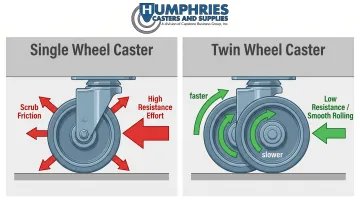
Single wheel casters feature one wheel mounted in a horn or yoke. When the caster swivels to change direction, the single wheel must "scrub" or pivot against the floor, creating friction and requiring more force to initiate movement.
Twin wheel (dual wheel) casters mount two wheels side-by-side on a single axle. The wheels rotate independently, creating differential action that reduces pivot friction. When turning, the two wheels spin at different speeds — cutting the effort needed to redirect heavy equipment.
What Are Single Wheel Medical Casters?
Single wheel medical casters feature one wheel per caster housing, available in swivel and rigid configurations with plate or stem mounting. "Medical-grade" designation means the wheel material and bracket construction are engineered to withstand chemical disinfectants and meet cleanroom standards—unlike standard furniture casters.
The core functional advantage: fewer moving parts and a streamlined design result in lower upfront cost and easier cleaning. This matters in infection-sensitive environments where every surface, including caster housings, must be sanitized regularly. A 2025 S2k clinical guideline requires all hospital bed components—including casters—to have smooth surfaces, be easy to dry, and resist disinfection procedures. Hollow bodies in caster assemblies must be reliably sealed and liquid-tight.
That streamlined design does come with a trade-off. A single contact point means the caster must pivot entirely on itself when changing direction, creating higher floor friction and typically requiring more push force—a real ergonomic concern for staff moving equipment dozens of times per shift.
Use Cases for Single Wheel Medical Casters
Single wheel casters are best suited for:
- IV poles and infusion pumps — non-marking semi-elastic rubber wheels run quietly across carpet, tile, and linoleum, with optional thread guards for sterile environments
- Lightweight instrument carts — low-maintenance construction and available locking mechanisms keep equipment secure during procedures
- Utility trolleys — non-abrasive wheels protect flooring while supporting stable supply transport
- Shower chairs — stainless steel or corrosion-resistant plastic holds up in wet environments; total lock keeps the chair stationary when needed
- Overbed tables — quiet, non-marking operation avoids disturbing patients and preserves room flooring
In larger diameters (6-8 inches / 150-200 mm), single wheel casters become the standard choice for patient transport stretcher chairs requiring long-distance transport through large facilities. The larger diameter provides smoother rolling over thresholds, elevator gaps, and cable covers.
What Are Twin Wheel Medical Casters?
Twin wheel medical casters (also called dual wheel or double wheel casters) mount two wheels side-by-side on a single caster fork, sharing the load between them. This dual-wheel design is the standard configuration for patient-bearing equipment in acute care, long-term care, and surgical environments because of superior stability and weight distribution.
Load Distribution Advantage
When load spreads across two wheels, each wheel experiences less stress. This reduces wear, extends caster lifespan, and lowers the risk of failure under dynamic loading conditions—such as a patient shifting weight on a hospital bed mid-transport. The difference matters: undersizing casters in high-cycle medical environments (50+ engagements per day) leads to bearing failure within 90 days and wheel deformation within 6 months.
Maneuverability and Ergonomics
Because each wheel can rotate at a different speed, twin wheel casters handle directional changes more fluidly. This directly reduces the push force required from healthcare staff.
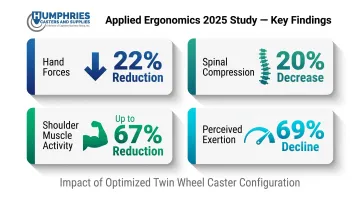
Research published in Applied Ergonomics (2025) found that manually pushing a 259.8 kg hospital bed produced mean hand forces of 51–111 N and peaks up to 231 N—regularly exceeding EN 60601-2-52 limits of 160 N (initial push) and 85 N (sustained motion). Spinal compression on ramps reached 4.1 kN, above NIOSH's 3,400 N safety threshold.
High-quality twin wheel casters cut these forces measurably. When a motorized drive wheel replaced one outer caster in the same study, results included:
- Hand forces dropped 22%
- Spinal compression decreased 20%
- Shoulder muscle activity fell up to 67%
- Perceived exertion declined 69%
Noise Performance
Twin wheel casters with TPR (thermoplastic rubber) or polyurethane treads minimize rolling noise, which matters for patient ward compliance. The WHO recommends average sound levels in hospital wards not exceed 30 dB LAeq during daytime and nighttime, with peak nighttime events below 40 dB Lmax. In practice, hospital noise typically reaches 50–70 dB daytime and 45–60 dB nighttime, with peaks hitting 80–90 dB.
Twin wheel casters sidestep the "scrubbing" friction single wheels generate against hard floors during turns. The main noise sources in caster systems are:
- Hard tread materials that don't absorb floor impact
- Loose raceways that create chatter during movement
- Missing wheel bearings that cause grinding under load
Key Limitations
- Higher cost per unit than single wheel
- Gap between wheels can trap debris and requires more diligent cleaning
- More complex bracket design
Use Cases for Twin Wheel Medical Casters
Primary applications include:
- Hospital beds (standard and bariatric-rated)
- Patient transport stretchers
- Medication and crash carts
- Imaging equipment carts
- Rehabilitation equipment
Long-term care facilities and high-traffic hospital departments rely on twin wheel casters because heavy equipment loads, constant repositioning by staff, and hard floor surfaces (tile or vinyl) all favor the dual-wheel design. Humphries Casters supplies these facilities directly—including the #1, 2, and 3 long-term care organizations in America and several top-ranked specialty hospitals—which gives the team firsthand visibility into what these environments actually demand from a caster.
Twin vs. Single Wheel Medical Casters: Which Is Right for Your Facility?
Getting this decision right comes down to four variables specific to your facility's operational demands:
- Total load weight (including patient weight if applicable)
- Movement frequency and distance traveled per shift
- Floor surface type
- Infection control and cleaning protocols specific to the department
Load Calculation Guidance
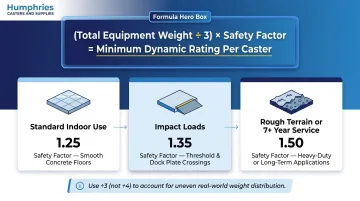
Calculate total load (equipment + patient + contents) and divide by 3—not 4—to determine minimum per-caster load rating. This N-1 method accounts for real-world uneven weight distribution where one caster periodically lifts off, redistributing the entire load to three casters.
Formula: (Total Equipment Weight ÷ 3) × Safety Factor = Minimum Dynamic Rating Per Caster
Safety factors:
- 1.25 for normal indoor use on smooth concrete
- 1.35 for impact loads (dock plates, thresholds)
- 1.5 for rough terrain or extended service life (7+ years)
When this calculation results in ratings exceeding 200 lbs per caster, twin wheel casters become necessary.
Department-Specific Guidance
Choose twin wheel for:
- ICU and surgical departments
- Patient transport and bariatric units
- Long-term care patient rooms
- Emergency stretchers
- Any patient-bearing equipment
Choose single wheel for:
- Lightweight supply carts
- IV poles and infusion pumps
- Utility stands in low-traffic areas
- Equipment moved infrequently and short distances
Floor Type Considerations
On hard hospital floors (vinyl composite tile or sealed concrete), softer twin wheel treads reduce both noise and floor marking:
| Wheel Material | Durometer | Contact Pressure | Rolling Resistance vs. 95A PU | Best Floor Types |
|---|---|---|---|---|
| TPR (Thermoplastic Rubber) | 65-75 Shore A | 60-100 psi | 40-50% higher | VCT (vinyl composite tile), linoleum, sealed concrete |
| Polyurethane | 90-95 Shore A | 150-250 psi | Baseline | Industrial epoxy, sealed concrete |
Critical insight: "Non-marking" does not equal "floor protective." A non-marking polyurethane wheel can still damage floors if its durometer is too high for the surface material. Floor damage correlates directly with contact pressure (load divided by contact area). See Humphries Casters' Durometer & Floor Protection guidance for the full breakdown.
For manual push applications using soft rubber/TPR, reduce capacity ratings by 50% to account for higher rolling resistance.
Bariatric Care Considerations
Standard load ratings apply to average-weight patients. Bariatric beds and transport equipment require higher per-caster ratings that only specific twin wheel configurations can meet. Bariatric hospital beds typically require specialized casters rated to 200 kg (440 lbs) or more per caster.
For reference:
- Standard hospital beds: 350-450 lbs safe working load
- Stryker Bari10A: 1,050 lb (476.3 kg) safe working load
- Stryker MV3: 1,102 lbs (500 kg) safe working load
A common procurement guideline is to select beds rated at least 50% above the patient's documented weight — this built-in margin protects both equipment longevity and patient safety.
Product Trials
Facilities evaluating a transition or new procurement can request product trials before committing to full purchase. Humphries Casters provides product samples for evaluation—especially valuable when outfitting multiple rooms or departments with a new caster type. Contact the team at 800-733-4758 or service@humphriescasters.com to arrange a trial.
Real-World Scenarios: Matching Caster Type to Facility Context
Scenario 1: Long-Term Care Facility Retrofitting Bed Casters
A 200-bed long-term care facility needs to replace casters across multiple patient floors. Total bed weight with patient averages 600 lbs. Using the divide-by-3 method: (600 ÷ 3) × 1.25 = 250 lbs minimum per caster. Twin wheel casters with 5-6 inch diameter (125-150mm), TPR tread, and a central locking mechanism are the appropriate choice.
Scenario 2: Hospital Outpatient Clinic Equipping Medication Carts
Lightweight medication carts weighing 80 lbs fully loaded travel short distances on VCT flooring. Calculation: (80 ÷ 3) × 1.25 = 33 lbs per caster. Single wheel casters with 3-4 inch diameter and TPR tread provide adequate capacity at lower cost while simplifying cleaning protocols.
Operational Failure Signals
Wrong caster choices reveal themselves through specific operational signals:
- Staff reporting high push force resistance – Indicates inadequate bearing quality or single wheel configuration on equipment requiring twin wheel
- Excessive noise complaints from patients or overnight staff – Hard tread materials, loose raceways, or absence of wheel bearings
- Premature wheel wear – Undersized load rating or wrong material for floor type
- Difficulty maintaining cleaning compliance around caster housings – Complex twin wheel assembly where single wheel would suffice
- Floor damage – Rubber treads reacting with floor polish to leave permanent marks, or hard wheels picking up debris that dents flooring

Conclusion
Twin wheel casters are the right choice when patient safety, load capacity, staff ergonomics, and frequent repositioning are primary concerns. Single wheel casters remain appropriate for lighter, less-demanding equipment where ease of cleaning and cost efficiency take priority.
Choosing the right caster type delivers measurable benefits across your facility:
- Reduces staff injury risk by lowering push/pull force requirements
- Extends caster service life by matching load ratings to real-world demands
- Maintains infection control compliance through appropriate wheel materials
- Supports patient safety standards across departments
Humphries Casters has supplied medical caster solutions since 1988, working directly with the #1, 2, and 3 long-term care organizations in America and several hospitals ranked #1 in their specialties — experience that translates directly into practical guidance for facilities like yours. Contact the team at 800-733-4758 or service@humphriescasters.com for product recommendations, technical specifications, or to arrange an evaluation trial.
Frequently Asked Questions
What are casters on a hospital bed?
Hospital bed casters are medical-grade swivel casters (most commonly twin wheel) designed to support the combined weight of the bed frame, mattress, and patient. A central locking mechanism lets staff secure all four wheels simultaneously with a single pedal, preventing unintended movement during patient transfers.
What are dual wheel casters?
Dual wheel (also called twin wheel or double wheel) casters feature two wheels mounted side-by-side on a single fork, sharing the load between them. This design provides improved stability, higher weight capacity, and smoother directional movement compared to single wheel configurations.
Which type of caster wheel is more durable?
Twin wheel casters tend to outlast single wheel casters under heavy or frequent use because load distributes across two wheels, reducing per-wheel stress and wear. Material quality—polyurethane vs. nylon vs. TPR—also significantly affects lifespan, with polyurethane offering the best balance of durability and floor protection.
Can you swap double wheel casters for single wheel casters on chairs?
It depends on mounting style (stem size and type), load requirements, and floor surface. The swap may be mechanically possible, but verify the chair's rated load capacity and confirm the new caster suits your floor type and cleaning protocols before making the change.
How do you know what size casters you need?
Divide the total load by 3 (for medical equipment), then apply a safety factor of 1.25–1.5. Choose a wheel diameter suited to your floor surface and threshold clearance, and confirm the stem or plate matches the equipment's existing socket.
Where should caster wheels be placed?
For most medical equipment, casters are placed at all four corners of the base to ensure even weight distribution. For longer equipment like hospital beds or stretchers, swivel casters typically go on the end that leads movement, with rigid casters (if used) at the opposite end for directional stability.