Introduction
Picture this: You're a small industrial distributor watching larger competitors win contract after contract, their branded product lines filling warehouse shelves while you're stuck reselling the same national brands as everyone else—at razor-thin margins. You know custom products would set you apart, but the idea of building a factory or hiring a product development team feels impossibly out of reach.
Private labeling changes that equation entirely. What was once the exclusive domain of retail giants like Costco and Amazon has become accessible to small businesses across industrial, commercial, medical, and facility sectors. 92% of B2B procurement leaders plan to purchase private-label products in the coming year, with expected volume increases of approximately 21% over the next three years.
The reason is straightforward: private-label products can carry about two times the gross margin of national brands.
This article breaks down what private label services are, the four main types, why they're transforming small business economics, the real challenges to watch for, and a practical five-step roadmap to get started on a limited budget.
TLDR:
- Private labeling lets small businesses sell branded products at margins 15-30 points higher than reselling national brands
- Four types exist (value, standard, premium, niche); premium and niche suit smaller players best
- Key risks include manufacturer dependency, inventory errors, and brand-building costs
- Start with market gap analysis, thorough manufacturer vetting, and conservative order quantities
What Are Private Label Services?
Private label services are a business arrangement where a third-party manufacturer produces goods to your company's specifications, and you sell those products under your own brand name. You don't own a factory, manage production lines, or hire manufacturing staff—the supplier handles all of that while you control branding, pricing, and sales strategy.
Private Label vs. White Label: The Critical Distinction
The terms are often confused, but the difference matters for your business model:
| Private Label | White Label | |
|---|---|---|
| Exclusivity | Made for one brand only | Sold to multiple retailers |
| Customization | Custom specs, packaging, features | Minimal or no changes |
| Competitive risk | Only you sell that exact product | Competitors may sell the identical item |
Private labeling also differs from branded manufacturing (designing and producing goods in-house) and contract manufacturing (outsourcing production while staying heavily involved in design and testing). Private labeling hands off most production complexity to the manufacturer, freeing you to focus on sales and customer relationships.
Beyond Retail: Industrial and B2B Applications
Private labeling isn't just for grocery stores. Several large industrial distributors generate significant revenue through their own private brands:
- Fastenal generates approximately 11% of consolidated sales from private brands
- W.W. Grainger reaches roughly 20% of sales through exclusive labels
- Medline operates roughly 190,000 private-label products across medical and surgical supplies
Concrete B2B example: An industrial equipment distributor sources casters and material handling components from a manufacturer, specifies custom load ratings and wheel materials, applies their own branding and packaging, then sells the finished product to factories and warehouses. The distributor never touches a production line but owns the customer relationship and captures significantly higher margins than if they simply resold a national caster brand.
Humphries Casters has worked with OEM clients on exactly this type of arrangement since 1988—helping them source custom casters and facility equipment components, from prototype through production, without the overhead of managing their own supply chain.
Types of Private Label Services
Understanding the four main private label types helps you position your offering strategically — rather than defaulting to a race-to-the-bottom price war.
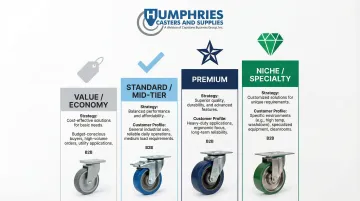
The Four Private Label Tiers
| Tier | Strategy | Best For | B2B Example |
|---|---|---|---|
| Value/Economy | Low-cost, high-volume alternative to national brands | Price-sensitive segments, commodity products | Basic disposable PPE, bulk janitorial supplies, standard fasteners |
| Standard/Mid-Tier | Quality matching national brands at 10-20% lower price | Mainstream buyers seeking value without sacrificing performance | Hand tools, HVAC filters, generic medical carts |
| Premium | Superior materials, features, or performance at higher price point | Quality-focused customers, specialized applications | Precision metalworking fluids, high-end diagnostic displays, specialized safety gear |
| Niche/Specialty | Unique attributes targeting specific segments | Differentiation through sustainability, certifications, or industry-specific features | Eco-friendly industrial cleaners, medical-grade components, biodegradable packaging |
Which Types Work Best for Small Businesses?
Small businesses typically succeed with premium and niche private labels rather than competing on volume with value-focused products. Why? Because differentiation matters more than scale when you're starting out.
According to AMA research on private label brandification, premium private labels captured 8.4% of total private label sales in the UK retail sector — evidence that customers across markets will pay more for exclusive quality. For a small industrial distributor, a premium line of chemical-resistant casters for pharmaceutical facilities builds stronger, longer-term customer relationships. Generic economy casters available from a dozen competitors cannot do the same.
That logic extends beyond physical commodity products too. Private labeling applies equally to branded facility equipment, industrial components, and customized supply-chain items. A small business might private-label powered carts, drum handling equipment, or specialized storage solutions — widening the opportunity well beyond consumer retail.
Why Private Label Services Are a Game-Changer for Small Businesses
The economics of private labeling fundamentally shift the playing field for smaller players. Here's why the model works so well when you're competing against larger, more established distributors.
Higher Profit Margins
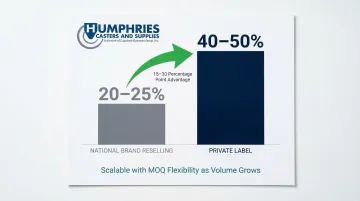
By sourcing through a private label manufacturer instead of reselling national brands, you eliminate middlemen and set your own pricing. Private-label products deliver margins 15 to 30 percentage points higher than national brands, with some distributors reporting gross margins above 40% compared to 35% for branded equivalents.
One distributor in a McKinsey case study increased gross margins from 35% to over 40% within 24 months by shifting just a portion of their catalog to private label. For a small business operating on tight cash flow, that margin difference can fund growth, cover staffing costs, or absorb slow periods without taking on debt.
Brand Ownership and Control
Private labeling gives you the ability to define your product's look, feel, quality level, and packaging without owning a manufacturing facility. This builds a distinct identity that customers associate directly with your business, not a third-party brand.
When a customer needs to reorder, they call you—not because you happen to carry a national brand they could buy elsewhere, but because your branded product solved their problem. At that point, you're no longer competing on price against other distributors carrying the same SKU. You own the relationship.
Faster Product Expansion
Manufacturer capabilities that already exist can expand your catalog in months, not years — letting you respond to demand signals or pilot new categories without a development team.
Risk reduction through sampling: Many manufacturers offer trial programs where you can test small quantities before committing to full production runs. This lets you validate demand with real customers using actual products, not just surveys or guesswork. If a new product doesn't gain traction, you haven't sunk capital into 10,000 units of dead stock.
Customer Loyalty and Repeat Business
Exclusive products only available through your business create more durable customer relationships. Buyers who value the product must return to you specifically, reducing the price-shopping behavior common with generic or nationally branded alternatives.
Once customers switch to a private label, they tend to be more loyal, according to BCG research. The initial conversion may take effort, but the payoff is repeat business with less churn and higher lifetime value.
Scalability Without Proportional Cost Increases
Private labeling lets you start with modest order quantities and scale up as demand grows, avoiding the capital risk of building manufacturing infrastructure. Many manufacturers offer flexible minimum order quantities (MOQs), allowing small businesses to test demand at low volume without committing six figures upfront.
As volume increases, per-unit costs drop through tiered pricing or negotiated production runs — without locking you into large inventory commitments before you've proven the market.
Key Challenges to Watch Out For
Private labeling isn't risk-free. Understanding where small businesses typically stumble helps you avoid expensive mistakes.
Manufacturer Dependency and Quality Control Risk
When you hand off production to a third party, any disruption—supply chain failures, production delays, or inconsistent output—directly affects your brand reputation. Your customers don't care that your manufacturer missed a deadline; they only know you failed to deliver.
Mitigation strategy: Vet manufacturers thoroughly before signing contracts. Request samples, ask for client references, and verify their quality systems (ISO 9001:2015 or ISO 13485 for medical products). For critical SKUs, consider dual-sourcing to avoid single-supplier dependency. Maintain control of product design and label templates so you can switch manufacturers if needed without losing your brand identity.
Building Brand Recognition Takes Time and Investment
Consumers and B2B buyers accustomed to established national brands may hesitate to try an unknown private label. 76% of B2B buyers initially select private labels because they're less expensive, not because they trust the brand. Earning that trust takes deliberate effort.
Mitigation strategy: Build credibility through consistent execution:
- Develop a clear brand story tied to a specific customer problem you solve
- Budget for samples and customer education materials during the launch phase
- Plan for longer sales cycles — 12-24 months before volume becomes reliable
- Accept that occasional stockouts are better than sitting on six months of slow-moving inventory
Inventory Forecasting and Dead Stock Risk
Without the sales history that comes with established brands, small businesses risk overestimating demand and ending up with unsold inventory that ties up capital. 46% of SMBs report that 5% or more of their inventory is dead stock.
Start conservatively: Launch with limited SKU ranges and modest order quantities. Use actual sell-through data to guide your next production run, not optimistic projections. It's better to stock out occasionally and reorder than to sit on six months of unsold inventory eating up cash and warehouse space.
How Small Businesses Can Get Started with Private Labeling
Follow these five steps in order. Each one builds on the last — and skipping ahead is where most first-time private labelers lose money.
Step 1: Identify a Market Gap and Choose a Product Category
Conduct research into what your existing customers need, where national brands are overpriced or underperforming, and what unique angle your business can offer. This informs both product selection and positioning.
Start by answering these four questions:
- What products do customers frequently request that you don't currently carry?
- Where are national brands charging premium prices for commodity features?
- What pain points do customers mention repeatedly that existing products don't solve?
- Which product categories align with your expertise and customer base?
Use customer feedback, competitor analysis, and industry trends to narrow your focus. Don't try to private-label your entire catalog at once—pick one or two high-potential categories and prove the model works before expanding.
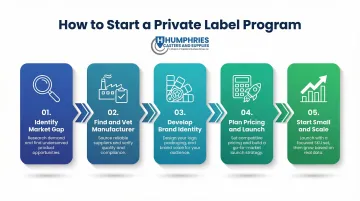
Step 2: Find and Vet the Right Manufacturer
Look for partners with proven quality controls, transparent communication, flexible minimum order quantities, and the ability to scale. Request samples, ask for references, and review past client work before signing contracts.
For industrial or commercial markets, consider suppliers already experienced with OEM partnerships and custom solutions. These manufacturers understand production to custom spec and can handle custom materials, load ratings, or certifications your customers require.
Vet every potential manufacturer against these criteria before signing anything:
- Valid quality certifications (ISO 9001, ISO 13485 for medical products)
- Financial stability and capacity to meet your volume as you grow
- Clear protocols for change management and quality deviations
- Transparent communication and responsiveness during the quoting process
- Willingness to provide samples and pilot runs before full production
For facility and equipment-related products, Humphries Casters has worked with OEM clients since 1988 on prototypes, competitive production pricing, and custom sourcing — the kind of hands-on support that matters when you're navigating your first private label run.
Step 3: Develop Your Brand Identity
Before products hit the market, define your brand's name, visual identity, packaging design, and value proposition. Ensure these are legally protected through trademark registration and that contracts with your manufacturer include nondisclosure and IP ownership clauses.
At minimum, you need:
- A distinctive name and logo that differentiate you from national brands
- Packaging that communicates quality and professionalism
- A clear value proposition: why should customers choose this over established brands?
- Trademark registration for your name and logo
- Contracts that explicitly assign all IP and design rights to you
The legal protections aren't optional. Lock them down before production starts.
Step 4: Plan Your Pricing, Logistics, and Launch
Calculate all-in costs including manufacturing, shipping, storage, packaging, and marketing. Set pricing that reflects your brand positioning and desired margin, then build a rollout plan that includes customer education and a feedback loop to refine future orders.
Your all-in cost calculation should include:
- Manufacturing cost per unit
- Shipping and freight (international if applicable)
- Storage and warehousing
- Packaging and labeling
- Marketing and customer acquisition
- Desired gross margin (target 40–50% for private label)
Build a launch plan that includes sample programs, customer testimonials, and clear messaging about why your private label offers better value or performance than alternatives. Plan to gather feedback systematically—surveys, follow-up calls, or direct conversations—so you can refine specifications and address issues before your next production run.
Step 5: Start Small, Measure, and Scale
Launch with a limited SKU range, gather customer feedback, monitor sell-through rates, and use real data to guide your next production run. Private labeling's flexibility is one of its greatest strengths for small businesses that need to manage risk while building momentum.
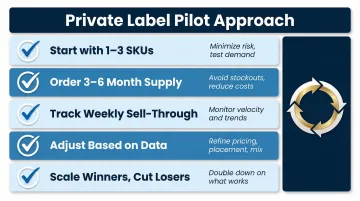
Pilot approach:
- Start with 1-3 SKUs in your highest-potential category
- Order conservative quantities (enough for 3-6 months based on realistic projections)
- Track weekly sell-through rates and customer feedback
- Adjust specifications, pricing, or positioning based on real-world performance
- Scale up successful products and discontinue underperformers quickly
The goal isn't perfection on day one—it's learning fast, iterating based on data, and building a repeatable process you can apply to additional categories as you grow.
Frequently Asked Questions
What are private label services?
Private label services involve a third-party manufacturer producing goods to your business's specifications, which you then sell under your own brand name. You control branding, pricing, and customer relationships without owning a factory or managing production.
Are private label services legal?
Yes, private labeling is entirely legal and widely practiced by businesses of all sizes, from small retailers to global corporations. Products must comply with applicable industry regulations, labeling requirements, and consumer safety standards for your sector.
What are the types of private labels?
The four main types are value (low-cost alternatives), standard (matching national brand quality at lower prices), premium (superior features or materials at higher price points), and niche/specialty (targeting specific segments like eco-friendly or medical-grade products).
How is private label different from white label?
Private label products are custom-made exclusively for one brand, meaning only you can sell that exact product. White label products are generic items sold to multiple businesses who rebrand them with minimal changes, so competitors may sell something identical.
What are the biggest risks of private labeling for small businesses?
Manufacturer dependency, quality control challenges, and inventory forecasting difficulties are the primary risks. Disruptions at your supplier directly impact your brand reputation, and overestimating demand can leave you with dead stock. Start with small order quantities and thoroughly vet suppliers before committing.
Can small businesses afford private label services?
Yes, private labeling is increasingly accessible for small businesses, with many manufacturers offering flexible minimum order quantities. The key is starting modestly, comparing manufacturer costs carefully, and ensuring your margins justify the investment before scaling up production.