
Introduction: Why Warehouse Storage Optimization Starts with the Right Accessories
Warehouses across the United States leave up to 50% of vertical space unused, while order picking consumes roughly 55% of total operating costs. Underutilized ceiling height, cluttered floors, and inefficient pick paths aren't just operational headaches—they're profit drains that compound daily.
Husky storage rack systems offer modular, scalable solutions built for demanding industrial environments. But the base rack alone leaves capacity on the table. The right accessories—additional shelf tiers, bins, dividers, mobility kits, and structural reinforcements—unlock the system's full capacity, turning fixed shelving into a configurable, space-efficient operation.
This guide walks through the accessories that make the biggest difference—and how to select, install, and scale them for your facility.
TLDR:
- Adding vertical shelf tiers can increase storage capacity 40–60% without expanding floor space
- Bins and dividers reduce picking errors and can improve accuracy by up to 25%
- Heavy-duty casters enable flexible layouts—verify load ratings before any reconfiguration
- Cross braces and anchoring hardware are mandatory for industrial safety compliance
- Proper accessory selection starts with a load capacity audit and compatibility check
What Are Husky Storage Rack Accessories?
Husky storage rack accessories are add-on components designed to expand, customize, and reinforce core shelving and rack frames. Engineered for compatibility with Husky's modular system, they transform a single rack platform into a versatile storage solution — handling bulk storage, small-parts organization, heavy-load staging, and zone-specific layouts — without requiring new infrastructure.
That adaptability has a real business case. The same rack can be reconfigured to handle diverse inventory types, adjusted for seasonal volume shifts, or reorganized as pick paths change — reducing capital expenditure while keeping pace with evolving storage demands.
Husky rack accessories serve a wide range of environments:
- Commercial warehouses
- Manufacturing floors
- Distribution centers
- Institutional and healthcare facilities
When evaluating Husky products, distinguish between two separate ecosystems: Husky Rack & Wire (heavy-duty pallet racking for large-scale distribution) and Husky (The Home Depot's industrial-rated freestanding shelving units). Both offer industrial-grade solutions, but components are not cross-compatible.
Key Husky Storage Rack Accessories That Transform Storage Capacity
Wire Shelves and Additional Shelf Tiers
Adding wire shelves increases usable vertical levels within the same rack footprint, effectively multiplying storage capacity without expanding floor area. Vertical racking systems can deliver 40% to 60% capacity gains without increasing the physical footprint.
Husky's industrial-rated units provide substantial load capacities when weight is evenly distributed:
- 77" x 72" x 24" units: 2,500 lbs per shelf
- 90" x 90" x 24" units: 1,800 lbs per shelf
- 48" x 78" x 24" units: 1,000 lbs per shelf
Wire shelving offers operational advantages beyond capacity. Wire decks provide ventilation that allows airflow around inventory—essential for temperature-sensitive goods. The open construction enables visual scanning without pulling items, which cuts pick times.
Wire decking also meets fire and safety regulations by allowing sprinkler water to pass through to lower levels, a compliance requirement that solid shelves cannot satisfy.
Bins, Dividers, and Drawer Inserts
Bin organizers, shelf dividers, and drawer inserts convert open shelf space into organized small-parts storage. These accessories are essential for hardware, fasteners, tools, and consumables that would otherwise scatter across shelves, forcing pickers to sift through mixed inventory.
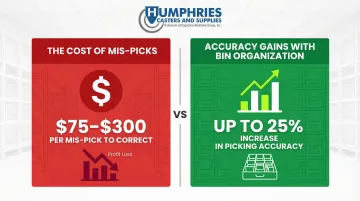
Proper small-parts organization directly impacts picking accuracy and speed. When multiple SKUs occupy the same bin, workers waste time sorting and increase the risk of picking errors. Each mis-pick costs between $75 and $300 to correct. For high-SKU environments, the ROI is clear: incorporating modular drawers with dividers can increase picking accuracy by up to 25%.
Best practices for bin organization:
- Assign one SKU per bin location — no mixing
- Separate similar-looking items to prevent mis-picks
- Pair bins with clear labels and barcodes to speed picking and restocking
Casters and Mobility Kits
Adding heavy-duty casters to rack bases transforms static shelving into mobile storage units. This enables facilities to reconfigure layouts without tools and bring storage to the point of use. Mobile shelving can increase storage space by 75% or more by eliminating permanent aisles.
Mobility does introduce safety requirements that can't be skipped. Caster load ratings must match or exceed the rack's total capacity — a 4-inch garage-cabinet caster kit rated at 1,500 lbs total is nowhere near adequate for Husky industrial units that can hold up to 10,000 lbs.
Locking casters are essential in dynamic warehouse environments to prevent unintended movement during loading or picking operations. Always cross-reference the caster's rated capacity against the rack's spec sheet before ordering.
Hooks, Pegboards, and Hanging Panels
Vertical hanging accessories use the side and rear planes of a rack to store long items, tools, or frequently accessed equipment that would otherwise occupy valuable shelf space. Wall-mounted bins and pegboard systems create high-density "pick walls" that reduce inventory search times by up to 40%.
Hanging panels are particularly effective for tools and frequently retrieved items. Placing these accessories at eye level within the "golden zone" (waist to shoulder height) reduces reaching and bending, improving ergonomics and pick speed.
Cross Braces and Structural Reinforcement Accessories
Cross braces and anchoring hardware maintain rack stability under heavy or unevenly distributed loads. These structural accessories are not optional in industrial settings—they are required for safety compliance.
Applicable standards include:
- OSHA 29 CFR 1910.176(b): Storage systems must be stable and secure against sliding or collapse
- ANSI MH16.1-2023: All rack columns must be anchored to the floor to resist movement
- Missing cross-aisle ties, beam safety locking pins, or crossbars severely compromise structural integrity
Row spacers keep uniformity of flue space and increase stability against overturning. Post protectors defend against forklift impacts and must be anchored in four locations. Every upright must be anchored to an adequate concrete floor using appropriate hardware.
How to Use Husky Rack Accessories to Maximize Warehouse Space
Most warehouses underuse ceiling height. The principle of vertical maximization is simple: stack additional shelf tiers and use tall uprights with the right accessories to significantly increase storage density per square foot. Median facilities use only 85% of their capacity, while best-in-class operations achieve 92% or higher.
Zone-Based Storage Planning
Accessories create dedicated zones on a single rack:
- Heavy items on lower shelves (reducing lift strain and lowering the center of gravity)
- Lighter bins and small parts above
- Hanging tools on side panels
This arrangement reduces travel time between pick locations and improves ergonomics by placing frequently accessed items within easy reach.
Dynamic Aisle Configurations
Reclaiming floor space is the other half of the equation. Mobile caster kits make dynamic aisle configurations possible — workers push racks together for dense storage when not in active use, then spread them apart during picking operations. This eliminates the need for permanent wide aisles, converting that floor space into additional storage capacity.
Labeling and bin systems work together to drive measurable efficiency gains. When dividers and bins are paired with clear labeling, picking accuracy improves and restocking becomes faster. Best-in-class operations achieve order-picking accuracy of 99.9% or higher, a target that requires disciplined organization.
Phased Accessory Addition
There's no need to invest in everything at once. Start with the highest-impact accessories and add as operational needs grow:
- Extra shelf tiers to capture vertical space
- Bins and dividers for small parts
- Mobility kits as inventory volume grows
- Structural reinforcements when loads increase
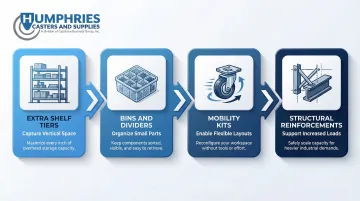
Each phase delivers measurable returns before the next investment is required.
Selecting the Right Husky Rack Accessories for Your Facility
Start with a load capacity audit. Before adding accessories, identify the heaviest items that will be stored per shelf. Confirm that the base rack and any add-on accessories—especially casters and extra shelves—are rated to handle those loads. Exceeding rated capacity compromises safety and voids warranties.
Compatibility matters just as much as capacity. Husky accessories are engineered for specific rack dimensions and weight classes — mixing new and used parts, or combining with other manufacturers' components, voids all warranties and compromises structural integrity. Match accessory specs to your existing rack model before purchasing.
Your storage type should drive accessory selection:
- Small-parts facilities benefit most from bins and dividers
- Heavy manufacturing environments prioritize structural braces and heavy-load shelves
- Mixed-use facilities should look for modular accessories that can be reconfigured
Humphries Casters has been sourcing facility equipment for industrial and commercial operations since 1988 — including hard-to-find components for specific rack configurations. Contact their team at 513-733-9322 or Service@HumphriesCasters.com for help matching accessories to your setup.
Installation Tips for Getting the Most from Husky Rack Accessories
Start with a level, stable base rack before adding accessories. Uneven flooring or improperly assembled uprights compromise the entire system's safety under load. Use floor shims where floors are uneven to ensure a plumb, level, and square installation.
General best practices for accessory installation:
- Always refer to manufacturer load ratings when configuring shelf heights
- Use anchor kits when the rack is in a fixed position
- Test caster locks before loading a mobile unit
- Install capacity signage identifying load size, weight, and rack configuration
Pay close attention to anchoring throughout the process. If a wedge anchor breaks during installation, do not replace it in the same hole — drill a new one or relocate the rack to maintain proper anchorage.
Ongoing inspections matter most in high-traffic warehouses, where wear accumulates faster than expected. Schedule monthly checks and watch for:
- Bent connectors or cracked weld points
- Shelf sag under sustained load
- Loose uprights or shifted anchor points
Replace any damaged components before adding load to the system to stay compliant with safety standards.
Frequently Asked Questions
What types of accessories are available for Husky storage racks?
Husky accessories include additional wire shelves, bins and dividers, drawer inserts, casters, hooks, pegboards, cross braces, and anchoring hardware. Husky Rack & Wire offers pallet rack kits, uprights, beams, wire decking, and post protectors for heavy-duty pallet racking systems.
Can Husky storage rack accessories handle heavy industrial loads?
Yes. Some industrial-duty units support up to 2,500 lbs per shelf. Always verify the load rating of both the base rack and each individual accessory before use to ensure safety and compliance.
How do I know which Husky accessories are compatible with my existing rack?
Match the rack model number to accessory specifications for dimensional and weight-class compatibility. Avoid mixing components from different manufacturers — it voids warranties and compromises structural integrity. When in doubt, consult the manufacturer or your supplier.
Are Husky storage racks and accessories suitable for commercial warehouse environments?
Yes. Husky systems are used in commercial and industrial settings. With the right accessories—structural bracing, heavy-load shelves, locking casters—they meet demanding warehouse needs. Select units carry NSF certification for dry food storage, and wire decking meets fire safety regulations.
Can I expand my Husky rack system over time as my storage needs grow?
Yes. Husky systems are modular by design. Additional uprights, shelf tiers, and accessory panels can be added as needed without replacing the existing structure — so your storage capacity grows with your operation, not ahead of it.
Do I need professional help to install Husky rack accessories?
Most Husky accessories are designed for straightforward installation. Larger or heavier commercial configurations may benefit from professional setup, since proper anchoring and load distribution are critical in industrial environments.