Introduction
In healthcare environments, a caster that drifts at the wrong moment can trigger a patient safety incident. When a hospital bed shifts during a transfer or a crash cart rolls away mid-procedure, the consequences range from workflow disruption to serious injury.
Total lock and swivel lock mechanisms both address mobility control, but they solve fundamentally different problems. Specifying the wrong type for your application wastes budget and creates gaps in safety coverage.
U.S. hospitals recorded 221,400 work-related injuries and illnesses in 2019, with overexertion accounting for 48% of lost-time incidents. Equipment mobility — pushing, pulling, and securing carts and beds — contributes directly to this injury burden. The right caster specification reduces both patient safety risks and staff musculoskeletal strain.
This guide breaks down exactly how each locking type works, which healthcare applications they're designed for, and what to consider before choosing between them for beds, carts, IV poles, or surgical equipment.
Key Takeaways
- Total lock casters freeze both the wheel and swivel with a single pedal, making them the right choice for stationary stability during procedures
- Swivel lock casters stop swivel rotation but let the wheel roll freely, which works best for straight-line corridor transport
- Neither type is universally superior; the right choice depends on whether you need immobilization or directional control
- Mixed configurations — total lock at the rear, standard swivel at the front — are common and often the most practical approach for balanced performance
Total Lock vs Swivel Lock: Quick Comparison
Locking Mechanism
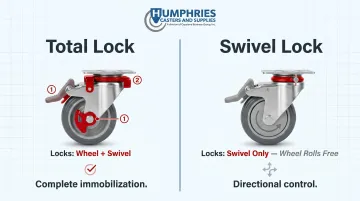
Total lock uses a single foot pedal to simultaneously lock both wheel rotation and the swivel raceway, preventing all movement. Swivel lock engages the swivel bearing assembly only, restricting rotational movement while the wheel rolls freely.
Primary Function in Healthcare
Total lock holds equipment completely stationary — essential when a device must not shift during procedures or patient transfers. Swivel lock converts a swivel caster into a straight-tracking rigid caster, useful during long-distance corridor pushes to reduce wander and operator fatigue.
Ease of Operation
- Total lock: Single-step foot pedal; slightly more mechanical complexity
- Swivel lock: Hand-operated or foot-activated pin; simpler mechanism but requires separate engagement from the wheel brake
Cost Considerations
Total lock casters cost more per unit because of the dual-locking mechanism — load capacity and material grade are the main price drivers. Swivel lock options represent a moderate cost increase and are often available as add-on configurations or retrofit components for compatible equipment.
Infection Control and Cleanability
Both lock types are available in medical-grade versions with sealed housings and minimal crevices. Total lock's foot pedal activation reduces hand contact, which matters in high-touch clinical environments. Verify that brake components can withstand your facility's standard disinfectants — quaternary ammonium, hydrogen peroxide, or bleach-based solutions. Stainless steel options resist corrosion and frequent washdowns.
What is a Total Lock Medical Caster?
A total lock caster integrates a braking mechanism that, with a single foot pedal depression, locks both the wheel (preventing rolling) and the swivel raceway (preventing rotation)—achieving complete immobility in one motion. That matters in healthcare, where staff regularly secure equipment with both hands already full.
The mechanism works through a foot pedal that engages a locking pin or cam, simultaneously contacting the wheel tread or hub and the swivel race. This distinguishes total lock from a top lock (wheel only) or directional lock (swivel only). Most total lock casters use kingpin-style construction, though kingpinless designs offer superior durability by distributing load over approximately 3x the surface area of traditional kingpin designs.
Core Benefits in Healthcare:
- Complete equipment immobilization during procedures, patient transfers, and medication preparation
- Eliminates drift risk on sloped floors or during IV setups
- Reduces staff injury risk from chasing drifting equipment
- Single-pedal activation allows one-handed operation when staff are occupied
Relevant Variations:
- Stainless steel total lock casters for sterile/cleanroom areas (316L grade resists harsh disinfectants)
- Conductive or ESD versions for imaging rooms
- Load capacity ranges from light-duty medication carts (100-150 kg per caster) to bariatric beds (200+ kg per caster)
Use Cases in Healthcare
Total lock is the standard of care for equipment where any drift creates patient safety risk:
- Hospital beds: Patient safety during transfers and treatment requires zero movement
- Surgical equipment stands: Complete stability during procedures
- Crash carts: Must remain stationary when accessed during emergencies
- Anesthesia carts — stability during medication preparation
- X-ray positioning equipment — precise placement without drift
That immobility requirement has regulatory teeth. Research shows traditional 2-lock caster configurations frequently fail IEC 60601-1 incline testing — sliding more than 50mm on 5-degree and 10-degree slopes. IEC guidelines now recommend four total-lock casters or a 2-swivel-lock + 2-rigid configuration to pass compliance testing.

What is a Swivel Lock Medical Caster?
A swivel lock (also called directional lock or positional lock) disables the caster's ability to rotate on its vertical axis, effectively converting a swivel caster into a rigid caster. When engaged, the caster rolls only in the direction it's currently pointing — it cannot turn. The wheel itself is NOT locked and continues to roll.
This functional difference from total lock is critical: swivel lock is a movement-control tool, not an immobilization tool. Its primary value is in transit — keeping long-haul pushes down 200-foot hospital corridors going straight without the wandering and shimmy typical of all-swivel configurations.
Core Benefits:
- Reduces push/pull force required by staff on long corridor moves, lowering musculoskeletal strain from manual material handling
- Eliminates caster shimmy and wander that makes transport difficult
- Improves directional precision when used as a positional lock at 90° intervals
- Reduces corrective steering force during transport tasks identified by OSHA as MSD risk factors
Variations:
- Inline directional lock: Fixes the swivel in whatever direction the caster is currently pointing
- 4-position swivel lock: Allows locking at 0°, 90°, 180°, or 270° — useful for carts that need to pivot between corridors
- Hand-operated plunger types: Manually engaged; common on heavy-capacity medical carts where foot pedal access is awkward
Use Cases in Healthcare
Swivel lock adds operational value in scenarios where transport control matters more than stationary immobilization:
- IV poles and infusion pumps: Walked long distances by nurses down corridors
- Linen carts and supply carts: Traversing lengthy hallways
- Transport wheelchairs or patient stretchers: Guided movement in straight lines
- Serving carts: Hospital dietary services requiring straight-line travel
In each of these settings, the goal is the same: staff control the direction, not the cart.
Total Lock vs Swivel Lock: Which is Right for Your Healthcare Setting?
The primary question is: Does this equipment need to be immobile while in use, or does it need to travel predictably while in motion? Total lock answers the first question; swivel lock answers the second. In many cases, both answers matter for the same piece of equipment.
Choose Total Lock When:
- Equipment must remain absolutely stationary during use (surgical tables, procedure carts, crash carts, patient beds)
- Facility has sloped floors or variable surfaces where drift is possible
- Patient or staff safety requires zero equipment movement
- Regulatory compliance requires IEC 60601-1 incline stability testing
Choose Swivel Lock (Directional Lock) When:
- Primary challenge is transit control over long distances
- Staff report fatigue or difficulty steering during corridor transport
- Caster shimmy is causing control problems
- Equipment frequently travels down long hallways
The Case for Mixed Configurations
One proven approach specifies 2 total lock swivel casters (rear positions) + 2 non-locking swivel casters (front), or 2 swivel lock + 2 rigid casters, depending on the application.
Standard configuration guidance recommends placing swivel casters at the push end (operator end) and rigid casters at the opposite end for carts under 4 feet long. For IEC 60601-1 compliance, 2 swivel casters with total lock + 2 rigid casters provides sufficient stability to pass incline testing without the expense of four total-lock mechanisms.
Additional Healthcare-Specific Factors:
- Match caster material to floor surface — smooth sealed concrete, vinyl tile, and carpeted areas each perform differently
- Size casters using the divide-by-3 formula (total loaded weight ÷ 3, not 4) to account for uneven distribution
- Specify kingpinless construction for high-cycle repositioning applications
- Confirm material compatibility with your facility's disinfection protocols before ordering
- Avoid kingpin total locks on any equipment used in towing applications
Real-World Applications: Matching Lock Type to Healthcare Equipment
These factors play out differently depending on the equipment. Here's how lock type maps to common healthcare applications:
| Equipment | Recommended Lock Type | Notes |
|---|---|---|
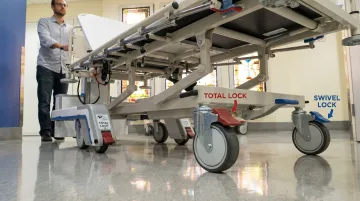
| Hospital Bed | Total lock (all swivel positions) | 2-lock + 2-rigid configurations meet IEC 60601-1 stability testing |
| Medication/Anesthesia Cart | Total lock | Add swivel lock at rear if staff report steering difficulty in corridors |
| IV Pole / Infusion Pump Stand | Swivel lock (directional) | Reduces nurse fatigue over long-distance patient transport |
| Mobile Imaging Equipment | Total lock | Specify stainless steel or conductive variants for MRI-compatible procedure rooms |
One mid-size hospital reported 15% faster crash cart delivery after upgrading to medical-grade casters. Facilities transitioning to stainless steel swivel casters have seen 40–60% fewer caster-related maintenance calls annually.
Humphries Casters has supplied the #1, 2, and 3 long-term care organizations in America and several specialty-ranked hospitals since 1988. Product trials and samples are available so your facility can evaluate total lock and swivel lock options before committing to bulk orders. Contact 800.733.4758 or Service@HumphriesCasters.com to get started.
Conclusion
Total lock and swivel lock are not competing alternatives but complementary tools — one optimizes safety at rest, the other optimizes control in motion. The right answer depends on how the equipment is used, not just what category it belongs to.
Correct caster specification has measurable operational payoffs: fewer patient safety incidents from equipment drift, less staff musculoskeletal strain during long transports, and lower maintenance costs from premature caster failure.
Before specifying either lock type:
- Evaluate your equipment, floor environments, and usage frequency
- Consider mixed configurations where stationary stability and transport control both matter
- Verify infection control material compatibility and regulatory compliance for your equipment class
Frequently Asked Questions
What is a total lock caster?
A total lock caster uses a single foot pedal to simultaneously lock both wheel rotation and the swivel head, preventing all movement. It's the standard choice for hospital beds, surgical carts, and any equipment that must stay stationary during patient care.
What is the difference between a rigid caster and a swivel caster?
A rigid caster has a fixed axle and only rolls in a straight line, while a swivel caster has a rotating head (raceway) that allows the wheel to turn 360 degrees. A swivel lock effectively converts a swivel caster into a temporary rigid caster when engaged.
Should all four casters be swivel?
All-swivel configurations offer maximum maneuverability but can cause shimmy and wandering during long-distance transport. For most medical carts and beds, a mix of swivel and rigid — or swivel with selective swivel lock — provides the best balance of maneuverability and directional control.
What are swivel casters used for?
Swivel casters allow equipment to pivot and maneuver in tight spaces, making them essential for navigating hospital corridors, patient rooms, and crowded work areas.
Can you use both total lock and swivel lock casters on the same medical equipment?
Yes. Mixed configurations are common and often recommended — for example, placing total lock casters at the rear of a cart for stationary stability and swivel lock or standard swivel casters at the front for maneuverability during transport.