Introduction
Hospital casters are the often-overlooked components underneath beds, stretchers, IV poles, crash carts, and surgical tables — working around the clock in one of the most demanding environments imaginable. They endure relentless loads, caustic disinfectants, hard tile floors, and constant movement — yet they're rarely inspected until something fails.
Neglecting caster maintenance in a hospital setting creates serious consequences. When wheels seize, emergency response slows. When brakes fail, patients face fall risks — 63% of fall-related sentinel events result in death, with equipment issues including brake failures listed as common root causes. Failed wheels also harbor contaminants, compounding infection control risks. Premature replacements drain budgets that could go directly toward patient care.
This guide covers why hospital caster maintenance is uniquely high-stakes, how to spot warning signs early, practical maintenance frameworks including cleaning and lubrication protocols, and a scheduling guide aligned with existing preventive maintenance programs.
Key Takeaways
- Hospital casters face harsher conditions than most industrial settings — sodium hypochlorite (bleach) rapidly degrades polyurethane and rubber, while hard floors and 24/7 loads accelerate wear
- Proactive maintenance extends wheel life and cuts replacement costs — facilities relying on preventive maintenance see 52.7% less unplanned downtime
- Brake failure isn't just operational — it's a patient safety incident directly linked to falls
- Structured schedules — daily brake checks, monthly lubrication, annual assessments — slot directly into existing PM checklists with minimal added workload
- Standardizing caster types across equipment categories means fewer SKUs to stock, faster reordering, and simpler staff training
Why Hospital Caster Maintenance Is More Critical Than You Think
Hospital casters operate in a uniquely punishing environment. Healthcare settings combine continuous 24/7 use with frequent exposure to bleach-based and quaternary ammonium disinfectants — chemicals that degrade common wheel materials fast.
Chemical compatibility data shows polyurethane, rubber, and thermoplastic rubber receive a "D" rating (rapid degradation) when exposed to sodium hypochlorite. Add heavy static and dynamic loads on hard tile or epoxy floors, and the conditions accelerate failure well before rated lifespan.

Patient Safety Impact
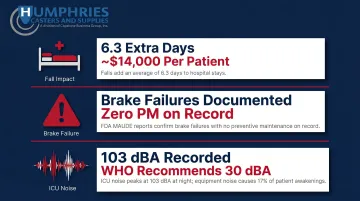
Failed brakes on beds or stretchers create direct fall risks. Falls with injury add an average of 6.3 days to hospital stays and cost approximately $14,000 per patient. Seized wheels on crash carts or emergency stretchers can delay critical care delivery. FDA MAUDE reports document multiple hospital bed brake failures, with manufacturer narratives stating "brakes not holding" and "no preventive maintenance on record." Caster failure is a clinical risk — one with documented patient harm attached to it.
Lifespan and Cost Impact
The financial case for maintenance is just as clear. Routine upkeep — a few minutes of labor plus lubricant — prevents hours of downtime and emergency procurement costs. Research shows facilities using preventive maintenance experience 78.5% fewer defects and 73% fewer lost sales due to delays compared to reactive-only approaches.
Infection Control Risk
Beyond mechanical failure, caster design affects pathogen spread. Casters with exposed bearings or recessed hubs accumulate biological material that standard mopping won't reach. Research from Peretz et al. found wheelchairs contaminated with MRSA, Pseudomonas aeruginosa, and Acinetobacter baumannii — all antibiotic-resistant strains. CDC environmental cleaning guidelines specify that terminal cleaning in operating rooms must include cleaning and disinfecting equipment wheels, and shared equipment like IV poles must be cleaned before and after each use. Routine cleaning is part of infection prevention, not just equipment upkeep.
Noise as a Clinical Issue
Deteriorating casters also affect patient recovery. ICU noise levels generally range from 50 to 75 dBA, with peak levels reaching 103 dBA — far exceeding the WHO recommendation of 30 dBA at night. Trolley and equipment noise are specifically identified among the leading culprits. Environmental noise causes 17% of patient awakenings and 11.5% of arousals in mechanically ventilated patients. Grinding or squeaking wheels signal bearing deterioration and disrupt the rest patients need to recover.
Preventive vs. Reactive Maintenance in Hospital Settings
Scheduled inspections, cleaning, lubrication, and brake tests performed on a fixed cadence make up a preventive maintenance program. This is the most cost-effective approach and keeps equipment in service longer.
Reactive maintenance — triggered by failure or complaint — carries hidden costs that preventive programs avoid:
- Emergency procurement delays
- Equipment swaps disrupting patient flow
- Potential patient safety events
- Staff overtime for urgent repairs
Minimize reactive maintenance through proactive programs aligned with CMS Alternative Equipment Maintenance (AEM) guidelines, which allow hospitals to adjust maintenance frequencies based on documented risk assessments.
Warning Signs Your Hospital Casters Need Attention
Early detection prevents costly replacements and patient safety events. Train front-line staff and housekeeping teams to recognize these signs during routine equipment use.
Wheel and Tread Condition
Common tread problems to look for:
- Flat spots, chunking, or severe tread wear on rubber or polyurethane wheels
- Visible deformation along the contact surface
- Discoloration or tackiness — both signal chemical degradation from disinfectants
Wheels exposed to bleach can become sticky or brittle. Catching this early prevents uneven rolling and accelerated wear on other components.
Swivel and Bearing Performance
Resistance when swiveling or a wheel that no longer rotates smoothly when spun by hand indicates dry or contaminated bearings. Grinding or clicking sounds during rotation signal bearing damage. A well-maintained swivel should rotate through a full arc with minimal effort; any drag warrants immediate inspection.
Brake and Locking Mechanism Failure
Critical warning signs requiring immediate attention:
- Brake that no longer holds equipment in place when engaged
- Foot pedal feels loose or fails to click into position
- Total-lock allows wheel to roll after engagement
- Brake shoe shows visible wear or cracking
Test brakes at every inspection. FDA MAUDE reports show brake failures often occur when no preventive maintenance is on record.
Visible Structural Damage
Inspect for bent or cracked forks (the metal frame holding the wheel), visible corrosion at weld points or on stems/plates, and loose or missing mounting hardware.
A bent fork can cause catastrophic swivel failure and should trigger immediate replacement. Structural compromise cannot be repaired safely.
Noise, Vibration, and Increased Push Force
Red flags include:
- Abnormal squeaking, thumping, or grinding during movement
- Cart requires noticeably more push/pull force than before
- Vibration felt through the frame
- Staff reporting equipment "feels heavy"
When staff report any of these, escalate to inspection immediately — each symptom points to bearing wear, debris buildup, or misalignment that worsens without intervention.
Hospital Caster Maintenance Best Practices
Effective caster maintenance combines daily habits with periodic deeper servicing. These practices apply across bed casters, stretcher casters, IV pole casters, and equipment carts.
Cleaning Protocol
After each shift or daily minimum:
- Remove debris (hair, thread, floor grit) wrapped around axles using a pick or blunt scissors — the single most common cause of seizing
- Wipe down wheel treads and caster rig with pH-neutral hospital-approved cleaner
- Avoid soaking bearings with disinfectant spray, which washes out lubricant and accelerates corrosion
Medical-grade casters designed for healthcare use feature smooth, continuous surfaces that eliminate gaps where biofilm accumulates, plus fully sealed bearings to block liquid intrusion during wash-downs.
Lubrication
For swivel raceways and wheel bearings, use a non-toxic, water-resistant grease — calcium sulfonate complex or an NSF H1 food-grade equivalent both work well in healthcare settings. Calcium sulfonate greases offer superior water resistance and won't wash out during equipment wash-downs.
Avoid WD-40 and penetrating oils. WD-40 contains 60-70% petroleum distillates (solvents) that break down existing grease, leaving bearings unprotected. These products lack the viscosity and anti-wear additives required for loaded bearings.
Apply grease via zerk fitting on swivel (if present) until fresh grease emerges. Increase frequency for high-use equipment like ICU beds or stretchers.
Brake Inspection and Testing
Every inspection must include a functional brake test:
- Engage the brake
- Attempt to push the equipment
- Attempt to rotate the wheel/swivel
- If either moves, the brake is compromised
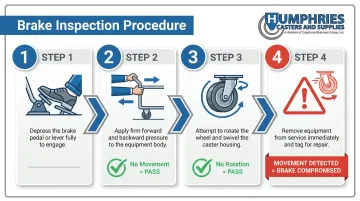
Check foot pedal for cracks, loose linkage, or wear on brake shoe. Total-lock brakes — which lock both wheel rotation and swivel — are the standard for hospital beds and should be verified at every service interval.
Fastener and Hardware Check
Check mounting bolts, axle nuts, and stem security at every scheduled inspection. Loose fasteners cause premature bearing failure and swivel instability. Use a torque wrench on critical equipment. Maintain a log of fastener checks by equipment ID, especially for ICU beds and surgical tables.
Standardization as a Maintenance Strategy
Using consistent caster types across similar equipment categories cuts maintenance complexity in three practical ways:
- Reduces staff training time when everyone works with the same hardware
- Simplifies spare parts stocking with fewer SKUs to manage
- Speeds up inspections since technicians know exactly what to look for
Establishing standardized specifications with a single supplier also reduces procurement time and lowers per-unit costs through volume programs. Humphries Casters, which has supplied the #1, #2, and #3 long-term care organizations in America, supports this process with product trials, samples for evaluation, and onsite in-service for larger items like hospital bed movers — so facilities can confirm compatibility before committing to a full rollout.
Hospital Caster Maintenance Schedule
Not all equipment needs the same attention. High-traffic items — ED stretchers, ICU beds, surgical transport carts — need more frequent checks than lower-use items like waiting room furniture or supply room carts. Industry benchmarks recommend annual PM as the standard baseline, with semi-annual intervals for high-traffic environments.
Maintenance Frequency Table
| Interval | Tasks |
|---|---|
| Daily / Per-Shift | Visual wheel inspection for debris wrap and tread damage; brake test on all patient-support equipment; report abnormal noise or push resistance |
| Weekly | Full debris removal (axle de-stringing); wipe-down with pH-neutral cleaner; swivel rotation test; fastener tightness check on high-use equipment |
| Monthly | Lubricate swivel raceways and wheel bearings; test brake mechanisms; inspect forks and mounting plates for corrosion or bending; document findings by equipment ID |
| Annually / Semi-Annually (high-use) | Full caster assessment: measure tread wear, test bearing smoothness under load, check all brakes, and replace casters with flat spots or bearing failure. Reconcile with procurement to identify standardization gaps. |
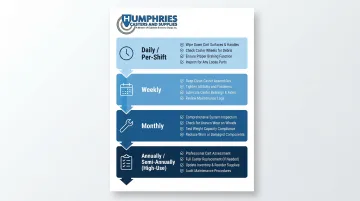
CMS allows hospitals to develop Alternative Equipment Maintenance programs that adjust frequencies based on risk assessments by qualified personnel. Written policies and documentation must be maintained to support this approach.
Conclusion
Hospital caster maintenance protects patients, reduces liability, and extends the life of expensive mobile equipment. A few minutes of routine care per piece of equipment prevents hours of downtime and hundreds of dollars in emergency replacement costs.
To put this into practice, three steps make the biggest difference:
- Schedule formal inspections — set recurring intervals and assign ownership to a specific role
- Train front-line and housekeeping staff on early warning signs so problems get caught before they escalate
- Consult a medical caster supplier to evaluate your current setup, standardize specifications, and arrange bulk stocking that reduces per-unit costs
With the right program in place, facilities consistently improve safety and reliability while cutting replacement spending.
Contact Humphries Casters at 800.733.4758 or service@HumphriesCasters.com to discuss caster audits, standardization programs, and product trials tailored to your healthcare environment.
Frequently Asked Questions
How often should hospital casters be inspected?
High-use equipment — ICU beds, stretchers, and crash carts — needs a visual inspection daily and a full maintenance check monthly. Lower-use equipment can follow a monthly visual and quarterly full-service schedule. Annual PM is the industry baseline for most hospital beds.
What are the signs that hospital caster wheels need to be replaced?
Replace casters when you observe flat spots or chunking on the tread, a brake that no longer holds, a swivel that drags or grinds after cleaning and lubrication, visible fork bending or corrosion, or persistent noise that doesn't resolve after servicing. Structural damage requires immediate replacement.
What type of lubricant should be used on hospital casters?
Use a water-resistant, non-toxic grease such as calcium sulfonate complex or NSF H1 food-grade equivalent applied to swivel raceways and wheel bearings. Avoid penetrating oils like WD-40, which are too thin for bearing protection and wash out quickly in wet hospital environments.
How often should a wheelchair be serviced?
Wheelchairs in active hospital use need weekly visual caster inspections and monthly full service — debris removal, lubrication, brake check, and tread inspection. According to University of Pittsburgh wheelchair caster performance research, nearly one-third of wheelchair failures are caster-related within 6-12 months of use.
What maintenance does a wheelchair need?
Key tasks include removing hair and debris from axles and caster forks, lubricating swivel bearings, testing brakes for hold strength, inspecting front casters for flat spots or wobble, checking tire pressure on pneumatic wheels, and tightening all mounting hardware.