Hospital floors represent significant capital investment. Luxury vinyl tile, epoxy coatings, and sheet vinyl cost substantially more than standard commercial flooring—averaging $6 per square foot for LVT and $7.50 for epoxy installations. Many standard industrial casters are incompatible with these surfaces, concentrating equipment weight over tiny contact patches that gouge, scratch, and strip floor finishes.
This guide explains how floor damage happens, which wheel materials genuinely protect clinical floors, and what to look for when specifying casters for healthcare environments.
Key Takeaways
- Polyurethane (65–95 Shore A) and neoprene wheels protect hospital floors by spreading load over larger contact areas
- Wrong wheel materials cost facilities 40+ hours monthly in waxing labor and floor refinishing
- Wider treads and larger diameters lower pounds-per-square-inch contact pressure, reducing floor wear and marking
- Match caster specs to the equipment type and floor surface for each clinical area
Why Hospital Floor Protection Matters More Than You Think
Why Hospital Floors Are Harder to Protect Than Most Facilities Realize
Capital Investment at Risk
Healthcare flooring represents 2–5% of construction budgets when specified correctly—but premature failure can push remediation costs to 10–15% of total construction spend. Common hospital flooring materials include:
- Luxury vinyl tile (LVT): $3–$18 per square foot installed, averaging $6
- Epoxy coatings: $3–$12 per square foot, averaging $7.50
- Sheet vinyl: $2–$4 per square foot for material, plus installation
These surfaces require protection from the moment they're installed.
The Compounding Damage Cycle
Damaged floors create escalating problems beyond aesthetics.
Maintenance Costs Compound Fast
When one hospital switched from nylon-wheeled chairs to neoprene-wheeled casters, they saved approximately 40 hours of waxing labor and over 20 gallons of wax per month. Floor streaks and scuffs from hard wheels demand constant attention to maintain appearance—labor hours that add up quickly across large facilities.
Surface Deterioration Creates Infection Risks
Surface micro-cracks from wheel damage harbor pathogens that standard cleaning can't reach. A 2016 systematic review published in Epidemiology and Infection found:
- Floor contamination accounts for up to 15% of airborne bacteria in operating rooms
- Walking on contaminated floors disperses bacteria 17 times more effectively than mopping
- 61% of microorganisms transfer from contaminated floor tiles to fingertips
- Over 80% of aerosolized particles from floors are respirable-size
- Up to 40% of shoe soles carry toxigenic C. difficile

When moisture causes flooring to delaminate or seams to breach, the resulting voids harbor Staphylococcus aureus, C. difficile, biofilms, and mold—all shielded from standard cleaning protocols.
High-Traffic Areas Accelerate Wear
In ER corridors, ICUs, and procedure rooms, equipment moves dozens of times per shift. The cumulative load from hard, narrow wheels or flat-spotted casters adds up fast—far beyond what most facility managers account for when selecting flooring materials or caster specs.
Regulatory Compliance Concerns
Damaged floor surfaces create slip hazards and trigger liability concerns. Three regulatory frameworks directly address floor condition:
- OSHA 29 CFR 1910.22: Requires floors to be clean, dry, and in good repair
- Joint Commission EC.02.06.01: Mandates safe, functional environments with furnishings in good repair
- CMS 42 CFR 482.41: Requires hospitals to maintain safe physical environments
Floor damage directly affects inspection outcomes and patient safety ratings.
How the Wrong Casters Damage Clinical Floors
Point-Load Pressure Mechanics
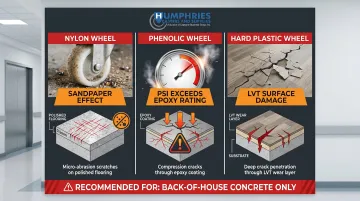
Hard wheel materials—nylon, phenolic, hard plastic—concentrate equipment weight over extremely small contact areas. A 4-inch wheel with a 2-inch face under 1,000 lb generates approximately 2,000 PSI on roughly 0.5 square inches. Standard 10-mil industrial epoxy has a continuous rating of approximately 1,500 PSI, meaning a single overloaded small wheel exceeds the floor's capacity. That pressure climbs further when equipment is pushed at angles or when wheels develop flat spots from stationary loading—both common in busy clinical environments.
The Flat Spot Problem
Casters left stationary under loaded equipment develop flat spots through compound creep—plastic deformation under continuous static load. Susceptibility varies by wheel material:
- Most susceptible: Thermoplastic rubber (TPR) flat-spots above 40% of dynamic load rating
- Moderately susceptible: 85A polyurethane (above 55%); 95A polyurethane (above 70%)
- Least susceptible: Phenolic resin (85% threshold); glass-filled nylon (80%)
- Mild: 0.005–0.015 inch runout
- Moderate: 0.015–0.030 inch
- Severe: over 0.030 inch
When equipment moves after extended parking (12+ hours overnight, or 60+ hours over weekends), flat spots skid and gouge rather than roll cleanly. Wheel geometry compounds this damage risk — contact patch size is just as critical as material choice.
Wheel Size Impact on Contact Pressure
A narrow, small-diameter wheel delivers far higher PSI than a wider, larger wheel carrying identical loads:
- Doubling wheel diameter (4" to 8") drops contact-patch PSI by approximately 40%
- Doubling face width (2" to 4") halves PSI at the same load
- Minimum 6-inch diameter recommended for loads over 1,500 lb per caster
Most Common Offenders in Hospital Settings
Nylon and phenolic wheels are common in clinical settings due to their durability and chemical resistance — but that hardness is exactly what makes them destructive to finished floors:
- Nylon wheels collect debris (sutures, hair, tape) that hardens into the tread, turning each rotation into a sandpaper pass across coated surfaces
- Phenolic wheels deliver concentrated PSI that epoxy and LVT coatings aren't rated to handle under repeated loading
- Hard plastic wheels of any type amplify damage on luxury vinyl tile, the most common flooring in modern clinical corridors
Best Wheel Materials for Floor-Safe Hospital Casters
Understanding Durometer (Shore A Hardness)
Wheel durometer determines load distribution. Softer wheels spread load over larger contact patches, reducing pressure per square inch. The 65–80 Shore A range is generally the sweet spot for hospital environments—firm enough to roll well under load, soft enough to protect floors.
Common material durometer ratings:
| Material | Hardness Scale | Rating |
|---|---|---|
| Rubber | Shore A | 70-75 |
| Polyurethane | Shore A | 90-95 |
| Polyolefin | Shore D | 65-75 |
| Nylon | Shore D | 80-85 |
| Phenolic | Shore D | 90-95 |
Source: Caster Central Durometer Guide
Polyurethane Wheels
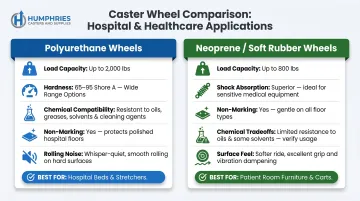
Polyurethane (PU) is the go-to wheel material for hospital floor protection. It delivers resilience, load capacity, quiet rolling, and floor safety that rubber and hard plastics can't match in a single compound.
Key advantages:
- Handles up to 2,000 lb per caster standard; up to 4,000 lb on sealed concrete
- Deforms approximately 0.005 inch under 1,000 lb, distributing pressure across a wider contact patch
- Compatible with dilute bleach (1–5%), hydrogen peroxide (30%), quaternary ammonium compounds, and isopropyl alcohol
- Leaves no marks on LVT or epoxy floor finishes
- Rolls quietly — a real advantage in patient care areas
Chemical compatibility caution: Polyurethane experiences severe degradation from phenolic disinfectants and concentrated ammonia. Verify wheel material compatibility with your facility's specific cleaning agents, especially in sterile processing areas.
For facilities working through those compatibility requirements, Humphries Casters stocks polyurethane wheels from 70 to 90 Shore A with core options in cast iron, aluminum, and fiberglass to match different load profiles.
Neoprene and Soft Rubber Wheels
Neoprene and soft rubber excel where even quieter rolling or greater shock absorption is needed—patient room furniture, over-bed tables, chair bases.
Characteristics:
- Rated to approximately 800 lb per caster
- Very gentle on floor finishes; non-marking formulations widely available
- Superior shock absorption — quieter than polyurethane in low-load applications
- Resists petroleum oils, greases, dilute acids and alkalis, and common industrial solvents
Tradeoffs: Lower load capacity than polyurethane and faster degradation with certain chemical disinfectants (ketones, concentrated acids, chlorinated solvents). Softer compounds may cold-flow under extended static loads.
Materials to Avoid on Sensitive Hospital Floors
Hard wheel materials belong in back-of-house areas on concrete or sealed industrial floors — not in patient care zones. On polished or coated surfaces, they concentrate load into small contact points and transmit every vibration, which accelerates surface cracking and finish wear:
- Nylon
- Phenolic
- Hard polyolefin
- Cast iron
Key Features to Look for in Floor-Safe Hospital Casters
Wheel Width and Diameter
A wider tread (1.5"–2"+) distributes load more gently across floor surfaces — doubling face width from 2" to 4" halves contact pressure. Larger diameter wheels (4"–5") roll over minor floor irregularities rather than digging into them, reducing floor wear and staff push effort. Upsizing from 4" to 6" wheels reduces flat-spot risk by 30–40%.
Sealed and Precision Bearings
Contaminated or worn bearings cause wheel wobble and uneven rolling, which increases side-load pressure on floors. Sealed bearings prevent dust, fluids, and microbes from entering the bearing assembly, protecting floors and helping meet infection control standards.
Humphries Casters offers medical-grade casters with stainless steel or Delrin® sealed bearings resistant to rust and corrosion, ideal for wet environments requiring frequent washdowns.
Bearing quality also affects what happens when equipment stops moving — which makes braking design the next critical variable.
Total-Lock and Directional-Lock Braking Systems
When equipment is locked in place, the braking mechanism should engage both wheel and swivel to prevent rocking loads being transferred to one wheel edge. Poor braking design concentrates stress on floors at rest.
Brake type recommendations by application:
- Hospital beds: Total lock brakes (prevent wheel rotation and swivel movement simultaneously)
- Medical carts: Tech lock/position lock brakes (ergonomic, foot-activated for high-frequency repositioning)
- IV poles: Directional lock/swivel lock (restricts swivel while allowing wheel to roll for controlled corridor travel)
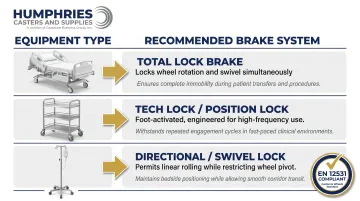
European standard EN 12531 for hospital beds requires casters to withstand 3x nominal load, with brake fatigue endurance testing over thousands of cycles.
Ergonomic Considerations
Caster selection directly affects how hard staff work to move equipment — and the injury risk that comes with it:
- OSHA recommends limiting push force to under 50 lbs for wheeled equipment
- Proper caster selection can reduce push/pull force by 10–50%
- Musculoskeletal disorders cost at least $50 billion annually in the U.S., with back injuries making up nearly 20% of all workplace injuries
Matching Casters to Clinical Equipment and Floor Types
Hospital Bed and Stretcher Casters
Hospital beds and stretchers carry the highest combined loads in routine movement—patient weight + bed weight + accessories. Typical specifications:
- Safe working load: 500–700 lb (Stryker Spirit Series: 500 lb SWL; Prime Series stretcher: 700 lb SWL)
- Recommended casters: 5"–6" diameter polyurethane swivel casters with total-lock brakes
- Wheel width: 1.25"–2" tread width minimum
Larger wheel diameter reduces floor contact pressure under heavy loads. Beds left in one position for extended periods benefit from wheel materials that resist flat-spotting (95A polyurethane preferred over 85A).
Humphries Casters carries central locking casters compatible with Hill-Rom, Joerns, Invacare, Hausted, Midmark, and Stryker hospital beds, featuring non-marking wheels and multiple stem configurations.
Medical Carts, IV Poles, and Over-Bed Tables
Lighter-duty applications where neoprene or soft polyurethane wheels excel:
- Recommended casters: 3"–4" swivel casters with polyurethane or neoprene treads
- Load range: 200–800 lb per caster
- Benefits: Quieter operation, softer floor contact, adequate durability for lighter loads
This is where nylon wheels have historically been misapplied—specified for chemical resistance but causing unnecessary floor damage. Polyurethane offers comparable chemical resistance with superior floor protection.
Matching to Floor Surface and Pilot Testing
Choosing the right material is only half the equation — the floor surface itself determines how well that material performs. Polished LVT, epoxy coatings, and bare concrete in service corridors respond differently to the same wheel under the same load.
Recommended approach:
- Identify floor types by clinical area (LVT, epoxy, VCT, concrete)
- Specify caster material based on load, chemical exposure, and floor sensitivity for each zone
- Pilot-test selected casters in one unit before committing to a facility-wide rollout

Humphries Casters offers product trials and samples so healthcare facilities can evaluate floor and mobility performance before placing full orders. For larger items like hospital bed movers, onsite demonstrations are available to evaluate performance in your specific environment.
Frequently Asked Questions
What caster wheels won't damage hospital floors?
Polyurethane (65–95 Shore A) and neoprene/soft rubber wheels are the top choices because their softer tread distributes load over larger contact areas, preventing the gouging and scuffing that hard nylon or phenolic wheels cause on LVT and coated hospital floors.
What are soft floor casters?
Soft floor casters are casters fitted with wheels made from softer tread materials—polyurethane, neoprene, or soft rubber—specifically designed to minimize contact pressure and prevent damage to finished or delicate floor surfaces.
Are rubber or polyurethane casters better for hospital floors?
Polyurethane is generally preferred in clinical settings—it handles higher loads (up to 2,000 lb vs. 800 lb for rubber) and resists hospital-grade cleaners better. Soft rubber or neoprene works well for lighter-duty furniture where quiet rolling is the priority.
What can I use instead of casters?
Alternatives include fixed glide feet for stationary equipment, slider pads, or leveling feet. However, for any equipment that needs routine movement in a clinical environment, properly specified floor-safe casters remain the most practical solution for staff and floors alike.
How often should hospital casters be inspected or replaced?
Inspect visually at least quarterly and replace wheels showing flat spots, cracks, or wobble. Degraded wheels increase push/pull force and accelerate floor damage. For high-use equipment, test brake function monthly.
Do caster wheel size and width affect floor damage in hospitals?
Yes—larger diameter and wider tread wheels reduce pounds-per-square-inch contact pressure on floors. Upsizing from a 3" narrow wheel to a 5" wide-tread wheel can reduce floor wear significantly even when using the same wheel material. Doubling wheel diameter drops contact PSI by approximately 40%.
Humphries Casters has been specifying floor-safe casters for hospitals and long-term care facilities since 1988. For guidance on selecting the right wheels for your facility, contact the team at service@HumphriesCasters.com or call 800.733.4758 to arrange product trials or an onsite consultation.