Introduction
Shelf space at Texas big box retailers—Walmart, H-E-B, Target, and Costco—comes down to packaging as much as product. Texas is one of the most competitive CPG distribution markets in the US, with Port Houston handling a record 4.3 million TEUs in 2025 and Dallas-Fort Worth leading the nation with 31.1 million square feet of industrial net absorption.
Retailer chargebacks, rejected shipments, and poor shelf performance are common—and most trace back to packaging decisions made without understanding big box compliance requirements. A single incorrect GS1-128 label can trigger a $200 chargeback per purchase order. Across dozens of shipments, that adds up fast.
This guide covers what CPG brands operating in Texas need to know: retailer-specific packaging standards, corrugated specifications, shelf-ready packaging engineering, chargeback avoidance, and sustainability mandates that now influence vendor tier status.
TLDR: Key Takeaways
- Texas hosts critical distribution infrastructure for Walmart, H-E-B, Target, and Costco—packaging compliance is non-negotiable for market entry
- Retailers enforce distinct compliance programs covering GS1-128 labeling, pallet configuration, and case design
- Corrugated material selection, ECT ratings, and flute type determine whether packaging survives Texas's heat and humidity intact
- Shelf-ready packaging (SRP) must meet the "5 Easies" framework while maintaining structural integrity during multi-stop distribution
- Walmart's Project Gigaton scorecard pushes suppliers toward 100% recyclable packaging and increasing post-consumer recycled content
Why Texas Is a Strategic Hub for CPG Big Box Distribution
Logistics Geography and Throughput
Texas functions as a national and cross-border distribution nexus, particularly through the Dallas-Fort Worth Metroplex, Houston, and San Antonio corridors. In 2025, DFW led the nation in industrial demand with 31.1 million square feet of annual net absorption. Houston closed 2024 with 21 million square feet of net new occupancy and a stabilized vacancy rate of 5.6%.
Port Houston processed 4.3 million TEUs and 54.5 million short tons of cargo in 2025 — a 4% year-over-year increase.
This logistics concentration means CPG products moving through Texas will undergo more touches and longer dwell times in high-heat, high-humidity environments. Your corrugated packaging must survive not just the initial shipment, but also multiple DC transfers and extended warehouse storage before reaching retail shelves.
Major Big Box Retail Infrastructure
Texas hosts massive, highly automated distribution facilities that demand packaging precision:
| Retailer | Texas DC Infrastructure | Facility Focus |
|---|---|---|
| Walmart | Lancaster (730,000 sq ft), Baytown (5M+ sq ft campus) | High-tech perishables, general merchandise |
| H-E-B | Valley View (600-acre campus), Temple (122-acre expansion) | Regional supply chain hubs for North and West Texas |
| Target | Denton (360,000 sq ft), Dallas consolidation point | Automated perishables/frozen, cross-dock terminal |
| Costco | Liberty Hill, New Braunfels, Forney (opening 2026) | Regional replenishment warehouses |
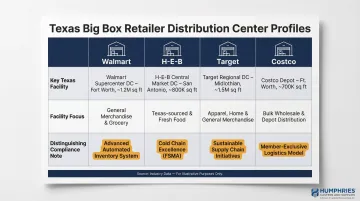
Each retailer operates a distinct vendor compliance program with different labeling zones, pallet specifications, and chargeback structures. What passes inspection at Walmart's Lancaster DC may fail at H-E-B's Valley View campus.
Competitive Shelf Space Reality
Texas is America's #1 jobs creator and led the nation for jobs added in 2025. This economic growth drives intense retail consumption and fierce competition for shelf space. With growing CPG manufacturing activity in the region, packaging performance often differentiates brands that scale from brands that get delisted. Retailers cut suppliers whose packaging jams conveyors, collapses on pallets, or adds floor time their teams can't absorb.
Big Box Retailer Packaging Requirements in Texas
Compliance Program Overview
Every major Texas big box retailer publishes a supplier compliance guide that dictates exact packaging standards. Walmart's Secondary Packaging Supply Chain Standards and H-E-B's vendor portal specify mandatory requirements with real financial teeth. Fail to meet them and automatic chargebacks are deducted directly from your invoice — no appeal process, no gray area.
GS1-128 Label Placement and Data Requirements
The GS1-128 barcode incorporating the SSCC-18 (Serial Shipping Container Code) is mandatory for all shipping and pallet labels. Walmart requires that SSCC-18 barcode values on the physical unit exactly match the Advanced Shipping Notice (ASN) "MAN" fields. A mismatch between your physical label and EDI 856 document will result in a rejected shipment.
Label placement zones:
- Bottom of barcode symbol: 1.25 inches (32 mm) from the natural base of the case
- Minimum 0.75 inches (19 mm) from any vertical edge
- Applied to two adjacent sides (Walmart) or upper right half, maximum 60 inches from base (H-E-B)
- Placed outside shrink wrap for scanner visibility
Required data elements:
- (00) SSCC-18 for unique container identification
- (01) GTIN-14 for product identification
- (10) Batch/Lot number for traceability
- (15/17) Best Before/Expiration dates for perishables
Use a 4x6 inch label to accommodate all data and maintain print grade ≥1.5 for reliable scanning. Human Readable Interpretation (HRI) must appear below the barcode with Application Identifiers in parentheses.
Pallet Configuration and Ti-Hi Requirements
Ti-Hi (tiers × units per tier) defines how cases stack on a pallet. Retailers specify exact Ti-Hi configurations per SKU to optimize receiving efficiency and planogram compliance.
Walmart requires 48"x40" Grade A, 4-way, flush, non-reversible GMA pallets. H-E-B accepts CHEP, iGPS 48"x40", and quarter/half pallets, but each must be treated as an independent logistic unit with a unique SSCC barcode.
Maximum pallet height:
- H-E-B: 66 inches (including pallet)
- Walmart: Varies by DC; confirm with your buyer
Pallet overhang—cases extending beyond the pallet edge—causes 20-40% compression strength loss and is a top chargeback trigger. Ensure cases sit flush within pallet dimensions.
RFID Mandates
Walmart has expanded RFID requirements to apparel, seasonal programs, and specific hardline departments (Home, Entertainment, Toys). There is currently no public Walmart mandate citing broad grocery/CPG coverage. CPG brands should verify department-specific scope with their Walmart buyer before investing in RFID tagging infrastructure. If RFID applies to your category, tags must be placed for readability without interfering with barcode scanning.
Display and Promotional Packaging Rules
Big box retailers regulate shipper displays, endcap units, and clip strip packaging through pre-approval processes. Display packaging must be flagged in Advanced Shipment Notifications (ASNs) and typically cannot exceed specific height restrictions (often 60-66 inches). Walmart requires that promotional shippers maintain structural integrity when partially depleted: cutouts in display trays must not exceed 50% of overall tray height, and full-height corners must extend beyond 50% of the first selling unit.
Getting these details right before your first shipment prevents costly chargebacks and protects your relationship with the retailer's buying team.
Corrugated Specifications and Shelf-Ready Packaging for CPG
ECT vs. Mullen Burst Ratings
The Edge Crush Test (ECT) measures edgewise compressive strength and predicts vertical stacking performance—ideal for standard warehouse logistics. The Mullen Test measures burst strength and is better for high-risk shipments requiring puncture protection.
Common ECT thresholds:
- 32 ECT (equivalent to 200# Mullen): Single-wall boxes up to 65 lbs
- 44 ECT (275# Mullen): Heavier loads up to 95 lbs
- 48 ECT or higher: Heavy or multi-tier pallet stacking
Walmart's standards are weight-dependent. For example, a 57 lb master case requires a minimum of 40 ECT or 250 psi burst strength. Always validate your corrugated spec against the actual gross weight of your filled case, not just the product weight.
Flute Type Selection for Texas Conditions
Flute type affects both stacking strength and cushioning. Texas's heat and humidity degrade corrugated performance, making flute selection critical.
- B Flute (3mm): Good for die-cutting and printability; moderate stacking strength
- C Flute (4mm): Most common; excellent stacking strength for general grocery items
- E Flute (1.5mm): Fine flute ideal for retail graphics and primary packaging
- BC Double-Wall (6mm): Combines B and C flutes for heavy-duty stacking; recommended for products exceeding 60 lbs or requiring multi-tier pallet stacking
The tradeoff: double-wall provides superior protection but costs 30-40% more than single-wall. Right-size your corrugated spec to actual distribution conditions rather than over-engineering for worst-case scenarios that rarely occur.
Texas Climate Impact on Corrugated Strength
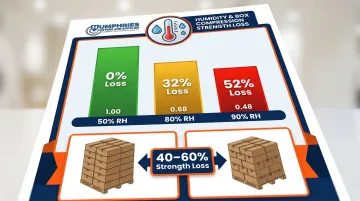
At 80% relative humidity (RH), corrugated boxes lose 32% of their compression strength. At 90% RH, they lose 52%. Texas warehouses and DCs frequently operate at 70-85% RH during summer months, noticeably reducing box performance.
De-rating factors to apply:
- 50% RH: 0% loss (1.00 multiplier)
- 80% RH: 32% loss (0.68 multiplier)
- 90% RH: 52% loss (0.48 multiplier)
Pallet patterns compound this effect. Interlocked patterns cause 40-60% strength loss compared to column-stacked configurations. If your product requires interlocking for stability, compensate by specifying a higher ECT rating.
Shelf-Ready Packaging (SRP) Defined
Once your corrugated spec is dialed in for climate and stacking, the next structural consideration is how that case performs at the shelf. SRP — shelf-ready packaging — is designed to move directly from the shipping case onto the retail shelf with minimal labor. It typically features perforated tear-away fronts and display-ready trays. Big box retailers increasingly require or incentivize SRP because it reduces store-level labor costs—a critical factor as retailers face rising wage pressures.
SRP Structural Design Requirements
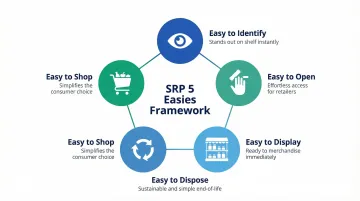
SRP must pass the "5 Easies" framework used by Walmart and the ECR Community:
- Easy to Identify - Clear branding visible before and after opening
- Easy to Open - Tool-free, clean tear without damaging products
- Easy to Display (Shelf) - One-move replenishment from case to shelf
- Easy to Shop (Buy) - Products accessible and visible to consumers
- Easy to Dispose - Recyclable materials that break down cleanly
Engineering considerations:
- Perforation placement must allow clean opening without tearing adjacent panels
- Graphics must remain brand-visible at shelf level after the front panel is removed
- The perforated panel reduces compression resistance during stacking—validate with ISTA 3E testing
- Trays must remain stable when partially depleted; full-height corners should extend beyond 50% of the first unit
Validate SRP designs under realistic distribution conditions — including truck vibration, temperature cycling, and partial-depletion scenarios — before committing to production tooling.
Box Sizing and Cube Optimization
Right-sizing corrugated cases to product dimensions reduces void fill and improves pallet density. It also determines how efficiently a retailer's DC can receive and store your product. Industry benchmarks target 85-90% carton cube utilization efficiency. Calculate cube utilization as:
Cube Utilization (%) = (Product Volume / Case Interior Volume) × 100
Higher cube utilization means:
- Fewer cases per pallet = lower freight costs
- Less void fill = reduced material costs and faster pack times
- Better pallet stability = fewer damaged shipments
- Improved DC throughput = fewer receiving delays and chargebacks
Avoiding Chargebacks and Compliance Pitfalls
What Chargebacks Cost CPG Brands
Chargebacks are financial penalties deducted from your invoice for non-compliant shipments. Walmart charges 3% of the PO value for OTIF (On-Time In-Full) failures. Walmart ASN errors trigger a $200 flat fee per PO (for DSDC/Pharmacy) or $200 per defect plus $1 per case. Target fines suppliers 5% of the cost of goods for late or incomplete shipments. Across the US, suppliers face an estimated $5-6 billion in annual penalties.
For a CPG brand shipping 100 pallets per month to Walmart, a single recurring label placement error could cost $20,000-$24,000 annually. At that scale, one overlooked compliance detail erases the margin on an otherwise healthy SKU.
Most Common Chargeback Triggers in Texas Big Box Distribution
Top violations:
- ASN errors: Late transmission, missing data, or SSCC mismatch between physical label and EDI 856 document
- Label violations: Unscannable barcodes, incorrect placement, or missing GS1-128 labels
- Packaging/pallet violations: Incorrect Ti-Hi, pallet overhang, exceeding maximum height, or poor securement
- OTIF failures: Shipments arriving outside the delivery window or with incorrect quantities
These violations apply consistently across Walmart, H-E-B, Target, and Costco — so a compliance program built around these four categories protects you at every major retailer.
How to Prevent Chargebacks Before They Happen
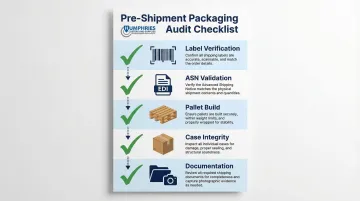
Pre-shipment packaging audit checklist:
- Label verification: GS1-128 on two sides, print grade ≥1.5, SSCC-18 confirmed
- ASN validation: Physical SSCC-18 must exactly match ASN "MAN" fields before EDI transmission
- Pallet build: Ti-Hi matches retailer spec, zero overhang, height within limits
- Case integrity: Corrugated strength verified, flaps sealed, SRP perforations intact
- Documentation: Time-stamped EDI records and dock photos on file to dispute any invalid chargebacks
Run compression and transit simulation tests using ISTA or ASTM standards before launching new packaging. ISTA 3E validates unitized loads for FTL shipments from manufacturing to DC. ISTA 3F tests individual packages (≤100 lb) shipped in mixed pallets from DC to retail. These standards simulate forklift handling, vibration, and shock that your packaging will experience in real distribution.
Partnering with a 3PL experienced in big box retailer requirements adds a final layer of protection — one that can flag a Ti-Hi mismatch or ASN discrepancy before it triggers a chargeback at the retailer's dock.
Sustainability and Warehouse Readiness in Texas Big Box CPG Operations
Retailer Sustainability Mandates
Walmart's Project Gigaton tracks supplier progress across packaging, energy, waste, and other pillars. For 2025, Walmart's packaging goals include:
- 100% recyclable, reusable, or industrially compostable packaging
- 20% post-consumer recycled (PCR) content in North American plastic packaging
- 15% absolute reduction in virgin plastic
Suppliers who set SMART goals, report progress, and share data can achieve "Giga Guru" recognition status (967 suppliers achieved this in early 2025). Walmart explicitly prefers uncoated paperboard and corrugated that is recycled or FSC-certified.
H-E-B requires suppliers to comply with its Supplier Code of Conduct, which outlines fundamental environmental expectations. While specific packaging scorecards are kept within H-E-B's secure supplier portal, the company expects compliance with the Environmental Protection Act and promotes joint responsibility for sustainable practices.
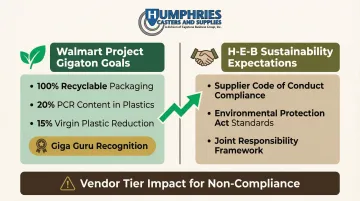
Brands that lag on packaging sustainability risk lower vendor tier status and reduced shelf allocation — sustainability compliance is now a vendor relationship factor, not an optional goal.
Eco-Friendly Materials That Still Perform Structurally
CPG brands can meet sustainability goals without sacrificing corrugated performance:
- Post-consumer recycled (PCR) content in linerboard: Increases recycled fiber percentage while maintaining structural integrity
- Water-based inks: Eliminate solvent-based inks that complicate recycling streams
- Elimination of plastic void fill: Replace with paper-based cushioning or right-sized cases
Caution: Recycled content can affect moisture resistance and compression strength. A study on corrugated boards noted that recycled boxes experienced greater compression strength losses than virgin boxes under cyclic humidity conditions. Because PCR linerboard is more sensitive to moisture, test recycled-content boxes at target Texas humidity levels (80% RH) using ASTM D642 compression testing before full-scale rollout.
When substituting plastic void fill with paper-based alternatives, run ISTA drop and vibration sequences to confirm that paper cushioning provides equal protective performance and prevents product settling during transit.
Warehouse Floor Readiness for Big Box Packaging
Managing high-volume corrugated packaging—heavy pallets, oversized cases, and bulk display shippers—places real demands on warehouse floors. CPG operations and distribution center teams need reliable material handling equipment to move product efficiently from receiving through staging.
Heavy-duty industrial casters and wheels are a practical way to reduce manual labor strain and improve throughput at the pallet level. Common applications in CPG warehouse environments include:
- Pallet jacks and hand trucks moving corrugated loads between receiving and staging
- Mobile carts transporting bulk display shippers to the floor
- Equipment dollies supporting oversized case movement in distribution centers
Humphries Casters has supplied industrial casters and wheels to the #1 grocer in the USA and leading consumer goods manufacturers — the same operations managing the kind of high-volume corrugated throughput that Texas big box distribution demands.
Frequently Asked Questions
What packaging formats do Texas big box retailers typically require for CPG products?
Most Texas big box retailers require palletized case configurations with GS1-128 labeled shipping cases, retailer-specified Ti-Hi pallet builds, and increasingly, shelf-ready packaging (SRP) formats. Each retailer's vendor manual specifies exact requirements—Walmart's Secondary Packaging Supply Chain Standards and H-E-B's vendor portal are the definitive references.
How can CPG brands avoid chargebacks from Texas big box retailers?
Audit packaging against the retailer's compliance guide before shipment, focusing on GS1-128 label placement, SSCC/ASN data match, and Ti-Hi configuration. Use compression testing (ASTM D642) to confirm boxes maintain strength under Texas humidity conditions. Submit accurate ASNs on time with all required data elements.
What is shelf-ready packaging (SRP) and do all big box retailers require it?
SRP is display-ready packaging designed to move directly from the shipping case to the retail shelf with minimal labor, typically featuring perforated tear-away fronts. It is not universally mandated, but major big box retailers strongly prefer it—and some require it outright—because it cuts in-store labor costs and speeds shelf replenishment.
What corrugated strength rating is typically needed for big box CPG distribution in Texas?
32 ECT is a common baseline for lighter CPG products (up to 65 lbs), while heavier or stackable goods typically require 44 ECT or higher. Texas's heat and humidity reduce corrugated compression strength by 32% at 80% RH and 52% at 90% RH—test performance under realistic environmental conditions and de-rate accordingly.
What sustainability requirements do major Texas big box retailers expect from CPG suppliers?
Walmart's Project Gigaton sustainability scorecard requires 100% recyclable packaging, 20% post-consumer recycled content, and 15% reduction in virgin plastic. H-E-B expects compliance with its Supplier Code of Conduct and Environmental Protection Act standards. Falling short on either can affect your vendor tier score and reduce your shelf allocation at the next contract review.
How does Texas's geographic position benefit CPG brands distributing to big box retailers?
Texas sits at the center of the US freight network, with major interstate corridors (I-35, I-10, I-45) and close proximity to Mexican manufacturing. Few states match it for distribution efficiency. Port Houston's 4.3 million TEUs and DFW's 31.1 million square feet of industrial absorption reduce transit times and freight costs for brands distributing nationally and across the border.