Introduction
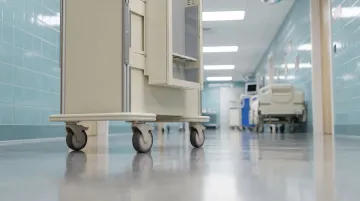
Hospital noise levels routinely exceed WHO-recommended thresholds — ICUs typically measure 52-59 dBA against a 35 dB WHO guideline, putting most units 17-24 decibels over the recommended limit. Among the documented sources of that noise, rolling equipment stands out: carts, beds, and medication trolleys contribute significantly to the acoustic disruption that affects patient recovery and HCAHPS satisfaction scores.
Caster selection is a direct patient care decision. The right casters reduce noise, protect floors, and improve staff ergonomics — and they directly influence the "Quiet at Night" HCAHPS metric, which carries 25% weight in CMS Value-Based Purchasing.
What follows covers the engineering principles behind quiet casters, compares five top products for hospital environments, offers zone-specific recommendations, and provides a practical buying checklist for facilities teams.
Key Takeaways
- Soft polyurethane (75-85 Shore A) and sealed precision ball bearings are the two critical drivers of noise reduction in hospital casters
- HCAHPS "Quiet at Night" scores directly affect Medicare reimbursement under Value-Based Purchasing — caster noise has real budget consequences
- Five product lines span light IV stands to heavy medication carts, with durometer ratings matched to hospital zones
- Match tread hardness to the zone: softer for patient areas, harder for high-traffic corridors and EDs
- Always request product trials before facility-wide deployment — real-world floor compatibility varies by surface type and cart load
Why Hospital Noise Is a Facility-Level Problem
Noise Levels Exceed International Guidelines
The WHO Guidelines for Community Noise recommend hospital sound levels not exceed 35 dB average with 40 dB maximum overnight. Yet ICU measurements consistently record 52-59 dBA median levels — exceeding guidelines by 17-24 decibels. Emergency departments measure even higher at 56.5 dB.
Studies identify rolling equipment — carts, beds, medication trolleys — alongside alarms and conversation as a primary noise source in patient rooms. A CDC/NIOSH survey documented peak levels up to 150.8 dBC inside patient rooms, with "carts and beds rolling through the hallway" cited as a consistent contributor.
HCAHPS Ties Noise to Revenue
The HCAHPS survey asks patients: "During this hospital stay, how often was the area around your room kept quiet at night?" This "Quiet at Night" question feeds the Person and Community Engagement domain, which carries 25% weight in CMS Hospital Value-Based Purchasing. CMS withholds 2% of base operating DRG payments for redistribution based on performance scores.
Low "Always quiet" responses reduce star ratings, which directly reduces Medicare reimbursement. A system-wide noise reduction initiative at Northwell Health improved HCAHPS Quiet at Night Top Box scores by 4.7 points with a 30 percentile rank improvement — demonstrating that environmental interventions produce measurable financial returns.
Why Commodity Casters Dominate — and Fail
Cart manufacturers install inexpensive commodity-grade casters to minimize purchase price. Those savings shift downstream costs to facilities — in the form of patient complaints, HCAHPS score penalties, and accelerated replacement cycles.
The clinical consequences are documented. Research shows environmental noise causes 11-17% of ICU patient arousals and awakenings, with sleep disruption identified as a linked risk factor for delirium. Key outcomes associated with ICU delirium include:
- Over 30% of ICU patients develop delirium during their stay
- Delirious patients experience measurably longer hospital stays
- Mortality rates are higher among patients who develop delirium
The financial and clinical case for upgrading casters is grounded in evidence, not speculation.
What Makes a Hospital Caster Truly Quiet
Wheel Material: The Primary Noise Variable
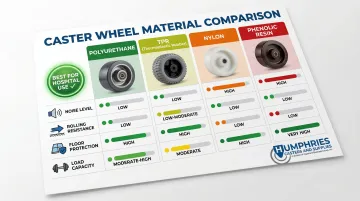
Soft polyurethane and thermoplastic rubber (TPR) absorb floor impact and vibration rather than transmitting it. Hard nylon and phenolic wheels create high-frequency noise, worsen on wet floors, and can damage polished surfaces.
| Material | Noise Level | Rolling Resistance | Floor Protection | Load Capacity |
|---|---|---|---|---|
| Polyurethane | Lowest — "significantly quieter" | Higher than nylon | Excellent — non-marking | Moderate to high |
| TPR | Low to moderate | Moderate | Good — non-marking | Moderate |
| Nylon | Highest — vibration/noise increases when wet | Very low — easiest start force | Poor — can mark/scuff floors | Highest |
| Phenolic | High | Low | Poor on polished floors | High |
Durometer (Shore A Hardness) Matters:
- 75 Shore A (Blickle Besthane Soft): Maximum vibration dampening, lowest noise, supports up to 1,100 lbs
- 85-87 Shore A (Hamilton Ergo-Tech): Balanced noise reduction and load capacity for general hospital carts
- 95 Shore A (Hamilton Duralast): Harder tread for heavy-duty transport, higher noise than softer grades
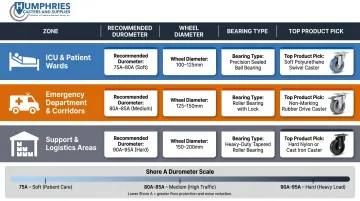
Facilities should specify 75-85 Shore A for ICU and patient wards, and 90-95 Shore A for heavy dietary or transport carts.
Bearing Type: The Second Critical Driver
Blickle's technical bearing guide documents that precision ball bearings provide the lowest rolling resistance and smoothest operation. Plain bore bearings (no bearings, just an axle sliding in a plastic hub) generate metal-on-plastic grinding — the most common noise complaint in hospital carts.
| Bearing Type | Rolling Resistance | Noise/Smoothness | Maintenance | Best For |
|---|---|---|---|---|
| Plain bore | Highest — sliding friction | Loudest; may run hot | Maintenance-free | Light duty, infrequent movement |
| Roller bearing | Moderate | Moderate | Largely maintenance-free | Standard transport |
| Ball bearing | Lowest — precise clearance | Smoothest, quietest operation | Varies | Frequent use, demanding transport |
| Sealed ball bearing (2RS/KAD) | Slightly higher than unsealed | Smooth; slight seal friction | Maintenance-free; KAD rated for machine wash | Healthcare, wet/chemical environments |
Sealed ball bearings (2RS or KAD) are the minimum acceptable standard for hospital casters. They provide contamination protection against chemical disinfectants while delivering the lowest noise output.
Raceway Fit and Swivel Head Construction
Loose raceways cause characteristic chatter in low-cost casters. Precision-ground raceways with double-ball race construction eliminate this. Hamilton's Series 62 uses cold-forged steel mounting plates with hardened, polished steel balls in case-hardened raceways — a design that maintains tight tolerances under loaded conditions.
Wheel Diameter and Tread Width
Larger diameter wheels (5"–6") roll over floor irregularities — tile grout lines, threshold strips — instead of impacting them. Wider treads (1.25"–2") distribute load and reduce point-impact noise.
Application guidelines by equipment type:
- IV poles and light carts: 3" wheels are sufficient
- General hospital equipment: 4"–5" diameter covers most needs
- Heavy medication carts and dietary equipment: 5"–6" for best noise and rollability
Noise and Ergonomics Are Linked
A 2025 Scientific Reports study found that over 80% of nurses experience work-related musculoskeletal discomfort, with pushing and pulling hospital carts contributing significantly to upper extremity strain. Casters that require high push force also vibrate and chatter more — compounding both the noise problem and the ergonomic risk.
Quiet casters with sealed bearings and soft treads reduce physical effort, lowering musculoskeletal injury risk and improving staff retention. OSHA recommends limiting push force to less than 50 pounds to reduce injury risk — a threshold soft-tread, precision-bearing casters consistently help facilities meet.
Top 5 Quietest Casters for Hospital Use
These five products cover the range of load capacities, mounting configurations, and wheel materials hospitals actually need. Use the profiles below to match each caster to your equipment type, load rating, and hygiene zone — selection criteria include noise performance, bearing quality, hygiene compliance, floor compatibility, and US market availability.
Blickle Besthane Soft POBS Series
Blickle, a German-engineered manufacturer with a strong US medical market presence, produces the Besthane Soft line specifically for sensitive environments including hospitals and pharmaceutical facilities.
Differentiators: Precision ball bearings in both wheel and swivel, 75 Shore A durometer (the softest among the five products compared), stainless steel bracket options for high-hygiene zones, and centrally encapsulated bearings with thread guard for water spray protection.
| Specification | Detail |
|---|---|
| Wheel Material / Tread Type | Besthane Soft polyurethane, 75 Shore A, molded to nylon center |
| Typical Load Capacity | 310 to 1,100 lbs per caster (at 2.5 mph) |
| Key Hospital Applications | Medication carts, IV stands, diagnostic equipment, hygiene zones requiring stainless steel |
For ICU and patient-facing zones where floor noise matters most, Blickle's 75A durometer and hydrolysis-resistant formulation deliver the softest ride in this comparison.
Hamilton Casters Series 62 (Vanguard)
Hamilton Caster, a US-based manufacturer, produces the Series 62 Vanguard line as their heavy-duty cold-forged caster line. When paired with Ergo-Tech or Poly-Soft polyurethane wheels, this series balances noise reduction with heavy-duty load capacity.
Differentiators: Double-ball race construction with hardened, polished steel balls in case-hardened raceways, 5/8" heat-treated kingpin, and optional precision sealed ball bearings. The Ergo-Tech polyurethane (85-87 Shore A) is marketed specifically for ergonomic, quiet operation.
| Specification | Detail |
|---|---|
| Wheel Material / Tread Type | Ergo-Tech polyurethane, 85-87 Shore A (Poly-Soft also available at 85A) |
| Typical Load Capacity | 410 to 1,500 lbs per caster |
| Key Hospital Applications | Heavy dietary carts, stretcher bases, large mobile workstations, bariatric equipment |
With load ratings up to 1,500 lbs and a reinforced swivel, this is the right call for heavy dietary carts, stretcher bases, and high-traffic corridors where lighter casters break down prematurely.
Algood Medical Casters (Envirothane Grey Line)
Algood Casters focuses on healthcare-specific products. Their Medical Series uses Envirothane Grey polyurethane bonded to nylon cores, with high-precision 6002 bearings and designs suited to wet, chemical-cleaned environments.
Differentiators: Moisture-friendly and disinfection-ready construction, non-marking tread, and double-locking brake (DLB) options. Designed for medical and diagnostic equipment including X-ray machines and ventilator carts.
| Specification | Detail |
|---|---|
| Wheel Material / Tread Type | Envirothane Grey polyurethane, durometer not published, bonded to nylon core |
| Typical Load Capacity | 225 lbs per caster |
| Key Hospital Applications | X-ray machines, ventilator carts, pharmaceutical facilities, food service equipment |
Algood fits well in nursing homes and procedure rooms — anywhere a 225-lb-rated, disinfection-ready caster handles light-to-medium diagnostic and transport equipment.
Shepherd Casters (Eclipse Medical Series)
Shepherd Casters, part of the Colson Group, produces the Eclipse Medical line with glass-filled nylon bodies for corrosion resistance and polyurethane wheels for quiet operation. Available in both plate and stem mounting, this line supports drop-in replacement for standard OEM cart configurations.
Differentiators: Broad availability through the Colson Group distribution network, compatibility with standard mounting patterns, Total Lock and Directional Lock brake options, and accessible pricing for mid-range equipment upgrades.
| Specification | Detail |
|---|---|
| Wheel Material / Tread Type | Polyurethane wheel, durometer not published, non-marking |
| Typical Load Capacity | 165 to 220 lbs per caster (varies by diameter) |
| Key Hospital Applications | Light-duty IV carts, mobile computer workstations, utility carts, medical furniture |
Facilities standardizing light-duty cart replacements will find the Eclipse line easy to source and straightforward to swap in — plate and stem mounting cover most OEM configurations without custom ordering.
Durable Superior Casters (Stainless Polimed Series SP5/SPT)
Durable Superior's Polimed line features precision-molded reinforced nylon polymer bodies with S304 stainless steel raceways and sealed precision bearings in both the wheel and raceway — a unique dual-sealed configuration among the five products compared.
Differentiators: The only product with dual-sealed bearings (wheel and swivel), S304 stainless steel for chemical resistance, and Thermo-Pro non-marking composite polymer tread. Suitable for central sterile processing and environments requiring frequent chemical washdowns.
| Specification | Detail |
|---|---|
| Wheel Material / Tread Type | Thermo-Pro composite polymer tread, durometer not published, non-marking and chemical-resistant |
| Typical Load Capacity | 300 lbs per caster |
| Key Hospital Applications | Equipment carts in patient-facing zones, sterile processing transport, environments with chemical exposure |
Where other casters fail under repeated chemical washdowns, Durable Superior's dual-sealed bearings and S304 stainless steel hold up — making this the right spec for central sterile processing and any zone with heavy disinfectant exposure.
Matching Quiet Casters to Hospital Zones
Patient Rooms, ICU, and Post-Surgical Wards
These zones carry the highest noise sensitivity in any hospital. ICU patients experience 11-17% of arousals and awakenings due to environmental noise, and sleep quality scores average only 56 out of 100 — well below therapeutic targets.
Specify sealed-bearing, soft-PU casters with 75-85 Shore A durometer, stainless steel or corrosion-resistant brackets, non-marking treads, and total-lock braking. Blickle Besthane Soft (75A) and Hamilton Ergo-Tech (85A) are best positioned here.
The ICU warrants the strictest spec for three converging reasons: patients are at peak noise sensitivity, monitoring equipment moves constantly through the night, and "Quiet at Night" HCAHPS scores are directly tied to reimbursement.
Emergency Departments and High-Traffic Corridors
Noise sensitivity here is moderate — ED ambient noise averages 56.5 dB, the highest of any measured hospital zone. The real specification driver isn't quiet; it's durability under constant, fast-paced movement.
Key specification requirements for ED and corridor casters:
- Reinforced swivel frames to handle high-frequency directional changes
- 5"-6" wheel diameters for clearing thresholds, cords, and floor obstacles
- Sealed bearings for chemical resistance to aggressive cleaning agents
- Short swivel lead for responsive steering in tight, crowded spaces
Harder durometers (90-95 Shore A) hold up better under heavy use and daily disinfection cycles. Hamilton Series 62 with Duralast wheels or Durable Superior SP5/SPT with stainless steel raceways are well-suited to this environment. The noise trade-off is acceptable — at 56+ dB ambient, a slightly harder tread goes unnoticed.
Support and Logistics Areas
Central kitchen, laundry, and loading areas sit furthest from patients — noise sensitivity is lowest. Ultra-silent casters aren't required here, but moderately soft treads (85-90 Shore A) still pay off.
Transport routes connecting back-of-house areas to patient wings pass through shared hallways where noise carries. Softer treads reduce rolling resistance on those routes, which matters for staff: over 80% of nurses report pain and strain from cart pushing, making lower-effort casters a genuine ergonomic improvement even in non-patient zones.
Hospital Caster Buying Guide: What Facilities Teams Need to Know
Evaluate These Critical Factors Before Specifying
Floor Type Compatibility:
- Vinyl, linoleum, tile, and epoxy each have different optimal tread hardness
- Softer polyurethane (75-85A) protects polished floors better but may leave slight impressions under long-term static loads
- Harder polyurethane (90-95A) suits high-traffic areas with frequent cleaning
Total Equipment Weight Per Caster:
- Calculate maximum loaded weight, not empty cart weight
- Divide total load by number of casters and add 25% safety margin
- Example: 800 lb medication cart on four casters = 200 lbs per caster × 1.25 = 250 lb minimum rating
Hygiene Requirements:
- Sealed bearings (2RS/KAD) prevent chemical intrusion during disinfection
- Stainless steel brackets resist corrosion from bleach, quaternary ammonium compounds, and phenolics
- Non-marking treads prevent floor staining
Brake Type:
- Total-lock brakes (lock wheel and swivel) required by infection control and patient safety protocols in most zones
- Side-mounted brakes easier to engage than tread-contact brakes
- Field-installable swivel locks available on some models
Avoid These Common Procurement Mistakes
Mistake 1: Buying on Lowest Unit Cost
- Commodity casters generate HCAHPS penalties, accelerate replacement cycles, and increase workers' comp claims
- Evaluate total cost of ownership over 5-10 year lifespan, not purchase price alone
Mistake 2: Specifying Hard Nylon for "Easy Rolling"
- Nylon rolls easily when unloaded but generates significantly more noise when loaded
- Noise increases further on wet floors
- Floor damage risk higher than polyurethane
Mistake 3: Not Testing on Actual Facility Flooring
- Tread performance varies by floor composition, finish, and age
- Request product samples or formal trial before facility-wide deployment
- Test under loaded conditions on actual flooring in the target zone
How Humphries Casters Supports Facilities Teams
Humphries Casters has supplied hospitals and long-term care facilities since 1988. For facilities teams evaluating caster upgrades, Humphries offers:
- Product trials and samples before bulk commitment
- Blanket order programs for facilities managing large inventories
- Supply relationships with leading medical caster brands including Blickle, Hamilton, Algood, Shepherd, and Durable Superior
- Replacement casters compatible with major hospital bed brands (Hill-Rom, Stryker, Joerns, Invacare), typically at 30–100% savings vs. OEM pricing
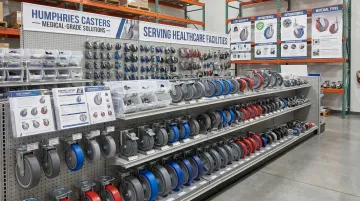
Facilities teams at larger hospitals can also request onsite evaluation support when considering caster upgrades across multiple zones or equipment types.
For product trials, contact Humphries at 800-733-4758 or service@humphriescasters.com.
Frequently Asked Questions
What are the quietest casters for hospital environments?
Soft polyurethane (75-85 Shore A) or TPR casters with sealed precision ball bearings perform best in hospital environments. If existing casters are noisy, you can reduce sound by swapping in soft-tread wheels, greasing or replacing worn bearings, and checking for a loose raceway fit.
What are casters on a hospital bed?
Hospital bed casters are the wheeled swivel assemblies mounted to the base of the bed frame that allow repositioning by staff. Medical-grade bed casters typically include total-lock brakes, soft-tread wheels for noise and floor protection, and sealed bearings for hygiene and smooth movement.
What is an alternative to casters?
Alternatives include fixed glides or leveling feet for stationary equipment, air casters (air-bearing systems) for ultra-precise repositioning of heavy imaging equipment, and rigid slides or furniture dollies for occasional moves. For most hospital carts and beds, however, swivel casters remain the most practical option.